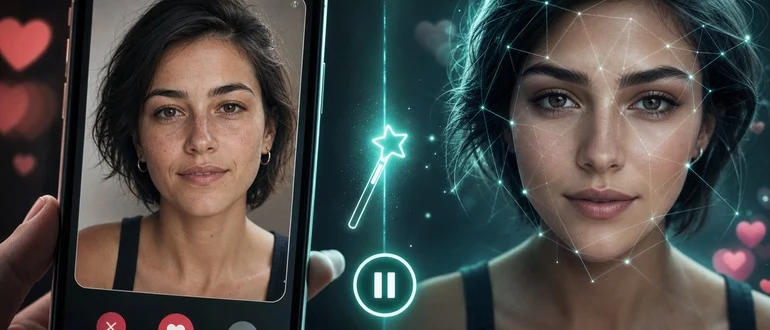
When Tinder promised to make it easier for users to put their most authentic selves forward, so others could “quickly get a sense of who you are,” users didn’t expect an AI makeover.
Tinder has d its AI-powered Photo Enhance feature across 13 U.S. states after users complained that the tool had automatically altered profile pictures without their knowledge or consent.
The dating app’s premise is simple: Swipe right to like. Swipe left to pass. In the world of online dating, romance often begins — or ends — with a single photograph. Before there’s chemistry to test or conversation to spark, there’s an image.
A little help with backlighting or a blemish might be welcome. But when users found that Photo Enhance altered smiles, skin tones, hairlines and other facial features to the point that some described the results as catfish-like, the technology had crossed a line.
The controversy came just months after Tinder announced Photo Enhance as part of a broader collection of AI-powered updates designed to improve online dating. In a March 12 news release, the company said features such as Photo Enhance would help users “put your most authentic self forward” and make it easier for others to “quickly get a sense of who you are.”
For some users, however, the enhanced version was not who they were at all. Reports surfaced that the AI sometimes went beyond correcting technical problems such as poor lighting or blurry images. Users said the tool made unexpected changes, including adding teeth to closed-mouth smiles, lightening skin tones, smoothing complexions, removing freckles and altering facial features in ways that made some photos feel unfamiliar.
On social media, some users described the edited images as “uncanny.” Others said they were uncomfortable that an AI system had changed their appearance before they knowingly agreed to use it. Some reportedly deleted their profiles, arguing that if online dating depends on authenticity, the first impression should belong to the person, not the algorithm.
Tinder has said that was never the goal.
According to the company, Photo Enhance “helps improve the technical quality of your photos.” The tool is designed to make profile pictures “clearer and better lit” while “keeping your photo authentic to you.”
The company said the feature can sharpen blurry images, adjust brightness and exposure, and improve clarity. It also emphasizes that it “isn’t designed to add or remove people, objects, or backgrounds, apply cosmetic effects, or change facial features or skin tone appearance.”
Tinder says Photo Enhance also includes “an automatic check to confirm that the enhanced photo still looks like you to preserve authenticity and show off the real you.”
That did not match the experiences reported by some users.
Tinder defended the initial rollout, saying internal testing showed that more than 90% of users who received an enhanced image kept it, while fewer than 0.5% flagged the result as inaccurate. Still, the company d the feature while it reviews the automated edits and works to strengthen its safeguards.
The issue facing Tinder is not unique.
Meta recently encountered backlash after launching an AI image feature that allowed users to generate images using references from public Instagram accounts. The company said the feature was intended to provide a creative tool while giving people control over whether their public content could be referenced.
But privacy concerns quickly emerged. The feature, called Muse Image, allowed users to generate AI images by typing a prompt and tagging a public Instagram account. Meta said it applied only to public adult accounts and excluded private accounts and users younger than 18.
Critics argued that the tool could allow people to generate images of others without their knowledge or permission, raising concerns about unwanted or misleading AI-generated content. Within days, Meta removed the feature.
In a July 10 update, the company acknowledged that “this feature missed the mark” after hearing feedback from users.