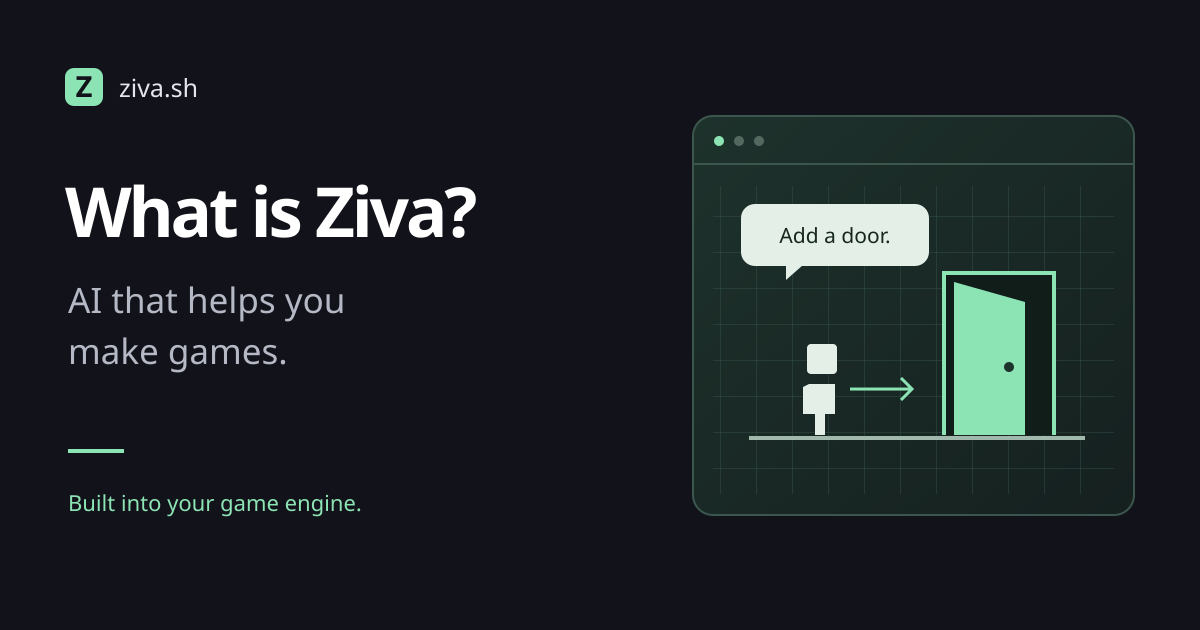
Ziva is an artificial intelligence assistant that helps people make video games. You describe what you want, and Ziva works inside your game-making software to build it. Ask for a door that opens when a player gets close, for example, and it can add the door, write its behavior, and run the game to check it.
We’re building Ziva so more people can finish the games they imagine.
Why making a game takes so long #
AI can produce a small, playable demo quickly. Finishing a game takes more work: making the controls feel right, giving players enough to do, and fixing the problems they find.
That work can take months or years. A 2026 analysis of 2,966 repeat Steam developers found a median gap of about two years between releases.
The financial return can be small. Video Game Insights estimated in 2020 that independently made games on Steam earned median lifetime revenue of $3,947.
Ziva helps game makers finish their games in half the time. In our paid tests, game makers using Ziva completed games twice as fast.
How Ziva helps #
Imagine you’re building a hotel with a steel frame. Someone offers you wooden beams for half the price. They might be good beams, but they don’t fit your building.
AI has a similar problem in game development. Most game makers work inside a game engine: software that draws the game’s world, handles things like gravity and collisions, and helps it run smoothly. These are complicated systems that game makers would otherwise have to build themselves.
Game engines powered at least 79% of 2024 Steam releases in a Video Game Insights study . The study covered games with at least 1,000 lifetime sales.
A chatbot can suggest code, but someone still has to fit it into the game. Ziva connects AI to the engine so it can work directly on the project, see errors, and test changes. Game makers can keep working in the software they already use.
Ziva is available for Godot, a free game engine. Unity support is in beta for studios, and Unreal Engine support is arranged with each studio. Ziva also subsidizes access to leading AI models, including models from the companies behind Claude and ChatGPT.
Getting games into players’ hands #
Ziva’s community of over 10,000 game makers gives people a place to share their work and find players to test it. Hearing where someone got stuck, or what made them want to keep playing, helps a maker decide what to improve before release.
Ziva also has a publishing program to help game makers release and promote their games.