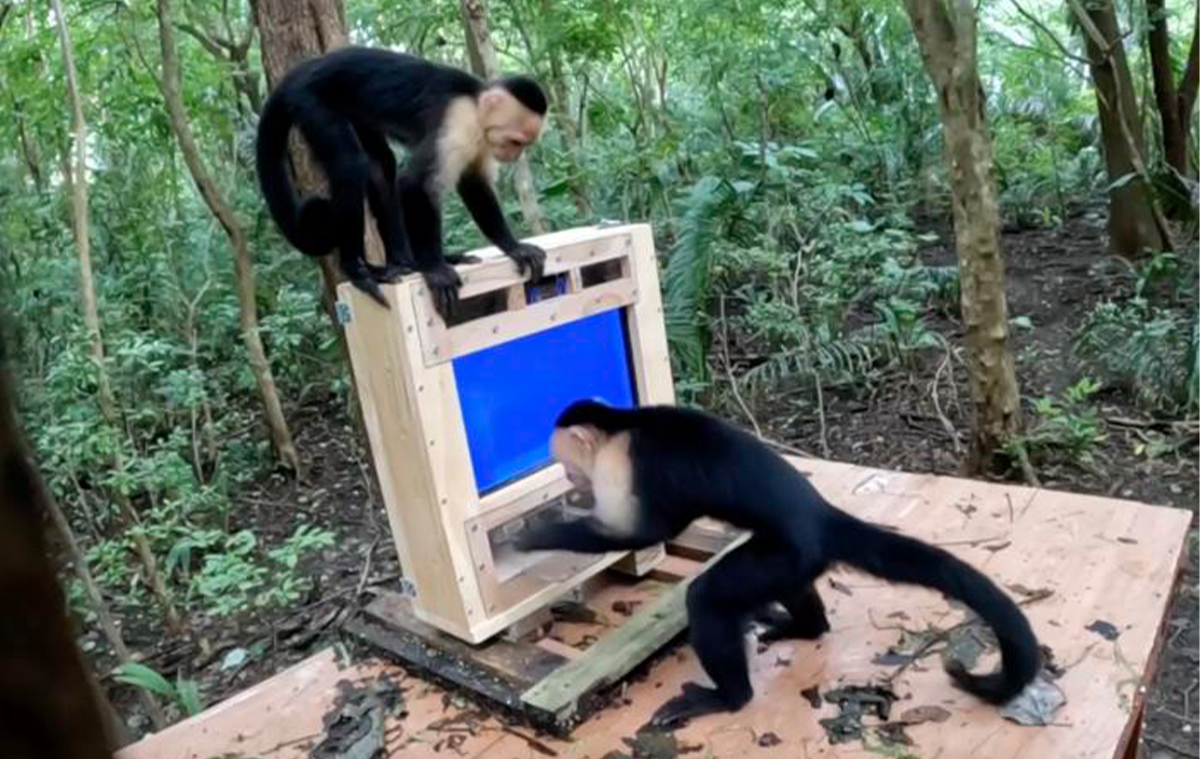
In 2001: A Space Odyssey, a mysterious monolith appears before a group of our ape-like ancestors. Startled by the alien device, a few brave individuals approach it cautiously at first, and eventually the whole troop gathers around to investigate. Now, thanks to primatologists from Emory University and computer scientists from the Georgia Institute of Technology, capuchin monkeys in a Costa Rican forest preserve have had a similar, real-life experience. The researchers recently published their findings in the American Journal of Primatology.
The team started by building a homebrew AI-powered facial recognition program called CapuchinAI. They then installed it on a computer outfitted with a camera and touchscreen, loaded it in a protective DIY box, and included a dispenser to dole out dried forest banana slices. When CapuchinAI detects a monkey’s face, the touchscreen turns on. If the monkey triggers it, the machine dispenses a tasty banana slice. Simple as that.
They placed the entire contraption in Costa Rica’s Taboga Forest Reserve and waited. It took a few days, but a dominant monkey soon approached the strange device to investigate. He climbed on the box to give it a slap, but eventually touched the screen, earning a banana for his efforts. “It was almost like you could see him realizing, ‘Ah, that’s what you have to do, touch the screen!’” study co-author Federico Sánchez Vargas of Emory University recalled in a statement. “It was amazing to watch an individual learn something so quickly.”
Read more: “ The Cosmopolitan Ape”
Over the course of the experiment, 16 capuchins interacted with the device, 10 of whom learned to trigger rewards. Not all of the monkeys took the same approach, some used their hands while others kissed the screen. Eight of these bright little primates developed “robust screen-reward associations,” the researchers wrote. Basically, they kept returning to the makeshift AI vending machine to smash the banana button.
According to the team, CapuchinAI offers an unprecedented opportunity to study primate cognition outside of a laboratory setting. “The primate brain didn’t evolve in a lab, it evolved in complex, competitive environments,” study co-author Marcela Benítez of Emory University said. “Yet primate cognition is rarely studied in the wild because the experimental control needed to measure cognition is difficult in unpredictable environments.”
And this is just the beginning of their investigation, a kind of pilot program. The next version of the device will allow researchers to conduct experiments that test the primates’ learning capabilities, cognitive flexibility, impulse control, and short- and long-term memory—all in their natural habitat. “We can explore outstanding questions about how the environment, individual experiences and behaviors connect to cognitive abilities,” Benítez explained. “Why are some individuals better at some tasks than others? How do different individuals adapt to different situations? How do different cognitive strategies relate to fitness?”
The researchers also hope to train the model to recognize individual monkeys. That way, when the computer recognizes a specific monkey, it will know what “level” it’s reached, and load the appropriate experiment in the sequence. (Novice monkeys will receive the entrance exam, “touch screen for banana.”)
If you’re worried about screentime, the researchers have considered that. There will be safeguards in place limiting the rewards dispensed in a single session to prevent banana-hungry monkeys from monopolizing the machine.

If only our phones came loaded with the same thing.

*Enjoying *[Nautilus](https://nautil.us/)*? Subscribe to our free *[ newsletter](https://nautil.us/newsletter/?_sp=c43011db-6fcf-42f2-a38c-e033b87a4a1d.1759265717430).
Lead image: Courtesy of the researchers