WekaIO revamps its AI data storage platform and unveils its first hardware for agentic workloads
WekaIO Inc. today announced what it says is its most significant product refresh to date.
The distributed big-data management platform provider unveiled a massive overhaul of its flagship software together with the release of its first custom-designed storage hardware that’s built specifically for artificial intelligence inference.
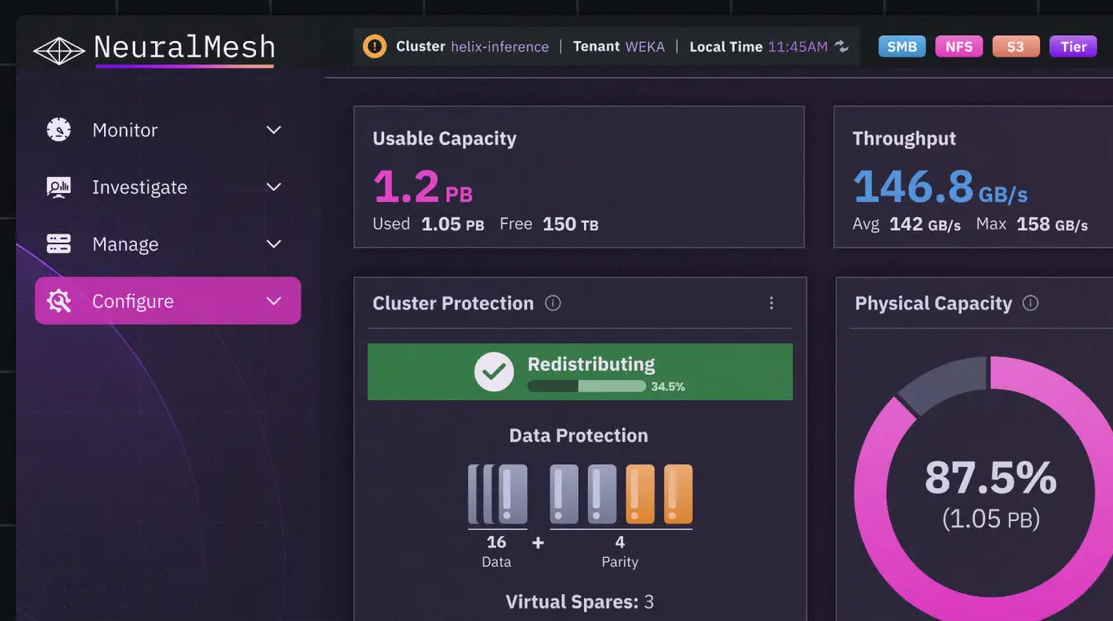
The two-pronged announcement saw the company launch WEKA NeuralMesh 6, the latest iteration of its software that’s designed to eliminate the storage and memory bottlenecks holding back AI inference workloads. It’s designed to run on the new WEKApod Nitro, WEKApod Prime and WEKApod Prime Max AI appliances that promise to deliver the perfect combination of capacity and performance for running interference workloads at scale with a reduced footprint and energy consumption.
According to WekaIO, it really could not have timed the release of its new software and systems any better. It says enterprise AI is reaching a critical inflection point as more organizations shift away from training AI models to running them in production inference environments.
The startup believes that the AI training-focused storage infrastructures of yesterday are quite unsuitable for the long-context reasoning, agentic workflows and retrieval-augmented generation workloads that are now the main focus of most organization’s AI efforts. Simply put, most businesses have already trained their AI models and now they want to see what they can do, and that requires a major overhaul of the underlying architecture that powers them.
Organizations are also facing some major physical constraints. The available space in physical data centers is shrinking fast, and energy grids are struggling to keep up with the power demands of these facilities. There’s no easy way to get around hardware shortages, other than to try to maximize the resources that you do have, and that’s what WekaIO is trying to do.
With NeuralMesh 6, WekaIO is introducing its powerful new augmented memory grid technology, which can extend the memory of graphics processing units by ensuring that the critical key-value cache is located within the NVMe storage. In this way, it’s able to bypass the recalculation overheads that silently drain GPUs running inference workloads. The company pointed to some nice benchmark results, saying that NeuralMesh 6 with NVMe delivered 10 times higher token throughout and served 10 times more concurrent users on Oracle Cloud Infrastructure than standard dynamic random-access memory.
The software also brings native hyperscale multitenancy, a unified file-and-object S3 protocol stack running directly on NVMe, and always-on data reduction with performance guarantees.
Chief Product Officer Ajay Singh said most data centers that are running production AI workloads today were built in a chaotic way, mixing and matching different platforms, chips and networking technologies from multiple vendors. Basically, they just grabbed whatever hardware was available. But the result is that you end up with separate stacks for file and object storage, which means using manual processes to move data between them.
“NeuralMesh 6 delivers what they’ve actually needed all along: a single platform that handles the high-performance file layer and the high-capacity object layer on the same blocks, with native multitenancy, intelligent data mobility and always-on data efficiency built in from the start,” Singh said. “This is what production inference infrastructure looks like when it’s designed for the workload, not retrofitted for it.”
On the hardware side, WekaIO is moving away from general-purpose servers and engineering its own platforms from the ground up. The new WEKApod systems are built with a PCIe Gen 6 internal fabric and feature a software-management thermal architecture to enhance both performance and capacity.
The new lineup is led by the WEKApod Prime and WEKApod PRIME Max arrays, which come with up to 245 terabytes of ultra-dense solid-state drives and utilize NeuralMesh’s proprietary data reduction techniques to create as much as 1.1 exabytes of effective capacity in a single 56-unit rack. There’s also a lower-cost system in WEKApod Nitro, which is aimed at high-concurrency environments where storage bandwidth determines GPU utilization.
Co-founder and Chief Executive Liran Zvibel insisted that WekaIO is, and will always be a software company first, adding that NeuralMesh is still its flagship product. “Building our own hardware was not the original plan,” he said. “Our customers’ inference economics made it a necessity. We built WEKApod because the alternative was letting someone else’s hardware define the limits of what our software could do.”
Image: WekaIO
Support our mission to keep content open and free by engaging with theCUBE community. Join theCUBE’s Alumni Trust Network, where technology leaders connect, share intelligence and create opportunities.
15M+ viewers of theCUBE videos, powering conversations across AI, cloud, cybersecurity and more** 11.4k+ theCUBE alumni**— Connect with more than 11,400 tech and business leaders shaping the future through a unique trusted-based network.
About SiliconANGLE Media
theCUBE AIand theCUBE SuperStudios — with flagship locations in Silicon Valley and the New York Stock Exchange — SiliconANGLE Media operates at the intersection of media, technology and AI.
Founded by tech visionaries John Furrier and Dave Vellante, SiliconANGLE Media has built a dynamic ecosystem of industry-leading digital media brands that reach 15+ million elite tech professionals. Our new proprietary theCUBE AI Video Cloud is breaking ground in audience interaction, leveraging theCUBEai.com neural network to help technology companies make data-driven decisions and stay at the forefront of industry conversations.