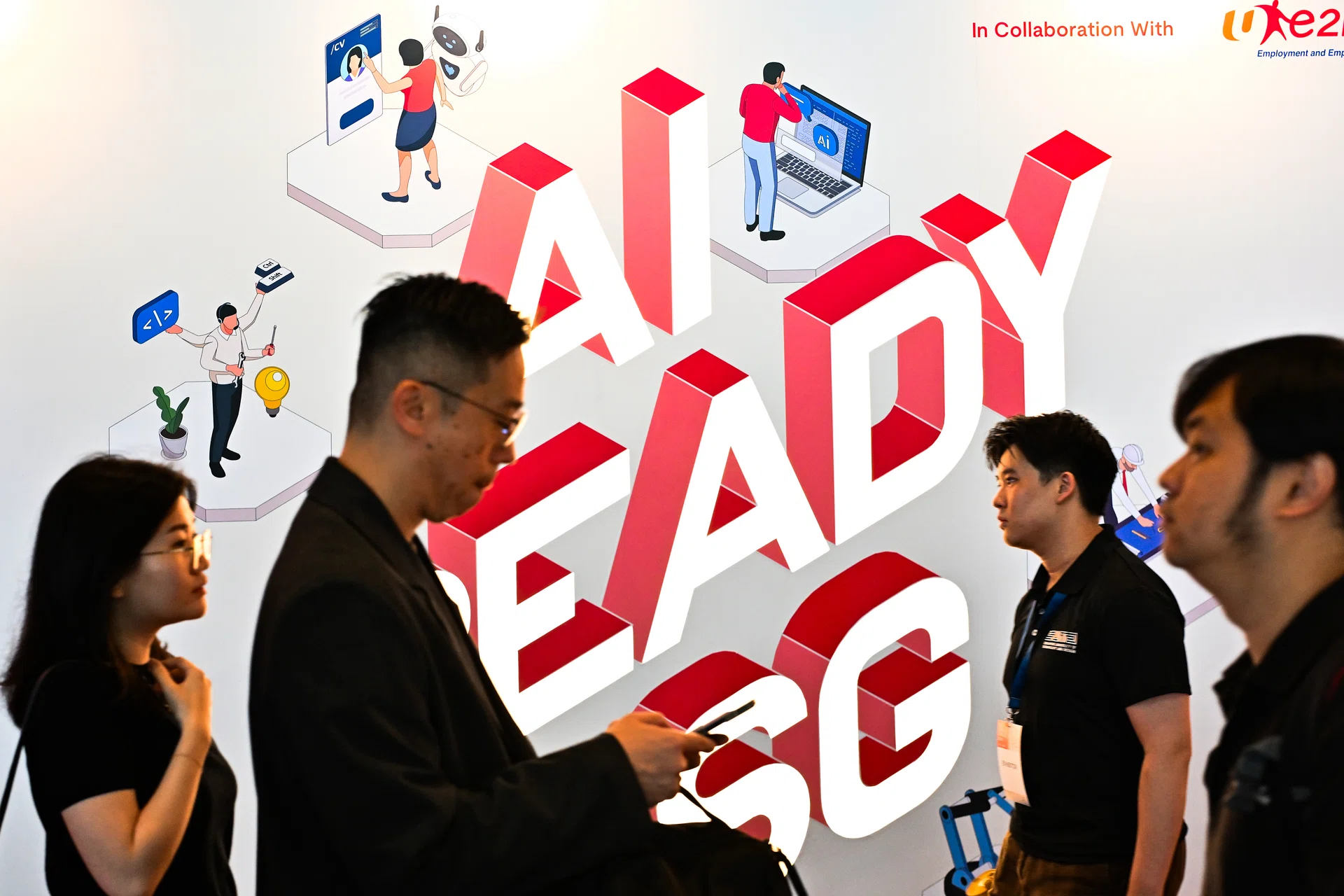
Singapore’s population trusts its government’s capacity to manage disruption – through retraining and regulation
ASK THE Americans, Italians or Australians how they feel about artificial intelligence and there’s a good chance that “concerned” is the first thing they will say. Ask Nigerians, Indians or Kenyans the same question, and you’re more likely to hear “excited”.
This represents one of the starkest attitudinal splits in the world today, and it runs counter to what you might expect. The rich world invented AI, funds it and will capture most of its near-term economic upside. And yet it is the rich world that is anxious, while the developing world — poorer, less connected and far from the frontiers of AI development — is comparatively sanguine.
The World Bank’s recently released World Development Report 2026, the first major assessment devoted entirely to AI and development, explains this split. Its conclusion: Developing economies have more to gain – and less to fear – from AI than richer ones.
The report is not alone in reaching this conclusion. Pew, Ipsos and a major KPMG-University of Melbourne survey all find the same pattern, replicated across dozens of countries and tens of thousands of respondents.
The question worth asking is why – and what it means for a small, rich, trade-exposed economy like Singapore that doesn’t sit neatly on either side of the divide.
The exposure gap is real – and it is large #
Start with the economics, which reveals a difference in exposure. The World Bank estimates that about 4.5 per cent of existing jobs in low- and middle-income countries are amenable to automation by generative AI, compared with 14.2 per cent in high-income countries – more than thrice the proportion.
At the same time, the share of jobs that stand to be complemented rather than replaced by AI is much closer across income groups: 16.2 per cent in developing economies versus 18.7 per cent in advanced ones. In other words, the downside risk is heavily concentrated in rich countries, while the upside is comparatively evenly spread.
This is a direct consequence of what people do for a living. In low-income countries, nearly 90 per cent of workers are employed in firms with fewer than 10 people, doing manual rather than cognitive work — agriculture, retail, informal services. Generative AI automates white-collar cognition, not manual labour. The occupations most exposed – information technology, finance, professional and business services – employ a comparatively small share of the workforce in poorer economies and a much larger one in rich, services-heavy economies.
There is a second, less obvious asymmetry: Productivity gains from AI are expected to be more than double in advanced economies compared with developing ones, given current adoption patterns – about two-thirds of that gap simply reflects that rich countries are adopting the technology faster and more broadly. So, developing economies are, paradoxically, somewhat insulated from AI’s disruptive edge precisely because they are further from its productive frontier.
SEE ALSO
A wide trust gap #
If the economics were the whole story, you might expect developing-world anxiety about being left behind rather than developed-world anxiety about being displaced. But survey data shows something more visceral: a trust gap, and it is wide. The 2025 KPMG-University of Melbourne global trust study, covering more than 48,000 people in 47 countries, found that less than two in five people (39 per cent) in advanced economies trust AI systems, compared with almost three in five (57 per cent) in emerging economies – an 18-point gap.
Ipsos surveys find something similar: Roughly three-quarters of respondents in the Middle East and Africa say they trust AI, against less than a third in North America and Western Europe.
Pew’s 25-country survey in 2025 found that in every country studied except Israel and South Korea, more people report feeling “more concerned than excited” about AI than the reverse – but the concern is sharply skewed by income.
Half of Americans, and around half of Italians, Australians and Greeks, report feeling more concerned than excited. By contrast, concern among Indians sits at 19 per cent, and Nigerians at 24 per cent.
The explanations researchers offer converge on three mechanisms. First, what economists call leapfrogging instead of displacement: In a lower-income country, AI is a tool for compensating for scarce expertise – a chatbot standing in for the doctor, agronomist or banker who doesn’t exist locally – whereas in a rich country it more often reads as a threat to a job that already exists.
Second, familiarity breeds wariness, not comfort: Workers in richer countries have more experience with prior waves of information technology, which sharpens awareness of downside risk.
Third, generative AI’s first wave has automated service tasks – drafting, coding, customer support, financial analysis – that are disproportionately concentrated in wealthy, services-heavy economies.
A pleasant digital experience #
There is a simpler, more concrete explanation for the gap than exposure statistics alone can offer, and it comes from Michael Spence, the Nobel laureate economist.
In an interview with me in June, he pointed out that emerging economies have already had a preview of what beneficial digital disruption looks like – and it has made them predisposed to welcoming the next wave rather than fearing it.
The clearest example is financial inclusion. Digital technology and AI-enabled credit scoring have allowed hundreds of millions of people in India to access digital wallets, bank accounts and microfinance through channels that conventional banking never reached. China did likewise through its technology giants.
Similar patterns are now spreading across the emerging world in education and healthcare, extending services to people who previously had none. As Spence put it, people in these economies have seen digital technology solve real problems for them directly, so when AI arrives, the reaction is “this is interesting” rather than “this is threatening”.
Advanced economies had their own version of this transition decades ago – mobile payments, digital banking, e-commerce. Having already banked the gains from that earlier wave of financial and digital inclusion, people in rich countries have less obvious upside left to associate with the next one.
“People (in rich countries) are much more focused on automation and whether they’ll have a job,” said Spence. “There have been some CEOs shooting off their mouths about how wonderful it will be to get rid of people who work for them, which is not helpful. And then people don’t like the idea of data centres near where they live, and the resulting upward pressure on electricity tariffs.”
He added that even an energy-independent country like the US isn’t insulated from this: Domestic supply doesn’t shield households from global price shifts, which simply show up as higher revenue for the companies selling the power rather than as savings for the people paying the bills.
Why Singapore bucks the trend #
The cleanest version of this narrative – rich and anxious versus poor and hopeful – breaks down when it comes to Singapore. Although Singapore is a developed economy with a high exposure to AI, surveys show it has among the world’s most AI-optimistic populations.
The 2025 University of Melbourne-KPMG study, covering 48,340 people across 47 countries, names Singapore as one of just a handful of advanced economies – alongside Israel, Norway, Switzerland and Latvia – with comparatively high levels of AI adoption, trust, acceptance and positive attitudes towards the technology, bucking the pattern of rich-world wariness that dominates the rest of the dataset.
A 2025 survey by Nanyang Technological University’s RSIS think-tank goes further, and points to why.
It finds widespread Singaporean support for AI use, research and regulation, anchored specifically in high public trust in domestic institutions to oversee AI’s development and governance, alongside comparatively low confidence in leading AI powers such as the US and China to do the same job.
This complicates the tidy income-based story the World Bank tells. What seems to distinguish the optimists from the anxious is not simply GDP per capita but institutional trust and a sense of agency over the technology’s deployment.
Singapore’s population trusts its government’s capacity to manage disruption – through retraining and regulation, as well as financial support to help ride out technological shocks – in a way that American or French respondents do not trust theirs.
The fear in Washington and Paris is not really fear of AI; it is fear of AI arriving in political systems perceived as unable or unwilling to manage its distributional consequences.
The policy implications #
This should reframe how developed economies think about their AI anxiety. The World Bank’s report is right that job-exposure numbers explain much of the gap between rich and poor countries. But Singapore’s outlier position suggests the remaining variance is about governance capacity and public trust in institutions to manage the transition – not just about income levels. A rich country with weak safety nets and low institutional trust will generate more AI anxiety than a rich country with strong safety nets and high institutional trust, even holding job exposure constant.
For policymakers in Washington, Brussels and Canberra, the lesson from the World Bank’s data is not that citizens are irrationally pessimistic. Given the exposure numbers, their pessimism makes sense. The lesson is that the antidote to AI anxiety is not reassurance about the technology itself, but credible, demonstrated capacity to manage the labour-market transition it produces. Singapore’s experience suggests that when citizens believe the state has that capacity, optimism about AI follows naturally, developed-economy status notwithstanding. The rich world’s AI problem, in other words, may be less about AI than about trust in the state — a much older and more familiar political problem. THE STRAITS TIMES
- Vikram Khanna is a former associate editor of The Straits Timeswho writes on economic affairs.
Decoding Asia newsletter: your guide to navigating Asia in a new global order. Sign up here to get Decoding Asia newsletter. Delivered to your inbox. Free.
Share with us your feedback on BT's products and services
TRENDING NOW National Day Rally: 8 things to know, from more childcare leave to higher BTO income ceiling
Stocks to watch: Mapletree Industrial Trust, OUE, OUE Healthcare
When every phone becomes a satellite phone, what happens to Asia’s telcos?
UltraGreen.ai’s big slump: Was it the Singapore market that failed the company, or vice versa?