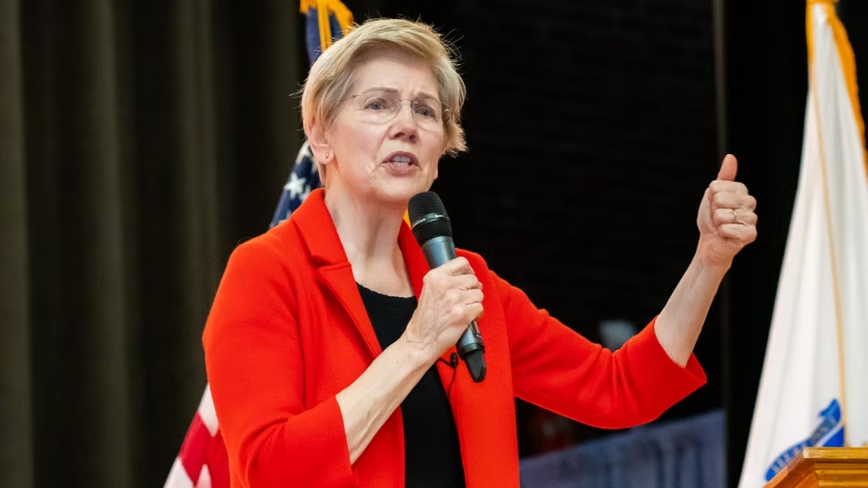
Senator Elizabeth Warren has accused the biggest AI companies of trying to write their own regulatory ceiling into a trade agreement, using the machinery of US trade policy to lock in limits on oversight that Congress has so far declined to grant them.
The accusation, reported by Reuters on July 23, extends a fight the Massachusetts Democrat has waged for more than a year.
Her argument is that Big Tech is quietly turning contested domestic questions into trade concessions, the same logic behind the trade probe into EU tech rules that lawmakers pushed the administration to open.
The mechanism she points to is a clause, not a headline. A run of recent US bilateral deals, catalogued in a Center for Strategic and International Studies analysis of what it calls a “containment doctrine”, carry near-identical “non-discrimination” language that bars partners from measures that “discriminate against U.S. digital services”.
That wording is broad enough to reach the rules the industry has spent two years trying to blunt: the EU’s Digital Markets Act and Digital Services Act, and the patchwork of state AI statutes that Washington has separately tried to preempt at home. A rule that survives a state legislature can still be challenged as a trade barrier abroad.
Warren has made versions of this case straight to the administration. In a May 2025 letter to Treasury Secretary Scott Bessent, Commerce Secretary Howard Lutnick, and trade representative Jamieson Greer, she wrote that “Big Tech firms have long sought to use trade deals to undermine pro-consumer, pro-competition policies”.
That letter named Apple, Amazon, Meta, and Google as funders of the industry groups pressing the US Trade Representative to treat foreign digital rules as barriers.
A follow-up in March 2026, prompted by the volume of sexual deepfakes generated with Elon Musk’s Grok, asked whether US negotiators had leaned on other countries to drop content-moderation laws outright.
In that letter she pointed to the administration’s handling of the EU’s Digital Services Act, which US officials have described as “overseas extortion”, alongside stalled talks over the UK’s Online Safety Act and France’s SREN law, which stiffens penalties for sexual deepfakes.
The through-line, she argued, is that content and competition rules keep surfacing at the negotiating table rather than in open rulemaking, where they can be debated and voted on.
The firms’ side of this is less a rebuttal than a reframing. The industry has argued consistently that measures like the DMA are protectionism dressed as consumer protection, discriminatory by design and therefore fair game for a trade complaint, an argument the same companies made while they bankrolled the campaign against AI rules at home.
The administration has been willing to back that reading with leverage, at one point threatening 100% tariffs over digital services taxes.
The CSIS analysis notes the tactic works unevenly: smaller economies such as Guatemala and Cambodia have signed accords carrying the restrictive clauses, while larger markets have held out.
The domestic side of the fight runs in parallel. Washington has separately weighed a federal standard that would override state AI statutes, and the industry has spent months girding to block those state rules, so a trade clause that reaches the same laws from outside the country would hand the effort a second lever.
What Warren cannot easily do is force the text into daylight. Trade negotiations are conducted with limited transparency, and she has co-sponsored legislation to require that deal text be published before Congress grants fast-track authority, so far without success.
Without the text, she has argued, neither lawmakers nor the public can judge what has actually been promised.
Whether the July charge lands any differently is unclear. Reuters reported the accusation; the companies named in her earlier letters have not addressed it publicly, and USTR has not answered the specific claim.
For now it is one senator’s reading of a clause most voters will never see, which is close to the point she is making.
Get the TNW newsletter #
Get the most important tech news in your inbox each week.