Harbor Capital named a new de facto sector on its midyear investor call , memory semiconductors , and the three companies at its center, Micron, SK Hynix, and Samsung, are collectively worth more than $3 trillion even as two of them trade well below their recent peaks.
Spenser Lerner, Harbor Capital's head of multi-asset solutions, dropped the term on a July 22 call with investors. Memi, a portmanteau of memory and semiconductors, was "very much intentional," Lerner said, because memory has become "the poster boy or poster person of the whole semis universe." That framing captured something real. The three companies that own the memory market have become the structural choke point in every major AI buildout, and Wall Street has started treating them as their own asset class rather than a dusty corner of the semiconductor index.
The timing of the label matters. SK Hynix, the South Korean chipmaker that holds roughly 56% of the high-bandwidth memory market by revenue, listed on the Nasdaq on July 10, raising $26.5 billion in what became the largest U.S. listing by a foreign company in history, surpassing Alibaba's $25 billion debut in 2014. The offering was reportedly more than seven times oversubscribed. Micron, meanwhile, has crossed $1 trillion in market cap and is up roughly 240% year-to-date. Samsung is up 116% on the Korea Exchange over the same period. Three trillion dollars in combined market value, and the sector didn't even have a name two weeks ago.
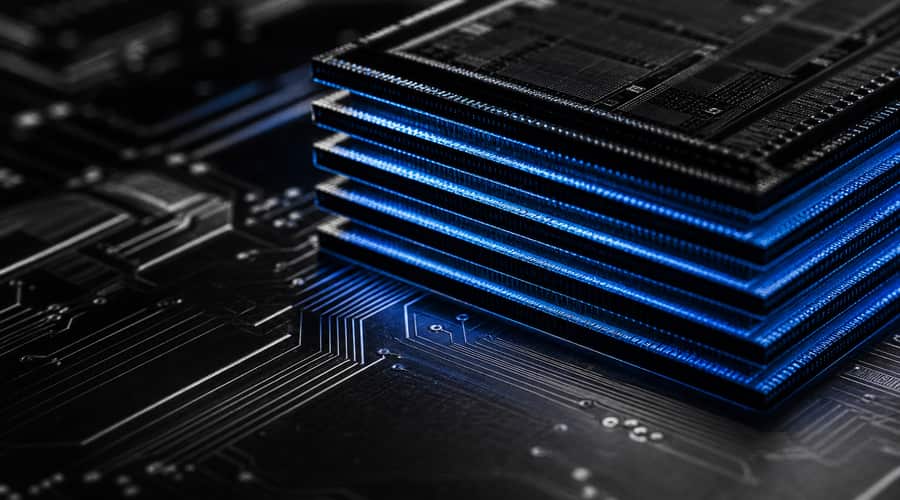
The simple story is that GPUs got too fast. Every frontier model is now bottlenecked not by arithmetic but by memory bandwidth: a chip can multiply faster than DRAM can deliver the weights it needs to work on. That gap is the "memory wall," and high-bandwidth memory, or HBM, is the workaround. HBM stacks DRAM dies vertically and connects them to the GPU through a silicon interposer, achieving bandwidths that conventional DRAM cannot approach. HBM4, entering mass production this year, hits 2 terabytes per second per stack, double the interface width of its predecessor.
The supply situation is severe. HBM now consumes 23% of all DRAM wafer starts, according to TrendForce, and demand has grown several times over since 2023 while advanced-packaging capacity has not kept pace. Micron has sold out its entire HBM allocation through 2026 and has purchase orders stretching to 2027 and 2028. SK Hynix is similarly committed. Prices reflect it: HBM3E runs about $300 per stack, and HBM4 is pricing closer to $500. If you're building AI infrastructure right now, you're paying those numbers, and there's no line to skip.
Lerner noted on the call that Korea and Taiwan now make up 51% of the emerging-market semiconductor index, meaning a U.S. investor buying a standard EM fund is, in large part, buying Memi whether they know it or not. Among emerging markets, the index has returned 43.51% over the trailing year, and most of that performance traces back to Korean memory names. Goldman Sachs has set a price target of 12,000 for the Kospi, a call that is essentially a bet on continued HBM demand.
Micron is down 30% from its high. Is that the story or the opportunity? #
Here's where it gets interesting. Micron posted record fiscal third-quarter 2026 revenue of $41.46 billion and guided to roughly $50 billion in the fourth quarter. The stock briefly hit an all-time high of $1,255 on June 25. Since then it's pulled back about 30%. Bank of America remains bullish. So does UBS. The bears point to Chinese competition, rising production capacity from all three players, and the ordinary cyclicality that has always plagued memory: margins surge, capacity expands, prices fall, and the whole thing repeats.
That cyclicality concern is real and worth taking seriously. Memory has wrecked investors before precisely because it looks most attractive at the moment demand peaks and supply is about to catch up. The counterargument is that HBM is structurally different. Unlike standard DRAM, where factories can pivot relatively quickly, HBM requires advanced packaging, specifically TSMC's CoWoS process, which has been the actual production bottleneck - not wafer starts in Korea. TSMC has tripled its CoWoS output two consecutive years and is still rationing it. That isn't a problem that resolves in a quarter.
For founders building AI products, the practical implication is that compute costs aren't going down fast. The cost of running large models is heavily determined by memory bandwidth, and memory bandwidth is priced by companies that are sold out. Plan accordingly. If your product's unit economics depend on inference getting dramatically cheaper in the next twelve months, Memi's supply picture suggests you should plan for a slower glide path.

For investors, the gap between Micron's fundamentals and its current price is a genuine puzzle. A company guiding to $50 billion in quarterly revenue, trading at roughly 7 times the annualized earnings implied by that guidance, is not obviously expensive. But memory investors have been burned by exactly that logic before, at exactly the moments when demand looked most durable. The honest answer is that Memi as a sector label is less than a week old, the underlying dynamics are genuinely structural, and the pullback in Micron is either a buying window or a warning. Probably worth knowing which one before the name sticks.
Also read: Tesla scraps its Model S and Model X lines to bet the company on humanoid robots • Amazon fires its AGI researchers and bets a billion dollars on deployment instead • IBM stock fell 25% in a single day because AI spending is eating the budgets that used to feed its mainframe empire