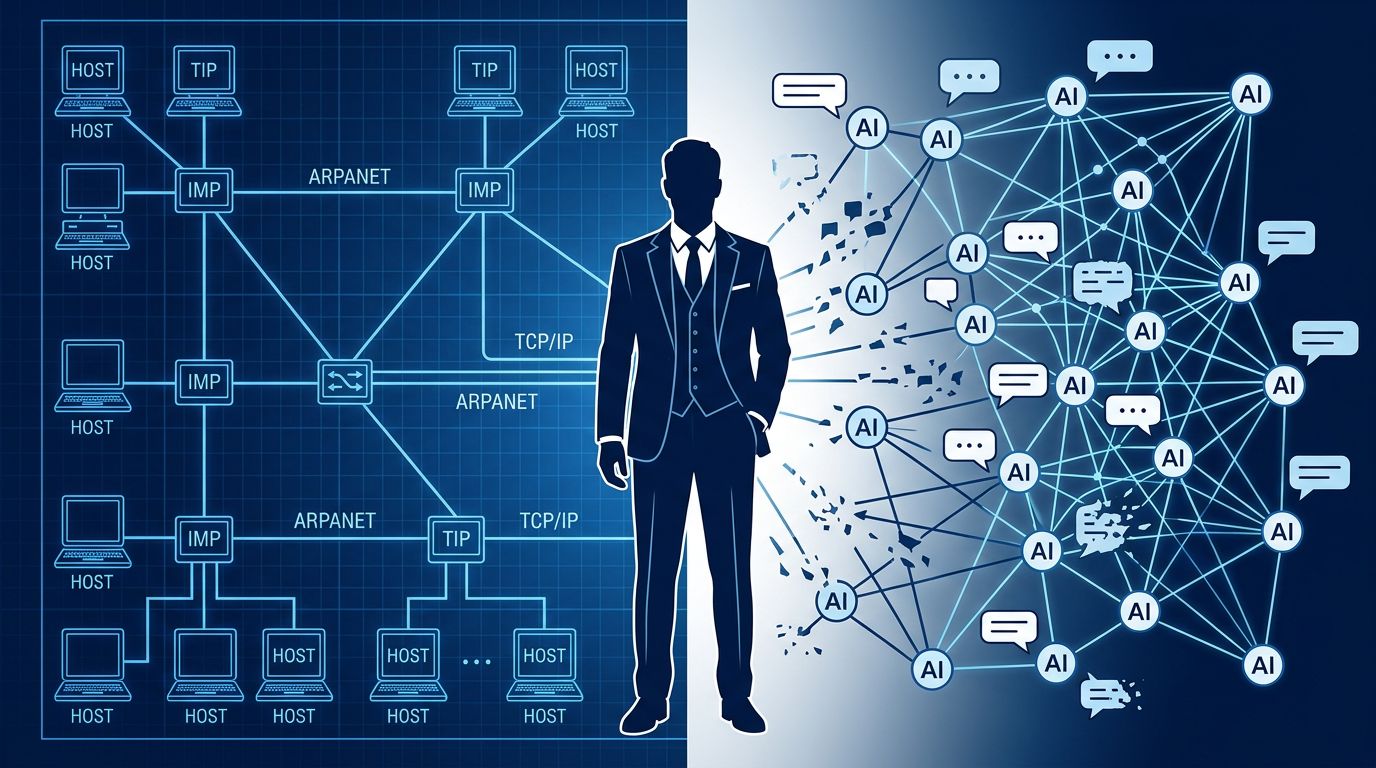
Vint Cerf — co-creator of TCP/IP and Google’s Chief Internet Evangelist for 21 years — retired on July 7, 2026. He left with a warning aimed at anyone building multi-agent AI systems: natural language is not a protocol. Treating it like one will not hold.
Who Cerf Is, and Why This Moment Matters #
Vinton Gray Cerf, 83, co-designed TCP/IP with Robert Kahn in 1974 — the protocol suite that replaced a patchwork of incompatible ARPANET standards and made the modern internet possible. He won the Turing Award in 2004. He joined Google in 2005 as Vice President and Chief Internet Evangelist and held that title for 21 years. He was, until last week, effectively the last founding-era internet engineer in an active, prominent industry role.
Google has not announced a successor to his title. That silence may be telling: the company that once championed open internet standards is now deep in AI competition mode. What Cerf represented — the engineer who built open, vendor-neutral protocols specifically so no single company could control the stack — is exactly the figure walking out the door as AI protocols are being defined.
The Warning, Verbatim #
At the Open Frontier conference on June 30, 2026 — days before his official retirement — Cerf addressed the agentic AI moment directly:
“Imagine a bunch of agents talking to each other in natural language, you know, that’s kind of terrifying.”
He continued:
“I don’t think English is going to be the best choice. There’s a flexibility in it, but there’s ambiguity, and I think precision for interagent interaction is going to be very, very important.”
This is not a theoretical concern from someone skeptical of AI. It is a structural prediction from someone who watched informal inter-node communication fail at scale, then designed the formal replacement. The problem Cerf is describing — heterogeneous agents from different vendors communicating reliably across unpredictable inputs — is not new. He solved it once. He’s telling you English won’t solve it again.
The TCP/IP Parallel Is Not a Stretch #
ARPANET (1969–1983) had individual nodes communicating through custom, incompatible protocols. TCP/IP — designed in 1974, adopted as ARPANET’s mandatory standard in 1983 — replaced them. That transition took nine years. Multi-agent AI is at roughly the 1974 moment right now: competing protocol designs, no clear winner, real adoption still ahead.
The current front-runners are MCP (Anthropic’s Model Context Protocol, for agent-to-tool interactions, now at 110 million monthly downloads and under open-source governance) and A2A (Google’s Agent-to-Agent Protocol, for peer coordination between agents, v1.0 launched April 2026, donated to the Linux Foundation with 150+ organizations backing it). They are complementary, not competing — MCP handles tool access, A2A handles inter-agent coordination. Together they cover most of what a production multi-agent system needs. ByteIota covered the MCP SDK migration deadline last week.
But in practice, natural language coordination still dominates. Most production multi-agent systems — including Claude Code, OpenAI’s Codex, and the majority of enterprise deployments — still route agent-to-agent instructions through English prompts. The formal protocols exist. Adoption is early. Cerf’s point is that this gap will become a problem before most teams expect it to.
The Structural Risk Developers Are Underweighting #
There is a second argument embedded in Cerf’s warning. If natural language remains the dominant inter-agent “protocol,” then the most capable language model becomes the de facto interface layer for all agent communication. The AI model that best understands ambiguous English becomes the protocol. That concentrates infrastructure control in frontier AI labs in a way that TCP/IP was explicitly designed to prevent. Cerf did not build vendor-neutral open protocols by accident. He built them that way because he understood what lock-in at the protocol layer looks like.
What to Do Now #
You probably cannot wait for an AI equivalent of the 1983 ARPANET mandate. But you can avoid building systems that will need to be re-architected when it arrives. If you are building multi-agent systems today: use MCP for tool interactions, use A2A where peer coordination is needed, and treat natural language agent-to-agent communication as a stopgap rather than a foundation. The protocols being written now — by Anthropic, Google, IBM, and open community efforts — will look a lot like TCP/IP in retrospect. Cerf has seen this before. So has history.