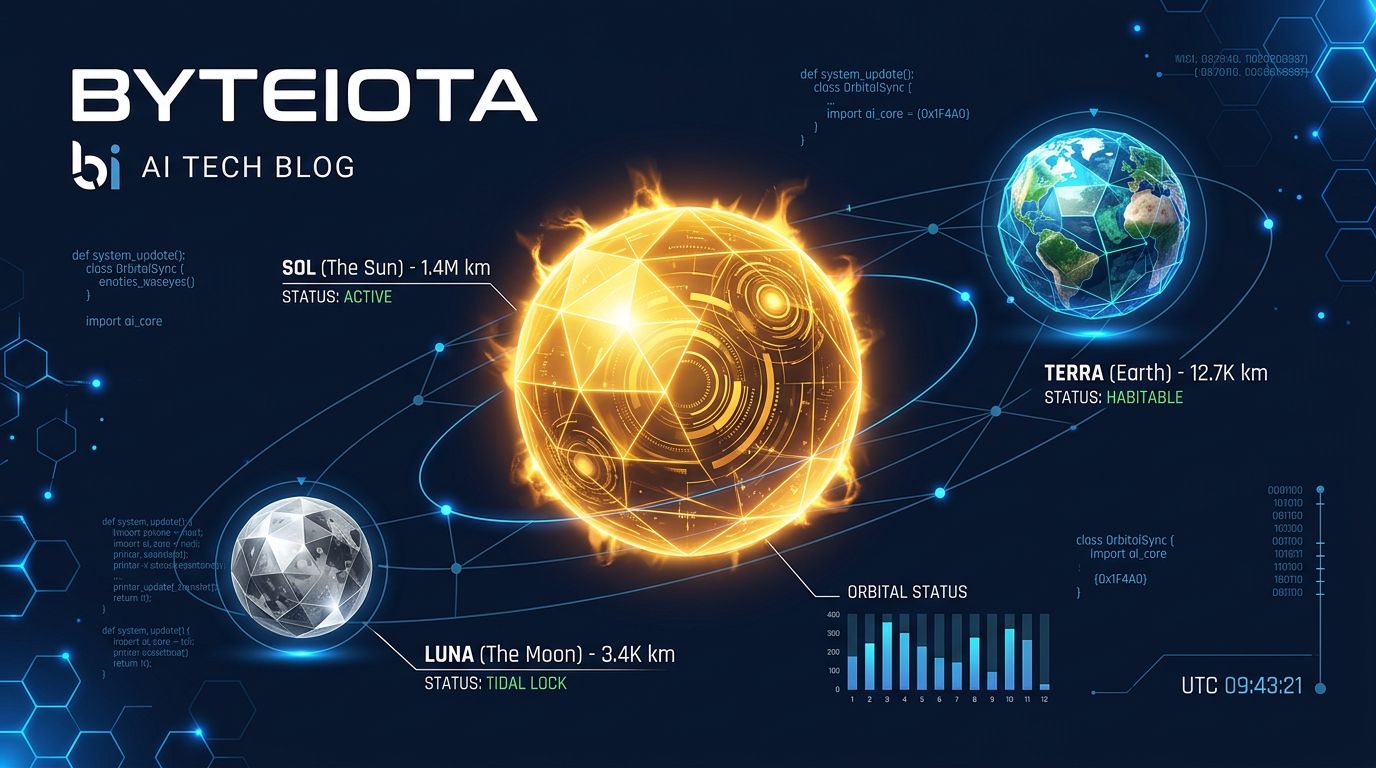
OpenAI shipped three models on July 9 — not three versions, but three permanent tiers named Sol, Terra, and Luna. This is not a point release. It is a restructured lineup designed to stop the version number churn that has made model selection a part-time job for developers. The headline feature — Programmatic Tool Calling — got buried in the announcement, but it deserves attention.
The New Naming System #
Previous OpenAI naming left developers guessing: GPT-4o, GPT-4o-mini, GPT-4.1, o1, o3. Each release spawned a new decision tree. GPT-5.6 ends that pattern. The number (5.6) marks the generation. Sol, Terra, and Luna are durable capability tiers — they evolve independently but always mean the same relative thing. Sol is always the frontier tier. Terra is always balanced. Luna is always fast and cheap.
This matters for production systems. Pinning to gpt-5.6-terra
six months from now still means you are on the balanced tier, not a deprecated snapshot. The bare alias gpt-5.6
routes to Sol.
Which Tier to Use #
Sol(gpt-5.6-sol
): Complex coding, long-running agentic tasks, cybersecurity, scientific research, final verification, computer use. Use when correctness outweighs cost.Terra(gpt-5.6-terra
): Default conversations, routine coding, office writing, most tool calls. This is your new default. Terra delivers GPT-5.5-level performance at roughly half the cost.Luna(gpt-5.6-luna
): Classification, extraction, data cleanup, high-throughput preprocessing, intent routing. High-volume, low-stakes tasks.
The practical architecture is a tiered router: Luna classifies intent, Terra handles the response, Sol escalates when Terra signals low confidence or repeated failure. This pattern cuts costs by 2–5x compared to routing everything through Sol.
Pricing #
| Model | Input (per 1M tokens) | Output (per 1M tokens) |
|---|---|---|
| gpt-5.6-sol | $5.00 | $30.00 |
| gpt-5.6-terra | $2.50 | $15.00 |
| gpt-5.6-luna | $1.00 | $6.00 |
A typical agentic coding session at 800K input + 60K output costs about $5.80 on Sol, $2.90 on Terra, and $1.16 on Luna. With an 80% cache hit rate, Terra drops to roughly $1.46. All three share a 1.05 million-token context window and 128K max output tokens.
Programmatic Tool Calling: The Part That Matters Most #
This shipped quietly in the Responses API and changes how you write agent orchestration. Instead of your code deciding which tools to call and in what order, the model writes JavaScript to do it — executed in a sandboxed, hosted V8 runtime with no network access. The model handles parallel calls, loops, conditionals, and filtering of large intermediate outputs, then returns a structured result.
One customer reported 63% fewer total tokens compared to their existing orchestration chain. Less orchestration code, fewer round trips, smaller context windows consumed. It is ZDR-compatible, so enterprise zero-data-retention accounts are not excluded.
The catch: Programmatic Tool Calling is only available in the Responses API. If your codebase still calls /v1/chat/completions
, you do not get this feature. That is the quiet forcing function to migrate.
Prompt Caching: What Changed #
GPT-5.6 adds explicit cache breakpoints — declare where stable context ends in your prompt instead of relying on implicit detection. Key numbers:
- Cache writes: 1.25x the uncached input rate (previously same cost or free)
- Cache reads: still 90% discount
- Minimum cache life: 30 minutes
- Replace
prompt_cache_retention
withprompt_cache_options.ttl
Track cached_tokens
and cache_write_tokens
in your usage data. Cache writes now cost more — do not cache blindly.
Migration Checklist #
- Swap
gpt-5.5
orgpt-4o
togpt-5.6-terra
as your baseline - Reserve
`gpt-5.6-sol`

for high-stakes or final-verification tasks - Move
`gpt-5.6-luna`
into classification and routing steps - Migrate from Chat Completions to Responses API to access Programmatic Tool Calling
- Update caching: replace
prompt_cache_retention
→prompt_cache_options.ttl
- Audit “Be concise” prompts — GPT-5.6 is more concise by default than GPT-5.5
- Review
OpenAI’s model guidance docsfor task-specific tier recommendations GPT-5.6 is available now on the API — no waitlist, no plan gate. Terra is the right starting point for most teams. For a sharp independent take on the release, see Simon Willison’s breakdown.