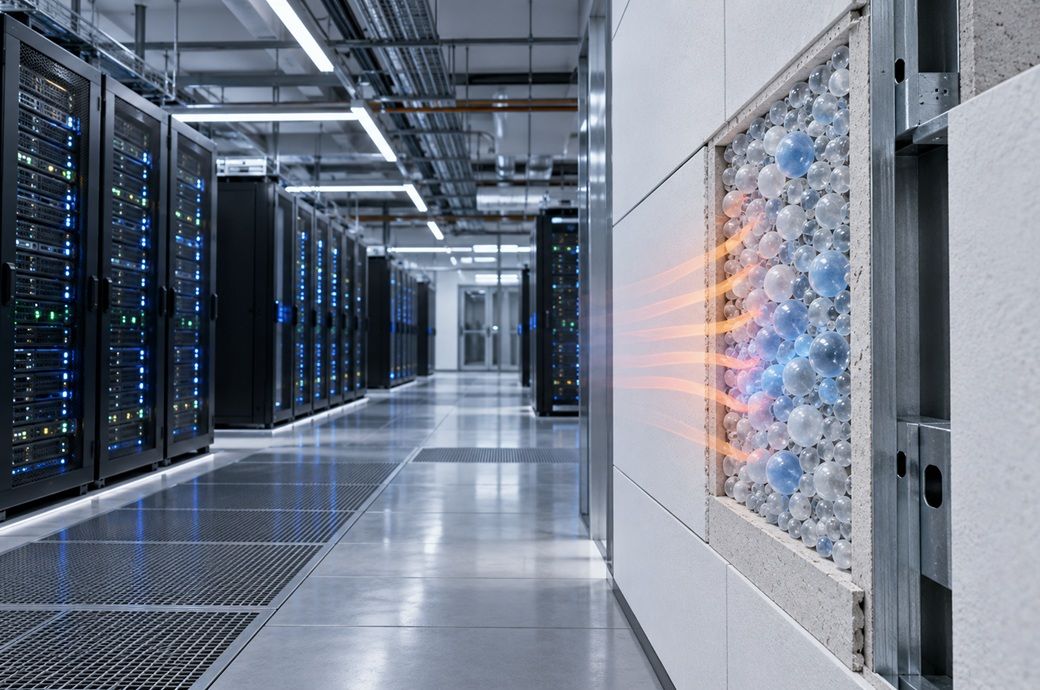
Micronal was originally engineered by BASF for gypsum board and plaster and backed by two decades of use in commercial buildings, Micronal joined Alexium’s portfolio with the December 2025 acquisition of Microtek Laboratories and is now manufactured in the United States.
Alexium International has made its microencapsulated phase change material solutions available to US data center developers, contractors and engineering firms as thermal buffers integrated into walls, ceilings and modular panels.
The company is also opening a co-development program for PCM thermal storage, targeting ride-through and peak-load needs at AI-era facilities.
Alongside the launch, Alexium is opening a co-development program for PCM-based thermal energy storage aimed at the ride-through and peak-load challenges of AI-era facilities.
As rack densities climb, the minutes after a cooling failure have become a design problem. Schneider Electric’s analysis of temperature rise during a cooling outage found that a dense data hall can climb roughly 5 °C per minute and exceed acceptable limits within about five minutes, before chillers can restart. Electrical, uninterruptible power supply (UPS) and battery rooms must hold their temperature through the same event, and daily load swings in support spaces force HVAC to be sized for peaks it rarely sees. Consulting engineers at Cundall wrote in July 2026 that thermal storage is the most effective ride-through provision available to designers.
Alexium mPCMs transform ordinary wallboard, plaster, aerated concrete, ceiling cassettes, architectural coatings into latent thermal mass. Each microcapsule holds a proprietary core inside a cross-linked shell, small enough to mix into the building material without changing how it is installed. When room air climbs past the PCM’s melt point, the core melts and absorbs heat; when the space cools, it re-solidifies and releases it.
As an example, single 15 mm gypsum board loaded with 3 kg/m² of Micronal stores about 330 kJ/m² at its switching point – the heat-storage capacity of roughly 9 cm of concrete – and hangs on standard furring with standard screws. The capsules have been tested through 10,000 thermal cycles, equivalent to about 30 years of daily use, with no notable change in performance.
Alexium mPCMs are a finite buffer: storing heat rather than removing it, slowing and blunting a room’s temperature rise and recharging once cooling returns. The solutions are designed to work alongside chilled-water storage and UPS-backed fans and pumps, not to replace them.
Alexium is positioning mPCMs for three places on a data center campus:
Support spaces. In electrical, UPS, battery and telecom rooms, network operations centers and offices, PCM board and plaster at a 23-26 °C switching point flatten daily peaks and hold a tighter temperature band through an outage, so mechanical systems can be sized closer to average load than peak.
Data hall walls and ceilings. A grade specified just above the cold-aisle setpoint – for example 26-28 °C for a 24 °C setpoint – stays charged in normal operation and adds latent capacity that slows the climb toward the ASHRAE allowable limit when cooling is lost, buying time for chiller restart.
Prefabricated, modular and edge facilities. Lightweight panel construction has almost no thermal mass. A 15 mm mPCM board gives a factory-built module the heat-storage capacity of 9 cm of concrete without the weight or freight.
Alexium is also inviting developers, MEP firms, cooling and thermal-storage OEMs, and board and ceiling manufacturers into a co-development program. Supplied in various forms, the mPCM solutions can be formulated into slurries, plates, and cassettes at custom melt points for active thermal storage; research published by SINTEF indicates PCM storage can be up to four times more compact than equivalent water tanks. Alexium’s broader microencapsulated PCM portfolio spans melt points from 6°C to 43°C.
“The data center industry is asking a building-materials question – how can active temperature management solutions help minimize peak energy demand during extreme daily temperature swings,” said Billy Blackburn, CEO and Managing Director of Alexium. “Alexium’s suite of PCMs are designed to meet these challenges and now vertically integrated for global manufacturing & distribution. We’re putting it in front of the developers, engineers and manufacturers who are building the data center & AI campuses of the next decade.”
“Our microencapsulation platform is what lets us tune the melt point to the room – a 26°C grade for a data hall envelope, a custom point for a chilled-water loop,” said Randall Lane, Alexium COO. “That’s the conversation we want to have with engineers and OEMs now, while these facilities are still on the drawing board.”
Note: The headline, insights, and image of this press release may have been refined by the Fibre2Fashion staff; the rest of the content remains unchanged.
Fibre2Fashion News Desk (MS)