Unitree Robotics received regulatory approval on July 3 for a $619 million IPO on Shanghai’s STAR Market — the first humanoid robot company to go public on China’s domestic A-share market. The approval came in 73 days, a record pace, which tells you everything about how seriously Beijing is taking physical AI. But the IPO itself is not the developer story. The developer story is what Unitree is doing with half the money.
UniStore: The App Store Moment for Physical Robots #
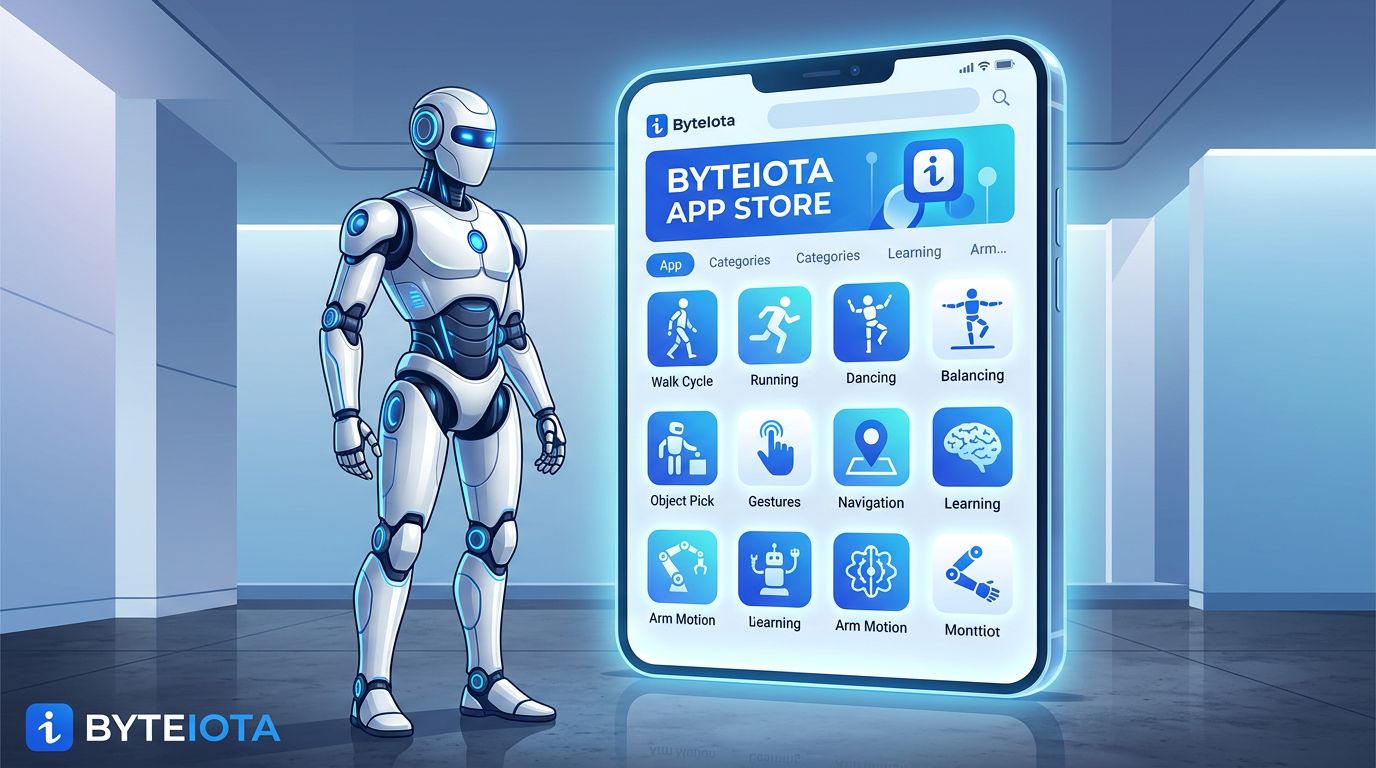
On May 7, 2026, Unitree opened UniStore — the world’s first app store for humanoid robots. It runs on the G1, H1, B2, and Go2 platforms. Robot owners browse a library of motion apps, tap install on their phone, and the robot executes the behavior autonomously. At launch, 24 apps were available: dance routines, boxing sequences, task-specific movements like folding clothes. It sounds like a toy store. It is not.
The parallel to Apple’s App Store moment in 2008 is deliberately apt. Unitree is building the platform layer above its hardware, and UniStore is the marketplace. Developers who build useful apps now — before the catalog floods with entries — have the same first-mover advantage that early iOS developers had. The submission process uses the Unitree SDK, and natural language-to-robot-instruction tooling means the barrier to entry is lower than it has ever been for robotics software.
The Developer Stack: SDK, Open Weights, Simulation #
Unitree’s developer toolkit is more capable than most people outside the robotics world realize. The core SDK (unitree_sdk2) is written in C++ on a CycloneDDS backbone, with a full Python wrapper via pybind11 (unitree_sdk2_python). It works without ROS2 but is ROS2-compatible if that is your stack. Access is granular: motor drivers, joint actuators, IMU streams, camera feeds — all exposed.
On the model side, Unitree open-sourced UnifoLM-VLA-0 in January 2026: a Vision-Language-Action model built on Qwen2.5-VL-7B that handles 12 categories of manipulation from plain-language instructions. Full weights and code are on GitHub. Simulation pipelines exist for IsaacLab and MuJoCo, with reinforcement learning policies that transfer directly to real hardware. XR teleoperation via Apple Vision Pro, PICO, and Quest is supported for data collection. This is a serious software stack with real documentation and open-source model weights — not a hobbyist kit with a half-built API.
Where the $619M Goes — and Why It Matters #
Roughly half of the IPO proceeds — over $277 million per the prospectus — is earmarked for AI model training over the next three years. That capital funds the embodied AI foundation that runs on Unitree hardware. Better foundation models mean better policy transfer, better natural language control, and more capable apps on UniStore. The developer ecosystem gets more powerful as a direct result of the IPO.
The remaining capital goes to hardware R&D and a new manufacturing base. Unitree’s move toward platform economics — where hardware is the substrate and software is the margin — mirrors what made Apple and Android ecosystems defensible at scale. The subscription revenue model for app distribution has not been formally announced, but analysts reading the prospectus expect it post-listing.
The Window Is Open, for Now #
The humanoid robot market sits at $6.24 billion in 2026 and is projected to reach $165 billion by 2034. ABI Research marks 2026–2027 as the inflection point where safety and ROI questions get resolved at scale. Unitree listing with a $619M war chest — mostly directed at AI — means the platform will grow fast. UniStore has 24 apps today. That number will change.
Developers who have been watching physical AI and waiting for the right moment should reconsider that posture. The SDK is mature. The open-weight VLA model is available. The app store exists and is accepting submissions. The window is open. It will not stay that way indefinitely.