On July 10, 2026, two of the most watched voices in enterprise tech made the same argument on the same day. Hugging Face CEO Clem Delangue told TechCrunch that companies are done “renting” AI from frontier providers, and Amazon CTO Werner Vogels told Fortune that cheaper open source models are gaining ground on “the bigger expensive models.” Neither was speculating. Uber had already burned its entire 2026 AI budget in four months — and every engineering leader in the industry knew it.
The open source AI models shift is accelerating. Companies that started on frontier APIs for experimentation are hitting budget walls as they scale. The question now isn’t whether to use open source AI — it’s when, and for what.
The Budget Wall Is Real, and It’s Happening Fast #
Uber gave the industry its clearest data point yet. After giving roughly 5,000 engineers access to Claude Code, adoption climbed from 32% to 84% of engineers classified as “agentic users” in a single month. Monthly cost per engineer ranged from $150 to $250 on average, with power users hitting $500 to $2,000. The company exhausted its entire 2026 AI budget by April, then responded by capping each employee at $1,500 per month. That’s a pragmatic patch, not a solution.
Amazon CTO Werner Vogels made the structural problem concrete in a Fortune interview published July 10. “Cost is a very important part of your architecture, you need to take that into account,” he said. He also cited an unnamed company that burned $500 million in a single month after failing to cap employee AI usage. These aren’t edge cases — they are the predictable outcome of metered token pricing at scale. Frontier AI was priced for experimentation. It breaks budgets in production.
The Numbers: A 35x Cost Gap That’s Hard to Argue With #
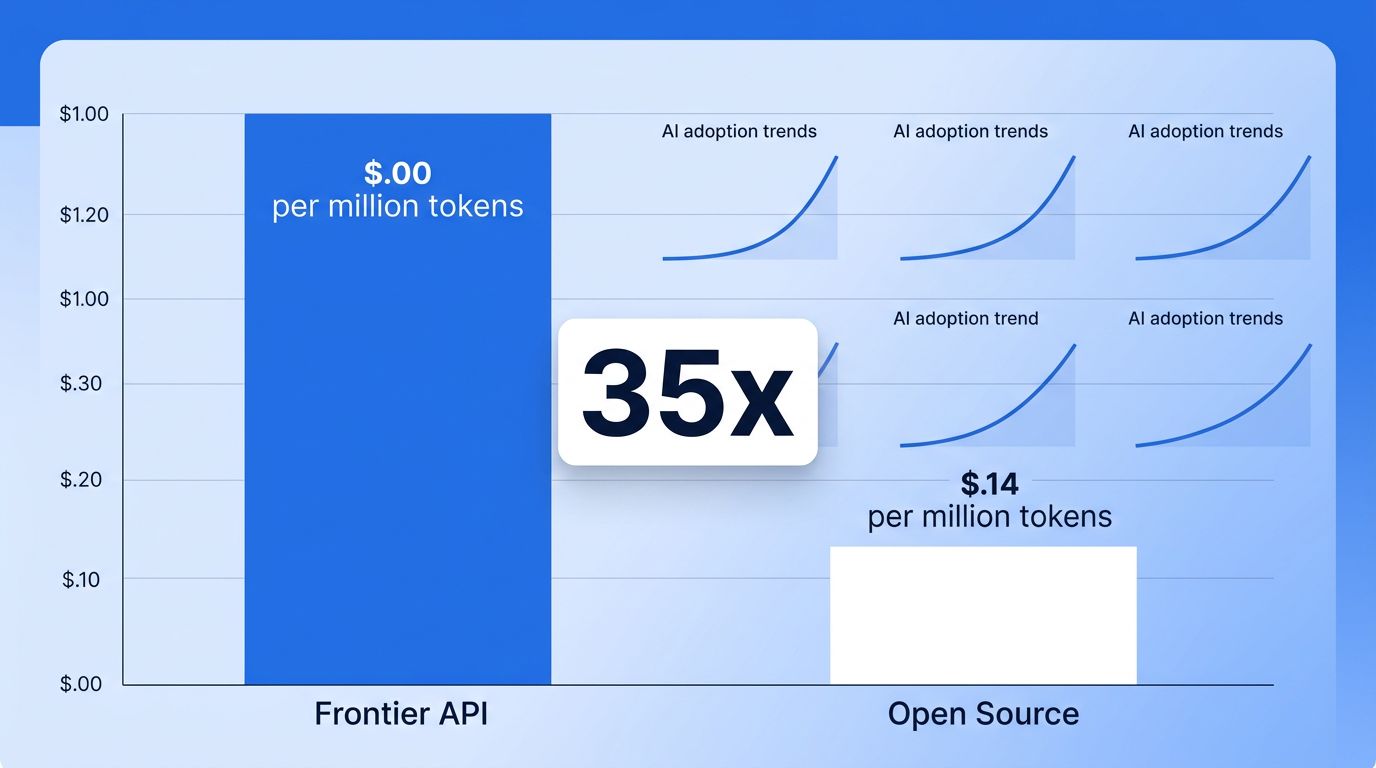
The economics are not subtle. GPT-5.5 costs $5.00 per million input tokens. DeepSeek V4-Flash costs $0.14 — a 35x gap. Even DeepSeek’s Pro tier, which competes more directly with frontier models on quality benchmarks, costs $1.74 per million input tokens. The quality gap that once justified the price premium has also narrowed. Open source models now come within 3-5 percentage points of frontier models on most standard benchmarks. For high-volume tasks — customer support triage, code completion, content drafting — the difference is often imperceptible to end users.
Lindy, an AI executive assistant startup, switched from Claude Sonnet to DeepSeek V4 and described it as “as capable while costing 10x less,” saving the company millions. As Vogels put it: “Do you really need to have the biggest, highest-end model to solve this? The answer is no, you don’t.” The vendor advice to always use the best available model is the advice of someone who bills by the token.
Related:[Kimi K2.7 Code in GitHub Copilot: First Open-Weight Model]
Open Source AI Models Won the Volume War #
Hugging Face’s Spring 2026 report confirms what the pricing data implies. The platform now has 13 million users, over 2 million public models, and 500,000-plus public datasets — nearly doubling in a year. More than 30% of Fortune 500 companies have verified accounts. The “open source is not production-ready” argument has a harder time landing when Fortune 500 procurement teams are the ones signing off on deployments.
Chinese open-source models are driving the adoption surge. They now account for 41% of all Hugging Face downloads — surpassing US models — and have hit 46% of US API tokens on OpenRouter in peak weeks, according to CNBC, up from 11% the prior year. Alibaba’s Qwen family alone has more than 113,000 derivative models on the platform. Delangue’s warning about market concentration rings different when the entities expanding the open ecosystem are, themselves, massive. However, the volume signal is clear: this is where enterprise AI workloads are migrating.
Related:[Ollama Raises $65M Series B: What Changes for Developers]
Where Frontier Models Still Earn Their Price Tag #
The case for open source doesn’t close the case against frontier. Complex multi-step reasoning, high-stakes autonomous agents, and cutting-edge coding tasks still favor the best closed models. GPT-5.5 scores around 91% on SWE-bench Verified; DeepSeek V4-Pro scores around 80%. For a team running a code review agent on a financial trading system, that gap is not a rounding error. Vogels acknowledged this: his point was that most tasks don’t require the top-tier model — not that no tasks do.
Healthcare, government, and humanitarian sectors add a different dimension: transparency and sovereignty. Open models allow organizations to inspect training data provenance, fine-tune on proprietary data, and satisfy compliance requirements that opaque frontier APIs cannot address. The Uber budget story will accelerate boardroom conversations about AI spend — but the answer is intelligent routing, not wholesale abandonment of frontier models.
The emerging architecture is tiered: frontier models for reasoning-heavy, low-volume, high-stakes workflows; open-weight models for high-volume, cost-sensitive automation; local or self-hosted models for regulated data environments. Hybrid is not a compromise. It is the correct architecture.
Key Takeaways #
- Frontier AI APIs were priced for experimentation and break budgets at production scale. Uber’s four-month burndown is a preview, not an outlier — an unnamed company hit $500M in a single month.
- The cost gap is empirical: GPT-5.5 costs 35x more per input token than DeepSeek V4-Flash, and the quality gap has closed to single digits on most standard benchmarks.
- Open source AI models have won the volume war — 30%+ of Fortune 500 companies are active on Hugging Face; Chinese open-weight models now account for 46% of US API token consumption in peak weeks.
- Frontier models still justify their price for complex reasoning, autonomous agents, and high-stakes workflows where quality definitively beats cost.
- The right response to AI cost pressure is intelligent routing: match model capability to task requirements. Hybrid architectures are not a fallback — they are the destination.