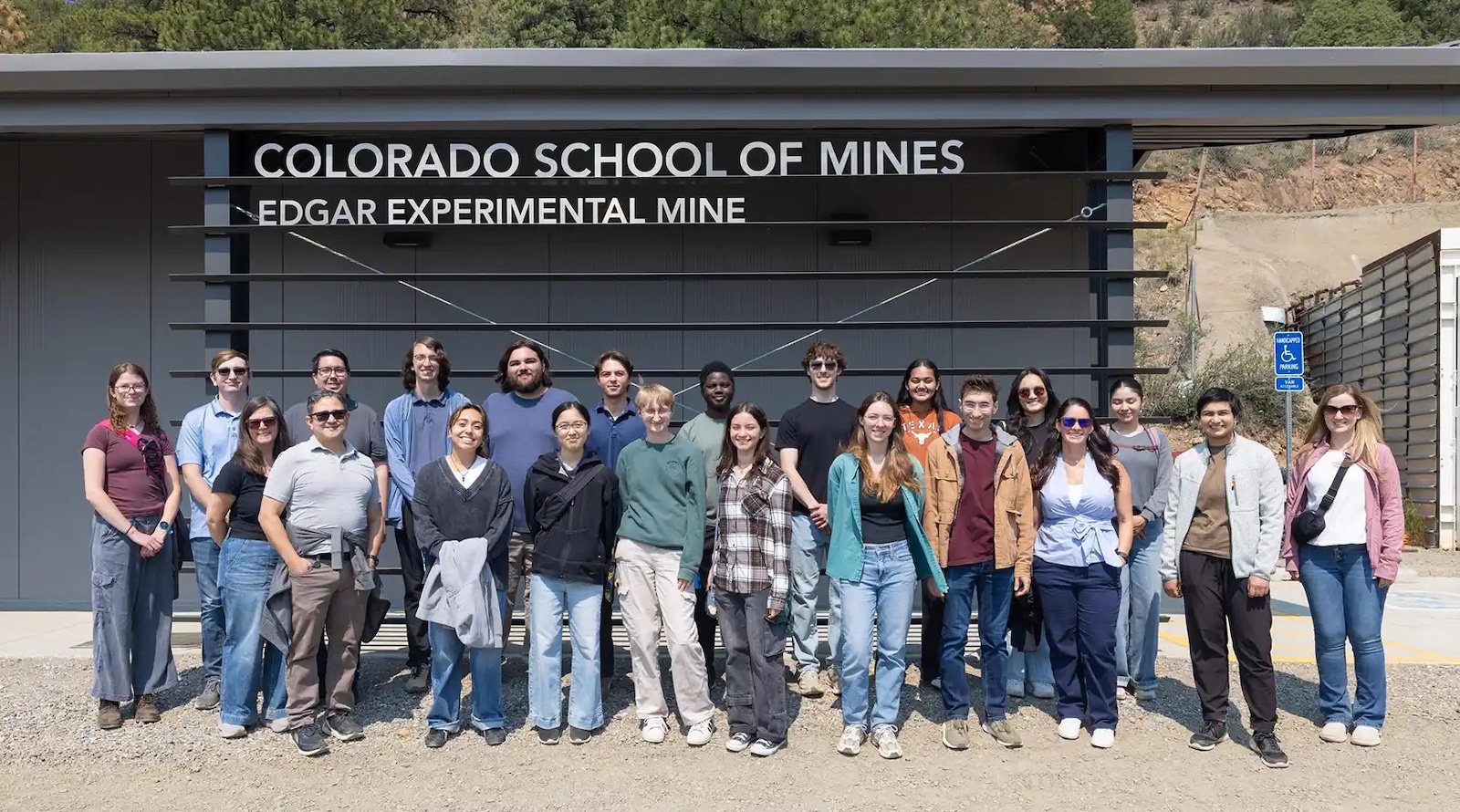
Support CleanTechnica's work througha Substack subscription,on Patreon, oron Stripe. Help us produce all of thehigh-quality, original content we publish week after weekdespite the challenges of content-scraping AI, antisocial media, inflation, and other hurdles.An underground mine provided some welcomed cool on a peak-summer day in the mountains west of Denver, Colorado, for a group of 21 undergraduate interns from the U.S. Department of Energy’s National Laboratory of the Rockies (NLR).
Outfitted with hard hats, and as gravel crunched under their closed-toed shoes, the interns were led into the main drift of the Edgar Experimental Mine, a research laboratory one-half mile into the side of a mountain that is training the next generation of mining engineers.
Colorado School of Mines, which operates the Edgar Mine, provides tours to the public that cover the history and development of the mine and fundamental mining practices. On this July morning, NLR interns saw up close what an industrial-size rock drill looks like—much larger than the home improvement store variety—as they passed around steel bolts used to drill into and reinforce the mine’s walls.
The temperature dipped to a constant 54 degrees. The light at the start of the tunnel descended into pitch black, save for a row of dim lightbulbs. The tour guide’s voice echoed slightly off the rock walls.
This hands-on tour was just one offering in NLR’s summer educational programs for interns of all educational levels, from high school to undergraduate and graduate students.
Undergraduate: Anisha Jarang #
Nearly 250 students from across the country joined the laboratory this summer to apply classroom concepts to advanced energy research. Anisha Jarang, a rising senior at the University of Virginia, is one of them.
As a member of her university’s outdoors club, Jarang has explored cave formations signature to the Appalachian Mountains, marveling at underground waterfalls and stalactites, those icicle-shaped minerals that hang from cave ceilings. The Edgar Mine, to her, was just another rock formation.
“I thought it would be a fun experience to see what a Colorado mine looks like, because I’m in that underground environment a good amount through caving,” Jarang said. “But it’s also a cool idea, that there’s a mine that a university owns and students work in there. That’s a really interesting concept overall.”
Jarang studies materials science and engineering at UVA and was drawn to NLR’s summer internship program because of a niche technique within organic semiconductor research, called charge modulation microwave conductivity, that “NLR is the best of the best at in the entire world,” she said.
It uses light and microwaves to study how electrons move and orient themselves within organic semiconductor thin films. The technique was created by researcher Obadiah Reid in the laboratory’s spectroscopy and photoscience group. Andrew Ferguson, group manager, is Jarang’s mentor this summer.
“The project that I’m doing here has two aspects to it. The first is the optimization of this really novel technique. And the second is to try out different material systems and see how they behave,” Jarang said. “The goal by the end of the summer is to have a good idea of the setup of this technique so that we’re able to reproduce results across a variety of samples and materials.”
If Jarang’s team can determine the upper limit of electron mobility in the polymers being studied—that is, just how fast electrons can move in soft materials—researchers will be one step closer to fast microchips for applications like organic light-emitting diode (OLED) displays, consumer electronics, wearables, smart packaging, and more. At NLR, Jarang has been exposed to a collaborative research environment that is unlike her previous experiences in university labs.
“Here, there’s a lab manager, group managers, lots of people who are involved in multiple research groups, industry partners—there’s a lot of overlap going on, which has been really interesting to me because I’ve been able to see what you can do past a Ph.D., as well.”
As she embarks on her senior year, Jarang is interested in pursuing a Ph.D. program and continuing her studies in polymer development. She will look back on her NLR internship with a “deep appreciation” for the novel work being done, the team and mentor that have supported her through it, and the opportunities she had to practice conveying her research to both technical and nontechnical audiences.
“It has been a great work environment,” Jarang said.
Graduate: Irene Walker #
The collaborative spirit at NLR also rings true for Ph.D. student Irene Walker. As part of the Advanced Energy Systems (AES) graduate program, Walker benefits from state-of-the-art technology and mentorship both at NLR and the School of Mines, which coadminister the program. That means access to two advisors, a national laboratory and a university lab, and equipment at both institutions.
“It’s really unique to have such an energy-focused lab right next door to an energy-focused school,” Walker said. “The more I looked at other grad programs, the more I realized that I was looking for something that AES had built in already. I was looking for a national lab connection.”
“I feel very spoiled, because we have really great, comprehensive pieces of equipment at the lab, especially for electrochemistry and characterization,” Walker added—equipment that she has used regularly throughout her studies.
Her dissertation research focuses on industrial waste, using electrical current to produce calcium carbonate from metals in mine tailings. As the mineral building block of limestone, calcium carbonate has a market value of “tens of billions of dollars,” Walker said, because it is used across industries and products—pigments, paints, fillers, soil, fertilizer, and more—to balance pH when something is too acidic.
In the mining industry, it is used to neutralize acidic waste created when processing gold ore. Walker’s research started four years ago on that premise, helping an industry partner extract calcium carbonate from their own mine tailings to use upstream in processing.
“We strategically looked at the theory behind the thermodynamics and kinetics of forming calcium carbonate and designed reactions that would maximize that potential,” Walker said. “So, we were able to make that process faster and more efficient with very little increases in energy input.”
This summer, that research has taken on new forms, as the same process to optimize calcium carbonate production can be used for critical minerals recovery. While global industries race to secure the minerals needed for next-generation electronics, Walker is using software to model the chemistry and costs associated with getting rare earth elements out of low-concentration ore and secondary sources.
Having defended her dissertation last month, Walker’s time at NLR is drawing to a close. As one of the first students hired by co-principal investigators Kerry Rippy and Robert Bell, Walker has learned from a host of postdocs, staff scientists, and senior researchers at NLR, who helped her reach her own milestones.
“The first paper that I got published was a really big deal, and I was really proud of it. And now that has almost 50 citations,” she said. “The first time I went to a conference—the American Chemical Society conference in Denver two years ago—my whole group was there, and they all came to my talk. It was a wonderful launch pad into the conference world because it can definitely be intimidating.”
“There is a great range of temporary workers at NLR, which I think speaks to the stewardship the lab does for young, early-career researchers like me,” Walker added. “It’s a wonderful thing to so deeply learn how an institution runs over four years.”
High School: Govind Kapur #
Before one of NLR’s college-level internships, like the Community College Internship (CCI) program, Research Participant Program (RPP), or the Science Undergraduate Laboratory Internship (SULI)—first, there is high school.
Summer 2026 brought the first time NLR has hosted the Pathway Summer School (PSS) Program, a U.S. Department of Energy (DOE) Office of Science initiative to produce a skilled workforce via student-driven, project-based, hands-on learning experiences for high schoolers and recent high school graduates.
The program was coadministered with SLAC National Accelerator Laboratory in California. NLR welcomed 21 students in June for four weeks of study, and another 17 students joined SLAC’s two-week program in July. Several other DOE national laboratories also hosted PSS programs this summer, the curriculum tailored to each lab’s unique research expertise.
At NLR, that expertise is electrochemistry, the same foundation of Walker’s AES research. Students learned fundamentals of chemistry, batteries, fuel cells, semiconductors, spectroscopy and microscopy, computation and modeling, and AI and machine learning—technology areas that underpin the laboratory’s Materials, Chemical, and Computational Science directorate, which sponsored the program.
As part of the battery curriculum, for example, “We broke out the parts of a cell phone and showed where all the different components—the battery, semiconductor materials, chips, minerals involved—where those things come from around the world,” said Tom Mason, NLR’s PSS program coordinator. “We’re trying to give students opportunities to visualize the full cycle of these technologies and the trade-offs from one technology to another.”
Weaved throughout the program were campus tours, panel discussions, and presentations from laboratory staff on everything from career mapping to NLR’s values as an institution. The students’ experiences also built up to project presentations at the end of the program.
Govind Kapur, a recent graduate of Kent Denver School, said he applied to the PSS program to experience another avenue of how science, technology, engineering, and math (STEM) is applied in the real world, specifically in the national laboratory complex.
“The entire process of how science and technology are developed and advanced, rigorously tested to ensure quality, scaled up to industry and public standards, and eventually given to the end user, through the various DOE national laboratories, really fascinated me,” Kapur said.
“Both of these reaffirmed that our life trajectories are nonlinear and that opportunities will need to be seized to create a career and a life,” Kapur said. “As someone about to begin the next big chapter, it has been very nice to hear about the paths of NLR scientists,underscoring the networking, mentorship, and dedication needed to blossom and build an amazing career—all with a growth mindset.”
Kapur began his freshman year at School of Mines this month, studying applied physics. He plans to share the knowledge he gained through PSS with his former teachers, hoping to introduce energy technologies to the science curriculum at Kent Denver School.
This action—paying it forward—is exactly what Mason hopes the PSS program will do.
“There’s a two-fold mission to the program: to introduce students to national laboratory careers and give them firsthand experience interacting with everyone from Ph.D. scientists to support staff,” Mason said. “But a secondary goal of mine is that students will leverage this opportunity to go home to their communities and become ambassadors for the laboratory, so that their families and community members are learning about NLR, as well.”
The laboratory’s workforce development team has planned at least two more summers of Pathway Summer School curriculum for 2027 and 2028.
Toward the Future #
Whether they are solving chemical equations in a high school lab, optimizing critical mineral extraction for a global supply chain, or studying the behavior of the electrons behind microelectronics, students in NLR’s summer programs represent a pathway from classroom to workforce. They are supported and guided by renowned scientists and staff during some of the most formative years of their young adult lives.
That holistic support is what internships are all about, said Marcus Giron, internship program manager at NLR.
“We aren’t just funding summer jobs; we are actively enriching students and cultivating the specialized workforce that will keep our industries competitive for decades to come,” Giron said.
Students are made better by unparalleled access to facilities, capabilities, and expertise unique to the national laboratory system, but the focus extends beyond scientific output. A student’s personal growth, well-being, and curiosity are just as critical to their success as the research they produce.
Back at the Edgar Experimental Mine, where this summer journey began, the hard-hat tour eventually came to an end, and the students headed back toward the surface—illuminated not just by the late morning sun but also by the futures ahead of them.
*Learn more about internship opportunities *at NLR.
By Hannah Halusker, NLR
Sign up for
CleanTechnica's Weekly Substack for Zach and Scott's in-depth analyses and high level summaries, sign up forour daily newsletter, andfollow us on Google News!Have a tip for CleanTechnica? Want to advertise? Want to suggest a guest for our CleanTech Talk podcast?
Contact us here.Sign up for our daily newsletter for 15 new cleantech stories a day. Or sign up forour weekly one on top stories of the weekif daily is too frequent.
CleanTechnica uses affiliate links. See our policy
here.CleanTechnica's Comment Policy