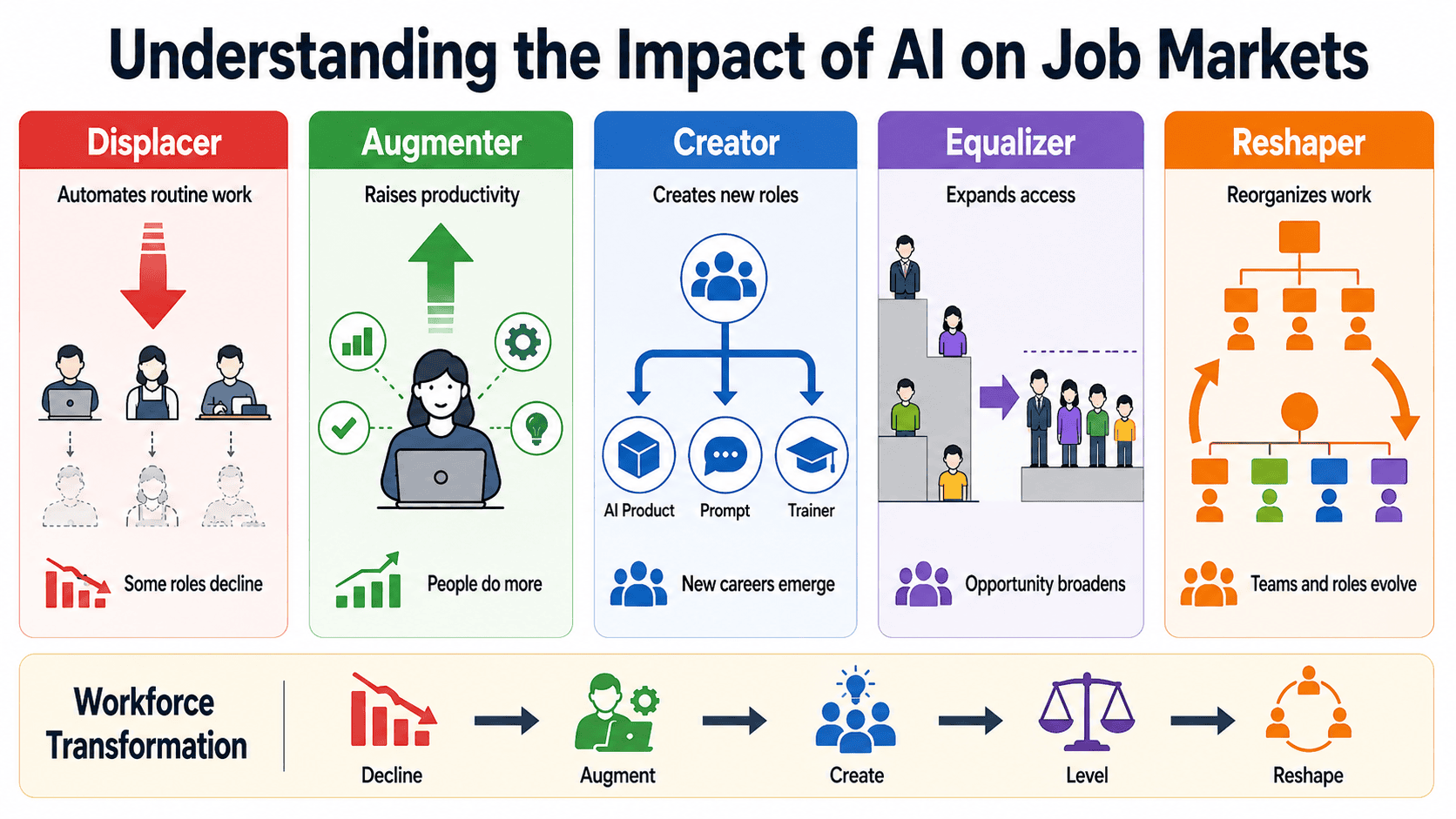
Explore five distinct ways AI is reshaping jobs, from automating routine tasks to thinning entry-level hiring.
For years, the conversation about AI at work has circled one anxious question: will a machine take my job? It's the wrong question, or at least an incomplete one. AI isn't a single force that either spares a role or erases it. It's several forces at once, and the effect on any given job depends on which of them is acting on it. Some tasks get automated away. Others get amplified. New categories of work appear that didn't exist a few years ago. And underneath all of that, AI is quietly changing who gets hired and how skills get built. To see where the labor market is heading, it helps to separate these effects and look at each one individually. Here are five ways AI is transforming work, backed by what current data shows.
# The Displacer: Automating Routine Tasks #
This is the effect most people fear, and with good reason. AI is good at pattern recognition, processing large volumes of data, and repeating structured tasks without tiring. Where work is predictable, it can take over the routine components that once required a person, reducing the need for certain kinds of manual and cognitive labor.
The ** World Economic Forum's Future of Jobs Report 2025** estimates that 92 million roles will be displaced by 2030 as technology, demographics, and economic pressures reshape the market. Its survey of more than 1,000 employers found that 41 percent plan to reduce their workforce as AI automates specific tasks.
Who feels this first? Roles built around routine information processing: data entry clerks, administrative assistants, accounting clerks, and first-line customer support. The pattern is rarely a whole job vanishing at once. Organizations break jobs into tasks, hand the predictable pieces to software, and leave people with the edge cases, the judgment calls, and the messy problems that resist automation.
Displacement is only one piece of the picture, though. For many workers — particularly those in knowledge-intensive roles — AI behaves quite differently.
# The Augmenter: Amplifying Knowledge Work #
For many professionals, AI acts less like a replacement and more like a capable collaborator. Rather than eliminating jobs outright, it absorbs the slow, repetitive parts — such as summarizing long documents, drafting boilerplate code, or producing a first marketing pass — freeing people to spend more time on strategy and creative direction. ** Goldman Sachs** research estimates that 300 million jobs worldwide are exposed to some degree of AI automation, with roughly two thirds of occupations at least partially exposed. The firm expects most of that to show up as a productivity boost rather than outright job loss, and projects AI could lift global GDP by around 7 percent over a decade.
Who feels this? Software developers, copywriters, financial analysts, designers, and middle managers. The work shifts from producing from scratch to directing and editing. A copywriter becomes an editor of generated drafts. A developer moves toward architecture and review while an AI assistant handles the first pass of code.
Augmentation can eventually shade into displacement. A colleague using AI well may outcompete someone who doesn't adapt. The key difference is that augmentation rewards people who adjust; displacement tends to hit those who don't.
# The Creator: Generating New Occupations #
Every major technology shift removes jobs and invents others, often in categories nobody anticipated. The web created demand for roles like web developer and search specialist that made no sense a generation earlier. AI is doing the same, and at a comparable scale.
The Future of Jobs Report 2025 projects 170 million new roles by 2030, a net gain of 78 million jobs after displacement. Fast-growing titles include big data specialists, AI and machine learning specialists, and information security analysts. The compute demand behind AI is also driving a physical buildout, lifting hiring for electricians, HVAC technicians, and construction crews building out data centers.
Who feels this? The wider technology sector, physical infrastructure trades, and specialized consulting. Alongside the obvious engineering roles, demand is rising for AI ethicists who handle bias and regulation, for people skilled at directing AI systems toward useful output, and for governance and compliance specialists who sit between the technology and the law. Many of these titles didn't appear on a single job board five years ago.
That's the reliable pattern across technology waves: the roles created are harder to picture in advance than the roles lost, which is part of why the displacement story tends to dominate the conversation.
# The Equalizer: Compressing the Skill Gap #
For most of the past thirty years, new technology rewarded the already skilled and widened wage gaps. Generative AI appears to work the other way inside many roles, and the data behind this is worth examining. Economists Erik Brynjolfsson, Danielle Li, and Lindsey Raymond studied more than 5,000 customer support agents at a large software firm. Access to an AI assistant raised productivity by about 14 percent on average, but the gains were far from even. Novice and lower-skilled agents improved by roughly 34 percent, while the most experienced agents saw little change. The tool worked by learning what the best agents did and passing that hard-to-teach knowledge to everyone else. Agents two months into the job began performing like peers with six months of experience.
Who feels this? Newer entrants and lower-tenure workers in roles with a clear right answer — such as support, writing, and routine analysis. The practical effect is a narrower spread between the strongest and weakest performers on a team. That reshapes how companies think about hiring criteria, training timelines, and pay tied to experience, since experience buys less of an edge than it used to.
This is often good news for individual newcomers. But the equalizer effect raises a harder question when you zoom out to the labor market as a whole.
# The Reshaper: Redrawing the Career Ladder #
The equalizer helps an individual novice get up to speed faster. It doesn't guarantee there will be a job for that novice to fill. This is the most recent and most unsettling signal in the data, and it sits in direct tension with the effect we just examined.
A 2025 ** Stanford** study titled "Canaries in the Coal Mine" tracked payroll records for millions of workers. It found that people aged 22 to 25 in the occupations most exposed to AI — including software development and customer service — saw about a 13 percent relative decline in employment after generative AI spread, while older workers in the same roles held steady. A follow-up dashboard released in 2026 showed the trend deepening rather than reversing. The broader picture for young graduates looks soft as well: the
put underemployment among recent graduates at 42.5 percent in late 2025.
Federal Reserve Bank of New YorkWho feels this? Early-career workers in exposed fields, where firms increasingly route junior tasks to AI instead of a first-year hire. The decline shows up where AI automates work, not where it augments it.
That raises a longer question worth sitting with: if the bottom rung of the ladder thins out, where will tomorrow's senior experts come from? The knowledge that makes a great worker is often built by doing the junior tasks that AI now absorbs. A team can draw on the expertise its senior people accumulated the slow way, but that reservoir doesn't refill on its own. Companies that lean hardest on AI to skip entry-level hiring may find, several years out, that they've quietly stopped producing the experienced staff they depend on.
# Reading the Shift #
Most roles don't experience just one of these forces. Here's how they compare:
| Force | Primary Effect | Roles Most Affected | Best Adaptation |
|---|---|---|---|
| The Displacer | Automates predictable, routine tasks | Data entry, clerical, basic support | Move toward complex, strategic, human-facing work |
| The Augmenter | Acts as a collaborator on knowledge work | Developers, writers, analysts, managers | Learn to direct, edit, and apply AI output |
| The Creator | Spawns new industries and roles | Tech, infrastructure trades, consulting | Keep learning and stay technically adaptable |
| The Equalizer | Narrows the gap between novices and experts | Support, writing, routine analysis | Adopt AI early to climb the learning curve fast |
| The Reshaper | Thins the entry-level rung | Early-career workers in exposed fields | Build judgment and skills AI can't yet replace |
The five forces overlap, and most roles feel more than one at a time. A software developer experiences augmentation today, benefits from the equalizer if they're newer to the field, and faces reshaping pressure at the junior end of their career — all simultaneously.
The market is going through its largest shift since the move to computers — possibly larger. The useful move isn't to ask in the abstract whether AI will take jobs. It's to look at a specific role, work out which of these forces is acting on it most strongly, and adapt accordingly.
A worker who can name which force is acting on their job — whether displacement, augmentation, creation, equalizing, or reshaping — is already better positioned than one waiting to find out. Start there: map your role against the five forces, identify your biggest pressure point, and let that guide where you direct your energy next.
is an AI and data science educator who bridges the gap between emerging AI technologies and practical application for working professionals. His focus areas include agentic AI, machine learning applications, and automation workflows. Through his work as a technical mentor and instructor, Vinod has supported data professionals through skill development and career transitions. He brings analytical expertise from quantitative finance to his hands-on teaching approach. His content emphasizes actionable strategies and frameworks that professionals can apply immediately.