Naveen Rao (@NaveenGRao) and the Unconventional AI team released Un-0 on Thursday, June 25, a first image-generation model meant to prove that the startup's physics-first computing thesis can do more than make an efficiency pitch.
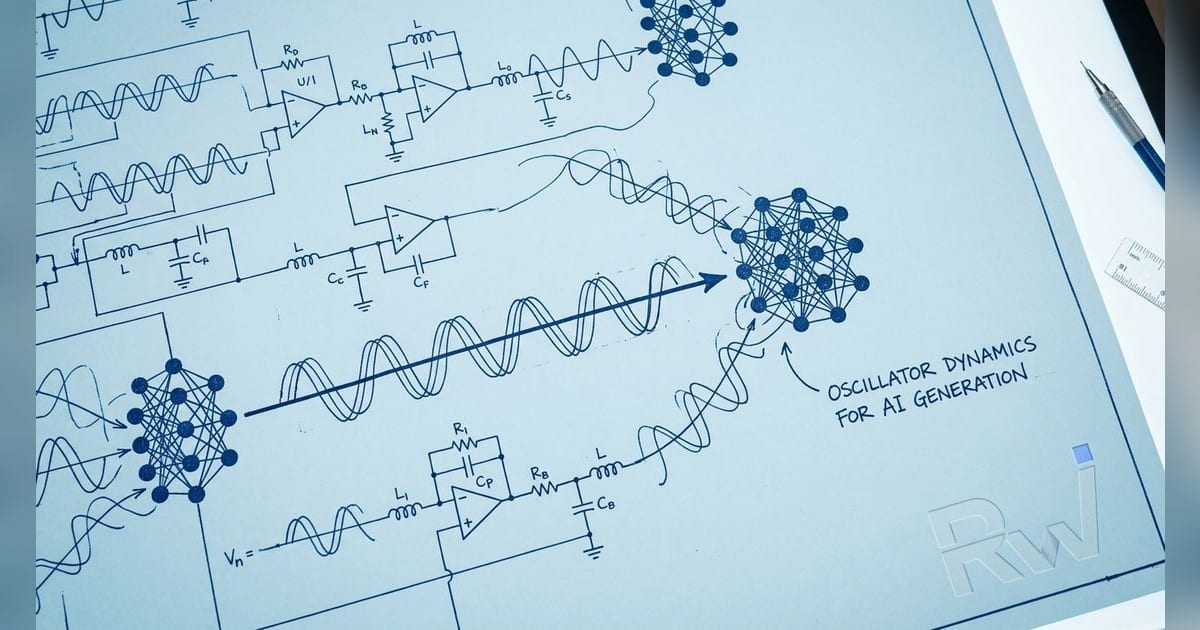
https://x.com/unconvAI/status/2070184800103919927 The company introduced the model in a thread on X and a detailed company blog post. Un-0 is an image generator powered by a simulated system of coupled Kuramoto oscillators, not a conventional transformer, diffusion backbone, GAN, or deployed analog chip. That distinction is the story: Unconventional AI has not shown commercial hardware yet, but it is now publishing a working model, code, weights, and ablation results around the computing primitive it wants to turn into hardware.
Rao is not approaching this as a first-time AI hardware founder. He previously founded Nervana Systems, the machine learning chip company Intel acquired in 2016, and MosaicML, which Databricks acquired in 2023. Unconventional AI was founded by Rao, MeeLan Lee, Michael Carbin, and Sara Achour, a group Lightspeed describes as spanning AI systems, analog circuits, computing theory, and neuroscience. That mix explains the product choice: Un-0 is less a consumer image model than a test article for a new compute stack.
Unconventional AI says the largest Un-0 model scales to 16,384 oscillators and 322.44 million trainable parameters, reaching an FID of 6.74 on class-conditional ImageNet 64x64 using 50,000 generated samples and the ADM evaluation suite. The company also trained CIFAR-10 variants, with the largest released CIFAR-10 checkpoint using 4,096 oscillators and 19.43 million parameters. In the company's framing, Un-0's result puts it near early conventional image generators, while still trailing later diffusion-era systems such as EDM and GDD on absolute quality and parameter efficiency.
The architecture is hybrid by design. Initial oscillator phases start randomly, class-conditioning oscillators bias the main oscillator population, the system evolves over time, and a conventional decoder converts the final oscillator phases into pixels. Unconventional AI says the decoder accounts for under 13% of the model's parameters in its ImageNet setup, leaving the oscillator couplings and frequencies as the main learned compute substrate.
That matters because the core risk for Unconventional AI is not whether a small decoder can generate images. It is whether the physics component does useful work. The company says its ablations compare the full trained dynamics against decoder-only baselines, frozen random Kuramoto reservoirs, and different integration-step settings. Its reported conclusion is that trained multi-step dynamics outperform decoder-only and random-reservoir alternatives, and that increasing integration steps improves quality. The claim is still company-reported, but the release is structured so outside researchers can test it: Unconventional AI has published the Un-0 GitHub repository, including a plain-PyTorch implementation, pretrained checkpoints, training scripts, inference code, and an ablation suite.
The repository underscores the gap between research artifact and product. Un-0 is trained and run on conventional GPUs today. The GitHub README says training has been verified on NVIDIA A100, H200, and B200 GPUs, and the company blog says the largest ImageNet 64x64 model used 640 B200 hours. ImageNet users also have to bring their own ImageNet data; the repo provides preprocessing and s, not a turnkey dataset download.
That makes Un-0 a simulation milestone, not proof of a 1,000x energy advantage. In its launch materials, Unconventional AI said it wants to build a new computer that runs AI on the dynamics of a physical system at a fraction of today's energy cost. In the Un-0 post, the company again points to a goal of around 1,000x lower energy. TechCrunch reported Thursday that Rao described Un-0 as the "hello world" of a new kind of computer and said the current version runs on a software simulation of oscillator chips, with hardware schematics planned later.
The funding behind that ambition is already unusually large. In December 2025, Unconventional AI said it had raised $475 million in seed funding at a $4.5 billion valuation, led by Lightspeed and Andreessen Horowitz, with participation from Sequoia, Lux Capital, DCVC, Future Ventures, Jeff Bezos, and others. Rao personally invested $10 million, according to the company's own launch post.
The timing is clear. AI companies are no longer just optimizing models against latency and accuracy; they are optimizing against electricity, grid access, and the capital cost of running inference at scale. Unconventional AI's December launch post argued that AI compute could become constrained by global energy supply within the next three to four years and that neural networks are inefficient when run as deterministic digital abstractions on chips that ultimately operate through analog physics anyway.
Un-0 is the first public attempt to make that argument falsifiable. If outside researchers can reproduce the results and improve the scaffold, Unconventional AI gets a stronger software case for a future hardware substrate. If the model's gains collapse under independent scrutiny, or if the simulated dynamics do not map cleanly to silicon, the release will instead show how much of the company's valuation still rests on Rao's track record and an energy-efficiency thesis rather than working hardware.
For now, the honest read is narrower than the company's long-term claim and more meaningful than a stealth startup pitch. Unconventional AI has not delivered an energy-efficient AI computer. It has delivered a reproducible image-generation experiment that puts coupled oscillator dynamics into a modern generative-model benchmark and opens enough of the stack for the field to test whether the physics is actually earning its keep.