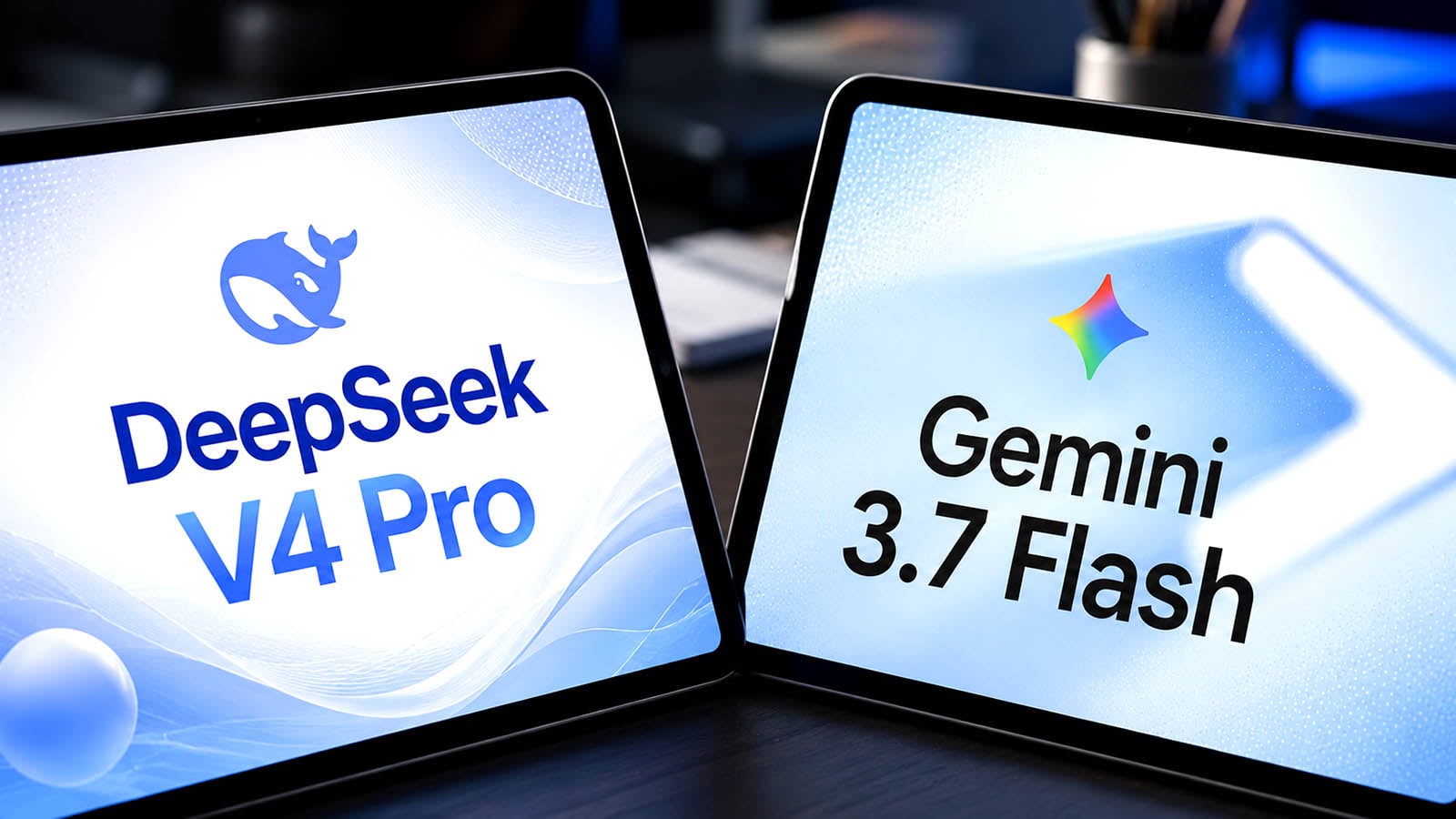
Google and DeepSeek released major AI model upgrades on Thursday, with Google unveiling Gemini 3.7 Flash and China’s DeepSeek launching the general-availability version of V4 Pro, as both companies push deeper into coding, autonomous agents and complex multi-step work.
The launches arrive from different directions but reflect the same broader shift toward AI models that can plan tasks, use tools and handle longer, more complex workflows with less human intervention.
Gemini 3.7 Flash lands just three weeks after 3.6 Flash, while DeepSeek V4 Pro turns the company’s April preview into an official production release.
Gemini 3.7 Flash targets stronger coding and agent workflows #
Google describes Gemini 3.7 Flash as its most capable Flash model yet, with upgrades focused on software engineering, web development, knowledge-heavy work and agentic workflows.
The model is designed to handle roadblocks more effectively, follow instructions more closely and put greater effort into multi-step planning and tool calls, reducing the need for developers to repeatedly intervene.
Google says 3.7 Flash scored 65.3 percent on DeepSWE v1.1, up from 49 percent for 3.6 Flash, while its AutomationBench score jumped to 30.4 percent from 17 percent. It can also generate more complete web applications from fewer prompts and more closely reproduce interfaces from screenshots, images or design systems.
The model retains a one-million-token context window and offers low, medium and high reasoning levels. Google is pricing it at an introductory $0.75 per million input tokens and $3.75 per million output tokens through 2026, half the original introductory price of 3.6 Flash.
The new model is available through the Gemini API, AI Studio and other Google developer and enterprise platforms, while also beginning to power the company’s Spark agent.
DeepSeek V4 Pro targets more capable AI agents #
DeepSeek, meanwhile, says the final V4 Pro delivers substantial gains in real-world agent performance. The model supports a one-million-token context window and now offers three reasoning-effort settings: low for simpler jobs, high for everyday agent tasks and max for more demanding work.
DeepSeek reported scores of 87.9 on Terminal Bench 2.1 and 62.7 on DeepSWE, while adding native support for OpenAI’s Responses API and optimizing the model for use with Codex.
DeepSeek will introduce different API prices for busy and quieter periods from Aug. 17, with usage during off-peak hours costing 50 percent less than peak-time rates.
Together, the releases show the model race moving beyond better chatbots toward faster and cheaper AI systems that can code, use tools and complete increasingly complex tasks with less human intervention.
China pushes domestic tech as U.S. pressure grows
The releases come amid a broader escalation in U.S.-China technology tensions, with Washington tightening pressure on Chinese firms across AI and semiconductors, while Beijing accelerates efforts to build domestic alternatives and reduce its reliance on Western technology.
On July 22, White House technology chief Michael Kratsios accused Moonshot AI of using Anthropic’s Claude Fable 5 to develop Kimi K3. Five days later, China’s Commerce Ministry rejected the broader allegations, accused Washington of pursuing “AI hegemonism,” and warned that Beijing would take countermeasures if U.S. actions harmed Chinese interests.
On July 27, reports revealed that China had begun producing domestically developed immersion DUV lithography systems. The machines remain behind ASML’s established systems and still require further testing, but could eventually give Chinese chipmakers a domestic alternative if Western restrictions on equipment and technical support tighten.