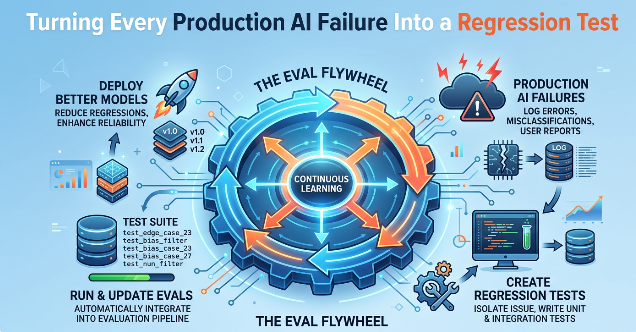
AI systems often miss the mark on handling recurring failures. Introducing the Eval Flywheel: a method to turn AI hiccups into opportunities for improvement.
In traditional software development, there's a solid process to catch and squash bugs for good. But with AI systems, especially the large language models and agentic types, the story is different. They often lack a similar safety net, which means failures can sneak back in without a trace. That's where the Eval Flywheel comes into play.
what's the Eval Flywheel? #
The Eval Flywheel is a strategy that turns every production AI failure into a permanent learning opportunity. How's that achieved? By treating each incident with a rigorous process: triage, label, distill to a reproducible example, and then evaluate using the right strategy. This could be anything from exact matches to LLM-as-judge evaluations. The outcome is added to an evaluation dataset that automatically runs in continuous integration (CI) environments to keep regressions at bay.
Why This Matters for AI #
The real test is always the edge cases. Given the non-deterministic nature of many AI systems, especially those that are agentic or rely on huge language models, these systems don't just need a fix. They need a way to ensure the fix sticks. Think about it: how often has an AI product you've interacted with repeated the same bizarre mistake? That's exactly what this approach aims to curb.
Pipeline and Practicality #
Here's where it gets practical. The Eval Flywheel isn't just a high-minded concept. It proposes a full-blown pipeline, from capturing incident traces to CI gating and feeding successful resolutions back into the testing suite. This includes choosing the right type of grader for each failure, whether it's concurrency issues, citation reliability, or complex fraud detection.
But let's be clear. In production, this looks different. While the idea is sound, the execution can get messy. Eval bloat and unreliable grading by LLMs are just some of the hurdles. Some cases might get stale, and the organizational will to maintain this discipline might wane. But these challenges don’t eclipse the potential benefits.
The Upside and the Catch #
There are pros and cons to adopting the Eval Flywheel. On the plus side, it can create a more resilient and trustworthy AI deployment. The catch is, it requires ongoing commitment and adaptability. It's not a one-off test suite. It's a living, breathing part of your AI toolkit. And if you're in the business of deploying AI, isn't that what you want? A system that learns from its mistakes and gets better over time?
Get AI news in your inbox
Daily digest of what matters in AI.