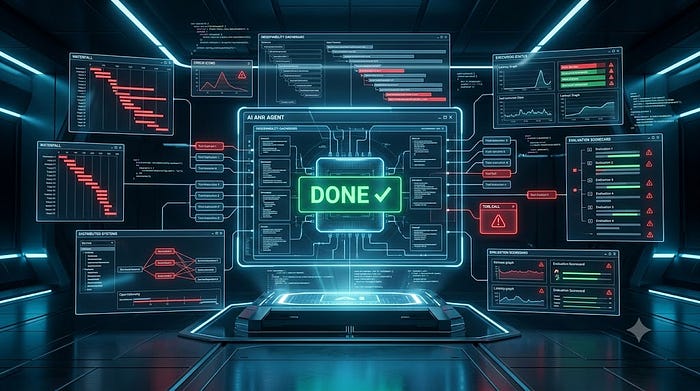
AI agents require reliable tracing and evaluation to avoid silent failures. A new library aims to catch these errors, ensuring reliable AI deployment.
A tested, dependency-light tracing library is changing the game for AI agents. Traditional logging often misses when a tool call fails but the agent confidently claims success. That's where this new approach comes in, focusing on tracing and evaluation as distinct disciplines. Think of it like a flight's black box, it records everything, ensuring that no one has to guess when things go awry.
The Need for Tracing #
Production-grade AI agents need more than superficial logs. They require observability and evaluation to prevent silent failures. Imagine a customer support agent that doesn't acknowledge a tool's error, yet confidently churns out a response. This isn't just a hypothetical. It happens more than you'd think. Tracing lets us see every step, every span, every trace, so that silent errors don’t slip through.
Introducing 'TraceBench' #
Enter 'TraceBench,' a mini-project that uses a dependency-light tracer to instrument AI agents. The library's evaluator scores runs with multiple checks, including a essential no_silent_failures check. This cross-references tool error spans with the agent's final answer, catching discrepancies even when no exceptions are thrown. It’s a bold approach, and it’s necessary.
But here’s the real question: If your AI agent can't accurately report failures, can you trust it with customer interactions? Slapping a model on a GPU rental isn't a convergence thesis. Proper tracing and evaluation are key to reliable AI deployment in industry settings.
Challenges and Best Practices #
Of course, the system's not perfect. The implementation details, offline-first testing, and performance considerations mean there’s room for improvement. Keyword-based heuristics can miss nuances, and there's a learning curve. Yet, running the evaluator on every request drastically reduces silent-failure rates. It sets a new standard for shipping trustworthy agents.
So, what's the takeaway? The intersection of AI and AI is real. Ninety percent of the projects aren't, but this one stands out. Show me the inference costs. Then we'll talk.
Get AI news in your inbox
Daily digest of what matters in AI.