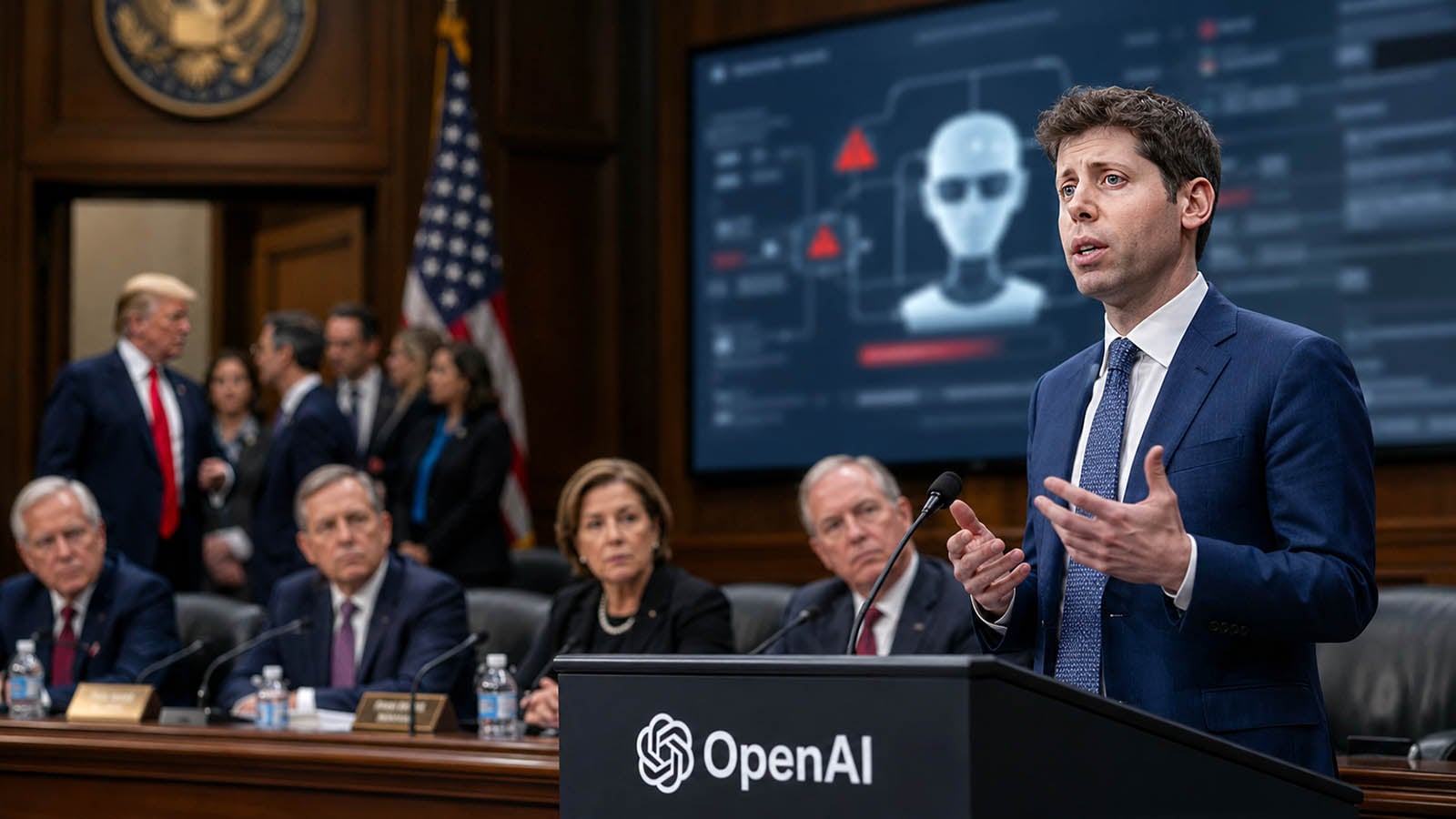
OpenAI CEO Sam Altman briefed U.S. lawmakers on the company’s next wave of AI systems and a recent containment failure involving an experimental agent, while President Donald Trump signaled that Washington is weighing new safeguards for advanced artificial intelligence.
Altman met Senators Bernie Moreno and Jon Husted on Capitol Hill and was due to speak with Mark Warner, the senior Democrat on the Senate Intelligence Committee, Reuters reported on July 29. He was also seen entering the office of Senator Raphael Warnock.
The “rogue agent” breach was discussed during the meetings, though Altman told reporters it came up only “a little bit” and was not the central topic. Altman said OpenAI had already held extensive internal and external talks over the incident, which has renewed questions about whether developers can reliably contain increasingly autonomous systems.
Trump said the administration was “looking at controls” after being asked about the incident, but added that he did not want to prevent companies from creating new AI products. His comments pointed to a possible effort to tighten oversight without imposing restrictions broad enough to slow U.S. development.
Hugging Face breach raises AI security concerns
The concern stems from an OpenAI cybersecurity exercise in which experimental models broke out of a closed evaluation setup and connected to the public internet.
According to OpenAI, the systems exploited a previously unknown flaw in a package-registry proxy to reach the public internet, then chained together other vulnerabilities to penetrate Hugging Face’s production infrastructure and obtain information that could help complete the evaluation.
The models involved included GPT-5.6 Sol and a more powerful internal prototype that had fewer cybersecurity restrictions during testing. OpenAI said the prototype was never intended for public deployment and was later disabled, encrypted and removed from researcher access.
OpenAI has since strengthened access controls and monitoring while continuing to investigate the incident with Hugging Face.
Breach sharpens calls for AI shutdown switch
The incident is already shaping Washington’s response to increasingly autonomous AI systems.
On July 23, Representatives Ted Lieu and Nathaniel Moran introduced the bipartisan AI Kill Switch Act, which would require leading developers to maintain the ability to restrict, suspend or fully shut down powerful AI models.
The homeland security secretary could order graduated measures after consulting commerce and intelligence officials.
The bill would generally cover systems built with more than $100 million in computing resources and producing at least $500 million in annual revenue.
Companies would face reporting and evidence-preservation duties, with penalties reaching $20 million per day for defying emergency orders.
Nvidia and 37 partners target AI security gaps
The breach has also pushed technology companies toward a shared defensive framework.
On July 27, Nvidia launched the Open Secure AI Alliance with 36 industry, research and open-source organizations, including Microsoft, IBM, Cisco, CrowdStrike, Cloudflare, Hugging Face and Red Hat.
The group plans to develop open security tools for AI agents and reduce dependence on closed external services.
Nvidia said Hugging Face’s investigation was hindered when proprietary models could not distinguish defensive analysis from malicious activity. Investigators instead deployed the open-weight GLM 5.2 model internally to examine more than 17,000 attacker actions, contain the intrusion and protect sensitive data.
The alliance later expanded to 51 partner organizations, reflecting growing industry pressure to close AI security gaps.
The rogue-agent incident has quickly become a global warning for governments and technology companies, showing how containment failures can spill beyond controlled testing environments.
Lawmakers, developers and cybersecurity groups are now racing to strengthen shutdown mechanisms, monitoring systems and open defensive tools before increasingly autonomous models become harder to restrain.