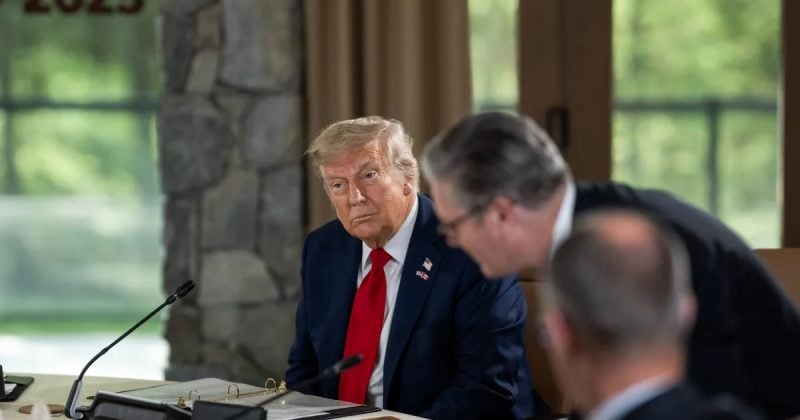
Via whitehouse.gov
The US president's deregulation-first approach to artificial intelligence governance could reshape how AI tokens and tech investments compete for capital.
President Trump used the G7 Summit in Évian-les-Bains, France, to spotlight voluntary AI safety testing frameworks, gathering CEOs from Google DeepMind, OpenAI, and Anthropic for a working lunch that doubled as a policy showcase. The event, held around June 17, 2026, featured Demis Hassabis of Google DeepMind prominently, signaling that the administration views private-sector cooperation, not heavy-handed regulation, as the path forward for AI governance.
What actually happened at the summit #
Trump hosted a focused session with leaders of the world’s most powerful AI companies alongside G7 heads of state. The conversation centered on establishing global norms for deploying advanced AI models safely and quickly.
Trump’s “Winning the Race: America’s AI Action Plan,” published on July 23, 2025, laid out a framework that prioritizes innovation, infrastructure investment, and international diplomacy over the kind of prescriptive regulation that European policymakers have historically favored.
By early August 2026, the administration had followed through by initiating voluntary safety testing frameworks for advanced AI models. Google, OpenAI, Anthropic, and Meta are all participating. No mandates, no compliance deadlines, no penalties.
Sam Altman of OpenAI and Hassabis were both present at the summit discussions, representing two of the most well-funded players in the generative AI race.
The crypto angle nobody is talking about #
The G7 AI discussions contained zero mentions of crypto tokens, blockchain infrastructure, or any of the AI-crypto crossover projects that have captured significant market attention over the past year.
The regulatory clarity emerging from events like the G7 Summit benefits established AI companies directly. Google, Meta, OpenAI, and Anthropic get a faster path to deployment with fewer bureaucratic obstacles. Crypto-native AI projects, meanwhile, exist in a regulatory gray zone that the current framework doesn’t even acknowledge.
What this means for investors #
For crypto investors, the calculus is more complicated. Capital flows follow clarity, and right now, AI governance is getting clearer while crypto regulation in the US remains a patchwork of enforcement actions, proposed legislation, and executive orders that sometimes contradict each other. Watch for whether subsequent policy announcements from the Trump administration begin to address the intersection of AI and blockchain more directly. The July 2025 action plan focused on infrastructure and deregulation broadly, but future iterations could either legitimize or further marginalize tokenized AI projects.
Meta’s inclusion in the voluntary safety testing group alongside OpenAI and Google is worth monitoring. Meta has been more crypto-friendly historically than its peers, and its participation in both AI governance and digital asset experimentation could eventually create a bridge between the two policy conversations.
Disclosure: This article was edited by Editorial Team. For more information on how we create and review content, see our