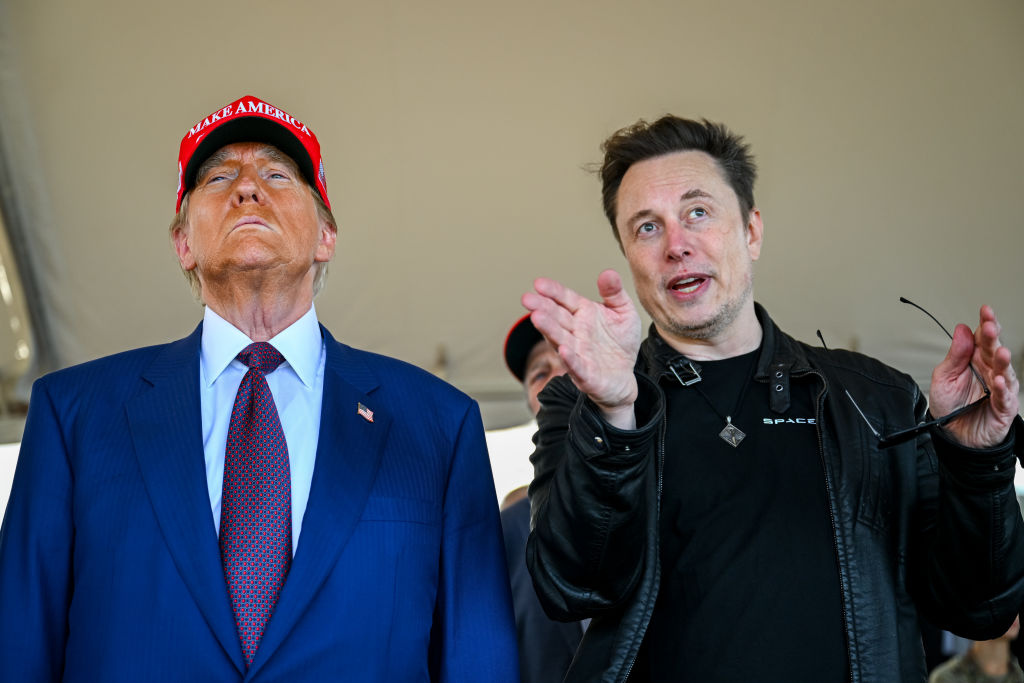
Donald Trump and Elon Musk recently made headlines over an issue we don’t typically associate with this president of the United States and a tech CEO: history.
On July 22, Musk posted on X, the social media platform he owns, that his generative artificial intelligence model Grok would produce, by year’s end, a feature-length movie of “The Odyssey” that is “historically accurate and true to the art of Homer.” Two days later, Trump issued an executive order mandating that signage be placed on the exterior of Smithsonian Institution museums, alerting visitors to the “inaccurate information” conveyed in the displays within, and directing them to “locations and resources for accurate information regarding America’s history.” Striking in these two apparently unrelated episodes is one word in particular — accuracy — and important lessons museums and historians can learn to combat these attacks on the integrity of historical research.
While frenemies Trump and Musk have a complicated relationship, both continue to be involved in a large-scale transformation of government by means of its fusion with corporate interests, and particularly with corporate investment in AI. There is an important, material connection between these incidents: AI. While frenemies Trump and Musk have a complicated relationship, both continue to be involved in a large-scale transformation of government by means of its fusion with corporate interests, and particularly with corporate investment in AI.
In the same week that the pair were ranting over historical “accuracy,” Michael Kratsios, the president’s science adviser, proposed overhauling the government’s approach to funding the sciences. His plan would leave that role to corporations and private philanthropists instead. Kratsios is not a scientist; his previous experience includes working at an investment fund run by Peter Thiel and for the Department of Government Efficiency under Musk. Among the priority areas Kratsios promotes for this new funding model are AI, quantum computing and robotics. And on the same day he introduced his proposal, Kratsios announced the winners of research grants from the Genesis Mission, the administration’s AI initiative.
While this push to redirect the country’s scientific research has incited alarm, reactions to interventions in the historical humanities have been more muted. Yet attacks on public museums and on creative retellings of historical narratives are just as dangerous to the health of this country’s democracy. When he testified on July 21 before the Republican-led House Oversight Subcommittee on the perils of government intervention in the Smithsonian’s activities, David Blight, a professor of American history at Yale University, offered a righteous defense of his profession. Besides highlighting the need for close engagement with history to lead to richer understandings of the past, Blight said it was necessary to disturb the questionable stories — those supposedly incontestable truths that the Trump administration insists are more “accurate” — that have been ingrained in our cultural memory. “If we’re not careful,” he warned, “we will end up with what the great writer Toni Morrison called ‘statist history.’ And it will create what she called ‘sanctioned ignorance.’”
AI has become a blunt instrument in the enterprise to impose precisely this form of sanctioned ignorance about America’s past. The signs Trump proposed for the outside of the Smithsonian suggest vaguely that there is another, more “accurate” history to be found elsewhere, and generative AI is exactly what Musk is proposing to provide this. Taken together, their plans amount to a one-two punch, history in the hands of the corporate state.
Start your day with essential news from Salon. Sign up for our free morning newsletter, Crash Course.
The federal government’s prospective disinvestment in the sciences has long been the status quo for the humanities, with corporate foundations and private philanthropy providing the main funding sources. Media outlets have recently been reporting on partnerships between museums, historical image collections and AI firms. A recent Financial Times article pointed to the prevalence of AI companies throwing struggling museums a “lifeline” by promising to bring in new audiences attracted by the prospect of chatbot-led “personalized” tours, along with other glitzy experiments.
It may be tempting to see value in projects such as the Schmidt Foundation — that’s Eric Schmidt of Google — funding a fellowship in AI at the Metropolitan Museum of Art, or the Musk Foundation’s support of the Scroll Prize to use AI in reconstructing ancient texts in the burnt scrolls of Herculaneum. But these projects are simply two among countless others that have been seeding AI into museums and historical research for well over a decade. Even more egregious is the case of AI companies buying and destroying rare books en masse in the process of scanning them for data. In the context of the dire austerity we are witnessing, the juggernaut of tech money seems impossible to resist. But the public should know the dangers of ceding the precious work of peering into the past to those whose chief aims are to exploit it for data and build visions of our collective history to their own liking.
Our Summer sale is on!
It is a fact that AI is inherently incapable of producing an accurate image of the past. The data on which image recognition and generative models are based rely on statistics and probability to arbitrate the truth. Algorithmic mediation of the past means that the greatest weight will be given to what privileged institutions have already been able to preserve in the greatest numbers.
In other words, AI is unable to treat evidence — or people — equally with context and knowledge of how that evidence relates to the inequities built into museums and image archives themselves. Yet the more space we grant to Big AI, in partnership with an authoritarian state, into institutions of historical research and public communication about history, the less able we will be to find our way toward historical accounts that have fallen into the cracks of algorithmic data sets.
No amount of feeding them more data will make them better able to offer a vision of history that is more accurate to the past and an essential part of our striving toward a more equitable future. That fact alone threatens the future of democracy.
Read more
about Trump’s war on history