The Trump administration is preparing another step in its effort to reduce China’s role in critical US technology infrastructure, with officials drafting restrictions on imports of some Chinese-made components used inside data centers that support AI workloads.
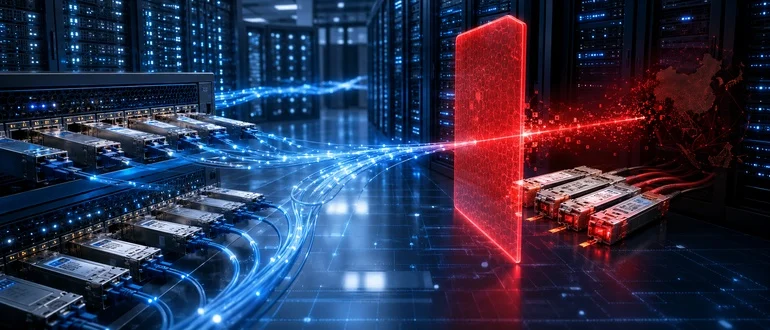
The Federal Communications Commission (FCC) is developing a proposal that would prohibit imports of new models of Chinese optical transceivers, networking components that transmit data over fiber-optic cables linking servers throughout today’s data centers. The measure has not been finalized and could still be revised or withdrawn, but officials are aiming to publish the rule before the end of the year.
Optical transceivers have become an essential element of AI infrastructure. The devices convert electrical signals into optical signals and back again, allowing enormous volumes of data to move between servers at extremely high speeds. As hyperscale operators expand facilities to train and run LLMs, these components play a central role in enabling low-latency communication across thousands of GPUs and networking switches.
The proposed restrictions reflect growing concern within Washington that Chinese-made networking hardware could introduce cybersecurity and supply chain risks into the infrastructure underpinning the US AI industry. Officials reportedly fear that compromised equipment could provide opportunities for data theft or disruption of services supporting AI applications.
Follows Recent Restrictions
The proposal is the latest expansion of a US strategy to limit Chinese technology in critical infrastructure. Recent actions have included restrictions on Chinese humanoid robots and power inverters, while policymakers have also examined potential limits on Chinese open-source AI models. In sum, the approach extends beyond semiconductors to the networking, power and infrastructure technologies required to support AI deployment.
Unlike export controls aimed at advanced AI chips, the latest proposal focuses on the networking layer that connects data centers. Beyond servers and GPUs, AI facilities depend on fiber-optic networks, optical transceivers, switches, storage systems and power equipment operating as an integrated platform. Securing each layer of that infrastructure has become a growing priority as billions of dollars are committed to expanding US AI capacity.
Clearly, the initiatives will run into a key challenge: balancing security objectives with the practical realities of global tech supply chains. Chinese manufacturers account for a significant share of the worldwide optical transceiver market, and many operators rely on those components because of their availability and competitive pricing. Replacing those products could increase costs while complicating procurement for US companies building new AI data centers.
Additionally, enforcement may prove difficult. Components can move through distributors, subsidiaries and third-party suppliers, making it complicated to identify a product’s origin throughout the supply chain. In addition, some categories of networking and power equipment currently have limited alternatives capable of matching Chinese suppliers’ production volumes.
China has opposed recent US technology controls and warned it would respond to actions that materially harm its interests. Washington, however, has encouraged allies to adopt similar supply chain safeguards, raising the possibility that restrictions on Chinese AI infrastructure components could expand beyond the US.