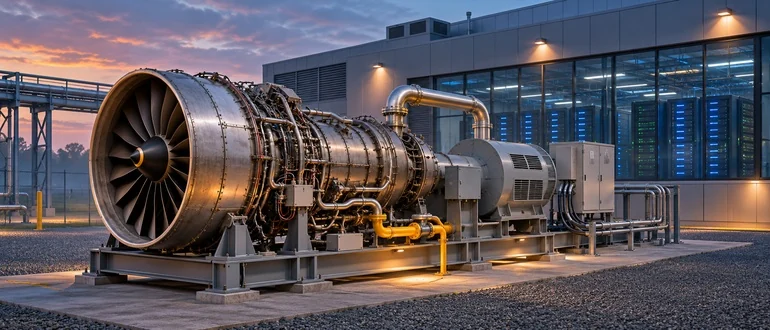
AI data center operators are turning to an unconventional source of electricity: retired commercial aircraft engines converted into natural gas generators. The technology offers a relatively fast way to power massive computing facilities, though the approach raises concerns about pollution and long-term efficiency.
The reuse of jet engines, as first reported by the New York Times, is yet another example of a major challenge facing the AI industry. While tech giants are spending billions on advanced GPUs and data center construction, obtaining enough electricity to operate the infrastructure has become a growing problem.
For Elon Musk’s xAI, the power shortage could complicate its expansion plans. Musk has said the company intends to increase its data center capacity sevenfold by the end of 2027. xAI has installed eight converted jet turbines at its Mississippi data center, using equipment supplied by Missouri-based ProEnergy. Each turbine can generate up to 50 megawatts (MW) of electricity, equivalent to the power required by approximately 15,000 homes. Remarkably, a July 2026 BloombergNEF forecast projected that data centers could consume 20% of U.S. electricity by 2035. The firm also sharply increased its estimate of how much data center capacity will be built by that year, raising its previous forecast by 83%. An April 2026 report estimated that 30% to 50% of U.S. AI data center projects scheduled for completion that year could face delays or cancellation, with electricity availability among the contributing factors.
Old Engines Find a New Market
The voracious demand for electricity has created a business opportunity for aviation companies that previously sold retired aircraft engines primarily for spare parts or reuse in other planes. ProEnergy converts General Electric aircraft turbines into generators that can operate on natural gas or diesel. The process involves removing components used for aircraft propulsion, modifying the combustion system and connecting the turbine to electrical generation equipment.
FTAI Aviation has also entered the market, converting engines previously used in Boeing 737 and Airbus A320 aircraft. In July, an FTAI joint venture signed a $1.5 billion agreement to supply converted turbines to a data center developer. FTAI is modifying its Montreal facility to support production, while Boom Supersonic is pursuing data center power generation as an additional market for its engine technology.
The benefit for data center developers is shorter lead time. Conventional power infrastructure can require years of development, while converted aircraft turbines offer an alternative for operators facing long utility connection delays. But the economics aren’t all positive: older aircraft turbines generally consume more fuel per unit of electricity than modern power plant equipment, potentially raising operating costs.
Pollution Concerns
The environmental impact of these recycled engines is already generating legal opposition. Mississippi regulators have authorized eight converted turbines at xAI’s data center in Southaven, Mississippi, under permits allowing carbon monoxide emissions at twice the rate permitted for other turbines at the facility. The permits also allow 25% higher emissions of volatile organic compounds.
The Southern Environmental Law Center has challenged the approvals, questioning whether the generators meet applicable pollution standards, including requirements involving formaldehyde. The organization also alleges that xAI underestimated projected emissions.
In separate litigation brought on behalf of the NAACP, the organization challenged xAI’s operation of other gas generators without required permits. The legal dispute took a major turn in late October when a federal judge ruled that temporary gas turbines operating at xAI’s Southaven facility require air permits, rejecting the company’s argument that they qualify for an exemption covering mobile equipment. The judge also allowed the NAACP’s lawsuit to proceed.
The dispute highlights an ongoing conflict between rapid AI infrastructure development and environmental protection. The Trump administration has encouraged data center developers to produce their own electricity rather than depend entirely on utility grids. Yet the xAI case demonstrates that this strategy can create new environmental concerns, particularly when operators rely on older, less efficient gas turbines that produce higher levels of air pollution.