TL;DR — Key Takeaways
– Russia is strengthening data center defenses. New guidance recommends underground or bunker placement for strategic facilities, along with camouflage, reinforced structures and drone defenses for existing sites.
– Ukrainian strikes have disrupted essential digital services. Attacks on facilities serving Yandex, Sberbank and VKontakte have affected banking, e-commerce, ride-hailing and cloud services.
– Damage could slow Russia’s AI development. Sanctions complicate replacement of advanced computing hardware, while concentrated infrastructure increases exposure to further attacks.
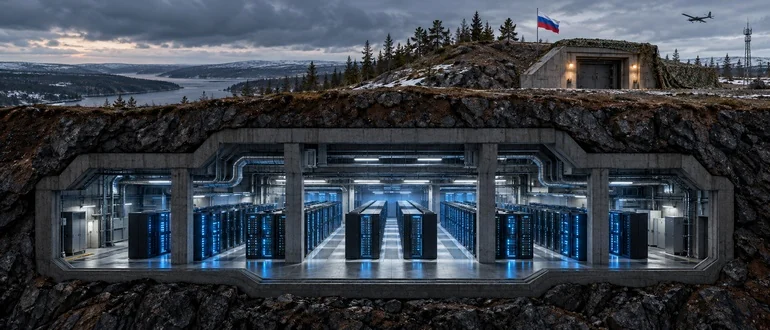
Russia is telling data center operators to start shoveling. The country’s Digital Development Ministry says new data centers should be built underground while existing ones should be camouflaged and equipped with drone defenses following a series of Ukrainian attacks in recent weeks. Russia also is moving three supercomputers to safer ground. The underground sites could include open-pit mines and quarries, a measure proposed by the governor of Kemerovo Oblast.
Russian data centers and digital infrastructure are particularly prone to service disruption because Russian “sovereign internet” law requires data to be stored domestically. Among the data centers hit in October are three main data centers belonging to tech giant Yandex, another belonging to the bank Sberbank, and a third belonging to VKontakte, the Russian equivalent of Facebook. Media reports also say the Russian Finance Ministry, the repository for tax databases and state registry data also has been targeted. Additionally, Russia has relocated three supercomputers responsible for Yandex service infrastructure and large language model training, according to the independent Institute for the Study of War (ISW).
The Ukrainian strikes have disrupted dozens of services across Russia, Belarus and Kazakhstan like banking apps, payment processing, e-commerce, ride-sharing, the Alisa virtual assistant and judicial arbitration sessions. The strikes also have set back Russian aspirations to be a player in AI development as sanctions make key computing hardware difficult to replace.
Russia’s Digital Development Ministry has announced a new set of priority guidelines organized in three tiers for data center defense. The top tier are data centers that would disrupt government activities for an hour or more. The second tier includes regionally or economically important data centers experiencing disruption for over four hours. At the bottom rung are corporate data centers where disruption isn’t a significant threat to the state.
The Ministry recommends that existing data centers take a layered approach to their defense by reducing visibility from the air and adding reinforced structures, electronic warfare systems and active drone defensive measures. It’s estimated that 80 percent of Russia’s data centers are in the Moscow region which puts them in easy range of Ukraine. Adding to the challenge is that even small strikes can be extremely damaging to electronic chips susceptible to smoke and soot from fires.
Russia also has targeted Ukrainian data centers, some of which have had extensive damage, including one operated by Datagroup near Kyiv that was declared damaged beyond repair. Unlike centralized Russia, however, Ukraine has dispersed critical data to servers in Europe, thereby reducing the instances of disruption.
Data centers have emerged as key targets during armed conflicts, a development that can be probably traced back to a series of drone attacks by Iran on data centers earlier this year. Two AWS data centers in the UAE and one in Bahrain were among the first targeted with additional digital infrastructure linked to American companies added to a target list published by Iran.
The targeting of data centers is likely to continue as AI becomes more important in military affairs. “As AI becomes more pervasive in warfare, the infrastructure enabling intelligence will increasingly come under threat,” said Helima Croft, head of global commodity strategy and MENA research at RBC Capital Markets, in a recent analysis.