TL;DR — Key Takeaways
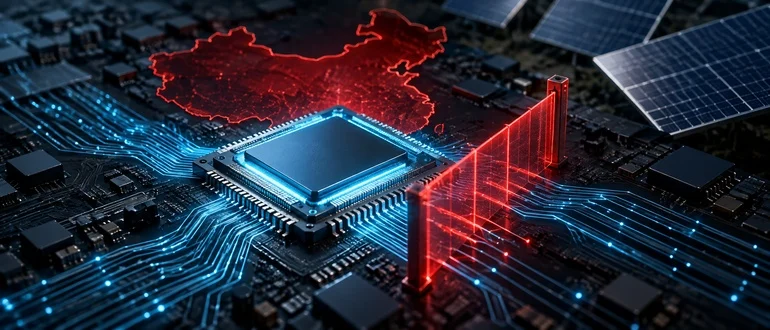
– China is proposing export bans or restrictions on 40 technologies across AI, solar energy and biotechnology.
– The proposal targets transfers of advanced technology, potentially complicating access to model weights, code and future updates.
– API access would generally continue, but buyers face new questions about supplier dependencies and switching costs.
China plans to restrict or ban the export of 40 critical technologies spanning artificial intelligence (AI), semiconductor design, and renewable energy in a hardening of its tech governance strategy.
The punitive policy signals a decisive shift in Beijing’s stance from managing domestic AI use to establishing outward controls on Chinese software and intellectual property as its tech rivalry with Western nations intensifies.
Jointly published by the Ministry of Commerce and the Ministry of Science and Technology as Announcement No. 48 of 2026, the draft update to China’s export-control catalogue targets 14 technologies for absolute prohibition and 26 for strict licensing restrictions.
A commerce ministry spokesperson called the measure “necessary,” pointing to national security, the prevention of technological abuse, and the imperative to ensure AI systems remain under human control.
China’s proposal concentrates heavily on advanced computing, placing 23 AI-related technologies on the control list. Among these are large language models containing two trillion or more parameters — such as Alibaba’s Qwen 3.8-Max and Moonshot’s Kimi K3 — or those ranking in the global top 10 on performance and safety benchmarks. Prohibitions also extend to AI agents built for sensitive environments like national defense, core model weights trained on national security data, and cutting-edge chip design methodologies.
Beyond AI, the restrictions cover 12 solar energy technologies — including next-generation perovskite cells and polysilicon manufacturing — and five advanced biopharmaceutical fields, such as cell and gene therapies.
Analysts view the move as a direct response to years of U.S.-led restrictions that restricted Chinese access to high-end semiconductors and advanced chipmaking machinery.
“Restrictions on AI technology exports can affect where enterprises run models and how they access future versions. API access and the ability to deploy a model yourself are different things. Customers need to understand which they are buying and what could change,” said Stephanie Walter, practice leader for AI Stack & Enterprise Application Development at HyperFRAME Research.
“The proposal’s final scope matters, so I would not assume every Chinese model is affected,” Walter said. “But this adds a concrete consideration to model selection: can you keep operating if access changes? Switching models takes testing and engineering work. That cost belongs in the buying decision alongside performance and price.”
Mitch Ashley, vice president and practice lead for Software Lifecycle Engineering and AI-Native Software Engineering at The Futurum Group, said export controls “now run in both directions, which makes the origin of AI and semiconductor design technology a condition of purchase. Buyers who choose suppliers on price and performance need to know which jurisdiction can cut off supply, updates, or support.”
“Answering that means mapping dependencies below the first supplier tier,” Ashley added. “Watch which of the 40 technologies reach the final list and how quickly buyers write country-of-origin terms into contracts.”
Despite the broad scope, the regulation includes notable carve-outs designed to shield commercial operations. Technologies already available in the public domain via open-source channels or academic literature remain exempt. Crucially, the draft distinguishes between structural technology transfers such as selling model weights, licensing code, or overseas M&A, and routine service delivery. Standard API and Software-as-a-Service (SaaS) offerings remain uninhibited, allowing Chinese firms to continue serving global customers through cloud interfaces without obtaining individual export licenses.
The policy creates a bidirectional cross-border regime. As Washington, D.C., restricts hardware flow into China, Beijing will now tightly manage the outflow of frontier software and technical IP.
While the public comment period for the draft catalogue runs through Nov. 15, interim registration rules went into effect immediately upon announcement. Cross-border transactions, technology transfers, or changes in corporate control initiated prior to the announcement must now comply with the registration requirements, signaling Beijing’s urgent priority to safeguard domestic tech assets.