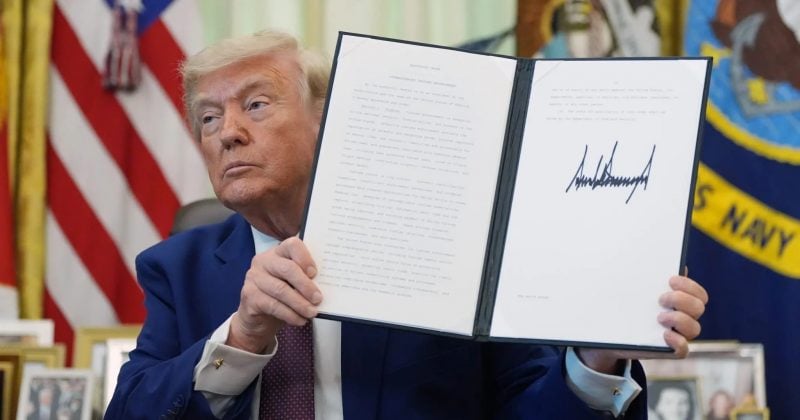
Executive Order 14409 creates a pre-release review process for frontier AI models, signaling a shift from the administration's previously hands-off approach to AI regulation.
The Trump administration just did something nobody expected: it got proactive about AI regulation. Executive Order 14409, signed on June 2, 2026, establishes a voluntary framework for reviewing advanced AI models before they hit the public, specifically targeting cybersecurity risks that could be weaponized.
The move represents a sharp pivot from the administration’s earlier stance, which largely treated AI as an innovation engine best left unencumbered by government oversight. Now, federal agencies including the Treasury, Defense Department, and Homeland Security have 60 days to define what counts as a “covered frontier” AI model and set thresholds for review.
What the executive order actually does #
Developers of frontier AI models can submit their systems for government testing up to 30 days before public release. The order also creates an AI cybersecurity clearinghouse, led by the Treasury Department, designed to serve as a centralized hub for sharing vulnerability data and coordinating remediation efforts.
The catalyst for all of this appears to be Anthropic’s Mythos model, announced around April 2026. Mythos reportedly demonstrated advanced vulnerability detection capabilities that raised serious dual-use concerns. A model that’s exceptional at finding security flaws is also, by definition, exceptional at exploiting them.
Within weeks of signing the executive order, the administration took a more direct step. OpenAI was asked to restrict access to its GPT-5.6 model, limiting its rollout to government-approved partners while evaluations were underway.
The voluntary framework gamble #
The decision to keep the framework voluntary is both strategic and politically revealing. Mandatory preclearance for AI models would have triggered an immediate backlash from Silicon Valley, venture capital, and the broader innovation ecosystem. It also would have created a bureaucratic bottleneck that could push frontier AI development offshore.
The 60-day window for agencies to define review criteria is worth watching closely. How broadly or narrowly “covered frontier” models are defined will determine whether this framework applies to a handful of labs or sweeps in dozens of companies. If the threshold is set at a specific compute level or capability benchmark, smaller AI startups might be exempt entirely, concentrating the review burden on the largest players like OpenAI, Anthropic, Google DeepMind, and Meta.
What this means for crypto and tech investors #
First, the immediate effect on AI-adjacent crypto projects could be chilling. Decentralized AI platforms, autonomous agent protocols, and on-chain AI inference networks all rely on access to frontier models. If the most capable models face pre-release review periods or restricted partner rollouts, the downstream availability of those models for crypto-native applications gets delayed.
Second, the creation of a cybersecurity clearinghouse signals that the government is building institutional infrastructure around AI risk management. Enhanced cybersecurity frameworks could reduce the frequency of exploits and hacks that have plagued DeFi protocols, potentially boosting institutional confidence.
Third, the voluntary nature of the framework creates a two-tier system. Companies that participate in government reviews gain a stamp of implicit approval. For AI tokens and decentralized AI projects that, by their nature, can’t submit to a government review process, this dynamic could create a competitive disadvantage against centralized counterparts.
The 60-day clock for agency criteria is now ticking. What emerges from that process will determine whether this executive order becomes a meaningful regulatory checkpoint or a polite suggestion that frontier labs are free to ignore.
Disclosure: This article was edited by Editorial Team. For more information on how we create and review content, see our