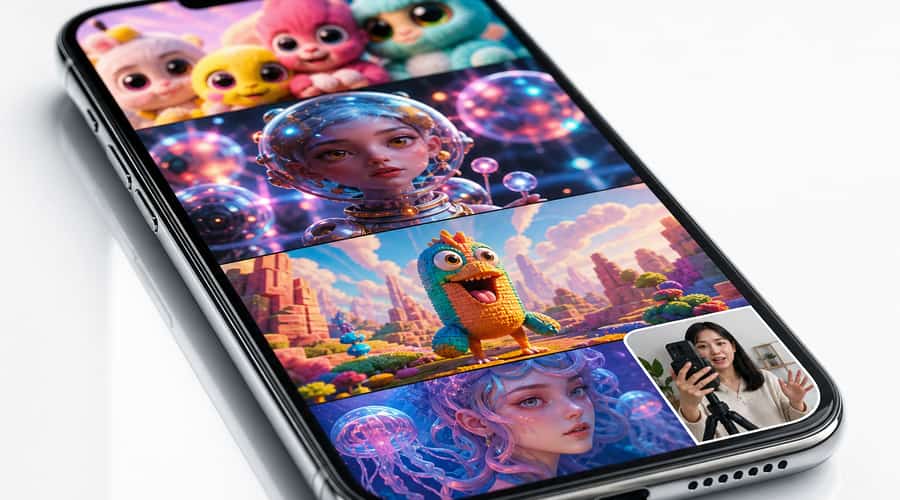
Kapwing's new TikTok sample says AI slop is no longer a fringe problem on the For You page, and advertisers shouldn't treat brand safety as a checkbox exercise.
If you opened a fresh TikTok account in May 2026 and let the For You page do its work, Kapwing says you were more likely than not to be served synthetic junk. The video-editing company said its TikTok AI Slop Report reviewed 10,742 videos across 20 categories and found that 294 of the first 500 videos shown to a newly created account were AI-generated or low-quality compilations built with AI scripts, synthetic visuals and voiceovers. That's 59%. You don't need to be hostile to AI to see the problem.
Kapwing's comparison point is YouTube Shorts, where it put the rate near 21%. That number lines up with an earlier Kapwing finding reported by The Guardian in December 2025, when a new YouTube account was shown 104 AI slop videos among its first 500 recommendations. The YouTube story already looked ugly enough. TikTok's reported rate is worse because the For You page is the product, not a side entrance to it.
The children's figures are the part that should make advertisers sit up. Kapwing said 57% of the 2,000 videos it examined in TikTok's kids category were AI-generated. In #CartoonKids, it said 97 of the top 100 videos were synthetic. #cartoons and #babysong were both at 83%, while #forkids came in at 79%. These aren't obscure tags buried in some weird back alley of the app. They are the labels parents and children actually use.
There is a fair caveat here. Kapwing sells video creation tools, so it has a commercial interest in the idea that human-made video is valuable. Its classification also relied on manual review, not a detector with a public benchmark. Frankly, you should read the exact percentages with that in mind. But the direction is hard to brush away, especially when separate research has been pointing the same way. A 2025 study on TikTok and Instagram search results across Germany, Spain and Poland found synthetic content appearing across political and general hashtags, and The Guardian reported that TikTok had already labeled more than 1.3 billion AI-generated videos by November 2025.
For brands buying ads on TikTok, this is the practical question: what is your ad sitting next to? A platform can sell you reach, targeting and a clean dashboard. It can't make a feed feel trustworthy if the surrounding inventory is being flooded with low-effort synthetic video built to hold attention for six seconds at a time. TikTok knows the issue exists. In May 2024, the company said it would start using C2PA Content Credentials to label AI-made content from other platforms, a move Lifewire described at the time as a first for major video-sharing platforms. In November 2025, The Guardian reported that TikTok was adding controls that would let users reduce the amount of AI-generated content in their feeds through its manage topics settings. The same report said the platform had more than 1.3 billion labeled AI-generated videos and was adding invisible watermarks for content made with some TikTok AI tools.
Those are serious moves. They still don't answer the advertiser's problem.
The weak point is that labeling is easiest when the content comes from a tool that cooperates. C2PA metadata can be stripped when a file is edited or reuploaded elsewhere, which TikTok itself has acknowledged as an industry problem. A cheap cartoon clip generated outside TikTok, cut into a compilation, voiced by a synthetic narrator and uploaded through a normal account is exactly the kind of thing that can live in the gap between policy and enforcement.
The startup opportunity is in the gap #
The more useful startup idea here isn't another tool that helps creators make more video faster. The feed already has enough of that. The better opportunity sits between TikTok's public AI policies and the actual surface where advertisers spend money.
Brands and agencies need independent feed auditing, content provenance checks and placement verification that aren't controlled by the platform selling the ads. That doesn't mean every synthetic video is unsafe or every human video is good. It means advertisers need to know when their campaigns are running beside material that looks automated, recycled or aimed at children through synthetic cartoons and nursery-song tags.
Look at YouTube for the warning. Kapwing's earlier work found AI slop channels with tens of billions of views and estimated annual revenue in the tens of millions of dollars. After that report, The Verge reported in February 2026 that several prominent AI slop channels identified by Kapwing had disappeared or had their videos removed. Platforms can act when the embarrassment is public enough. They are slower when the content is still producing watch time.
Don't wait for platforms to solve this neatly on their own. Their incentive is to keep content volume high, keep users scrolling and keep ad systems liquid. Your incentive, if you're spending real money there, is different. You want the audience without paying to sit beside synthetic clutter that trains people to trust the feed a little less.
That is where the Kapwing report is useful, even if you don't treat every number as gospel. It gives advertisers and founders a concrete brief: audit the feed as it is experienced, not as it is described in policy pages. The synthetic content problem isn't coming later. On TikTok, Kapwing says it is already in the first 500 videos a new user sees.
Also read: Tesla's Megapod trademark signals a serious play to sell AI infrastructure, not just cars • The Wu brothers built a billion-dollar chip empire while everyone watched Nvidia • Micron's sold-out HBM books and 81% gross margins make the June 24 earnings report its biggest test yet