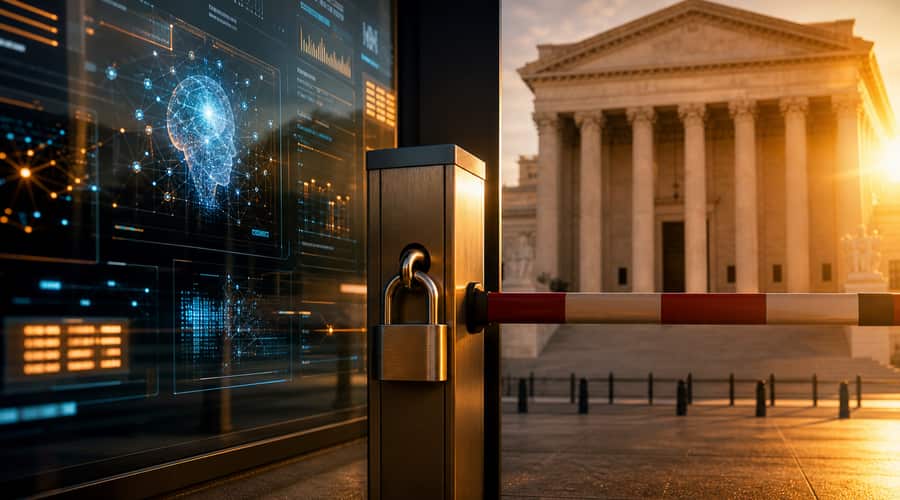
The White House has put a government checkpoint in front of OpenAI's next model, and you should treat that as more than a one-company delay.
Sam Altman told OpenAI employees this week that GPT-5.6 would not go straight into broad release. According to The Verge, early access will go only to a small group of enterprise customers, with the federal government approving users case by case during the preview period. Axios reported on June 25 that the request came from the Trump administration, guided by the White House's Office of the National Cyber Director and the Office of Science and Technology Policy. The Financial Times added a harder detail: roughly two dozen organizations are expected to get early access, with screening involving the Treasury Department, Commerce Department and the White House's cyber and science offices.
This isn't a normal model launch. It's not a safety card, a red-team badge or another voluntary pledge from a company that wants regulators to trust it. It's the US government deciding who gets to touch a frontier model before the rest of the market does.
The security argument is real. Officials are worried that a model strong enough to find software vulnerabilities could also help the wrong user break into systems before anyone has worked out reliable safeguards. You don't have to like the intervention to understand the fear. The Anthropic case made it concrete.
Earlier in June, the US government forced restrictions on Anthropic's Fable 5 and Mythos 5 models after concerns that safeguards around cyber capabilities could be bypassed. Business Insider reported that senior White House officials and Commerce officials were involved in urgent talks with Anthropic. The Verge reported that Chinese-linked actors may have gained access to Mythos, citing Semafor, though the White House did not publicly confirm that claim. Anthropic disputed the government's handling and argued the weakness was narrower than officials suggested. Still, the company took the models offline rather than try to run a launch through a legal fog.
That is the immediate backdrop for GPT-5.6. OpenAI is getting a softer version of the same message: slow down, show us the first customers, and don't assume a powerful model is just another product update. For a company built on the promise that developers can get access when the API says they can, that is a serious change.
The competitive cost is obvious. Google doesn't need to wait for OpenAI's calendar. Anthropic has already been knocked sideways by the Fable and Mythos restrictions. If GPT-5.6 spends weeks in a government-screened preview, every customer building security tools, coding agents or internal automation has to ask a practical question: can you build on infrastructure whose release schedule can be interrupted from Washington?
OpenAI also has the public markets hanging over it. The company said on June 8 that it had confidentially submitted an S-1 to the SEC, according to its own announcement and reports from Axios, Business Insider and The Guardian. Investor's Business Daily reported on June 25 that OpenAI is considering waiting until 2027 before going public, with advisers pointing to shaky IPO conditions and the pressure of huge AI spending. A government-managed launch of your flagship model is not fatal to an IPO story, but it isn't the kind of clean growth narrative bankers prefer.
The checkpoint is the story #
Frankly, the OpenAI drama is less important than the precedent. For years, US AI policy has leaned on voluntary commitments. Companies promised to test, publish, consult and behave responsibly. The government mostly watched from the side, stepping in through export controls on chips and pressure around national security.
Now the government is moving closer to the release button itself. In the Anthropic case, it used emergency restrictions. In the OpenAI case, it has used a request that the company is following. Those are different tools, but they point in the same direction. Frontier AI access is being treated less like a software rollout and more like a controlled export.
That may be necessary. A model with serious cyber capability is not the same as a chatbot that writes sales emails. But the process still looks improvised. Customer-by-customer approval may work for two dozen early users. It won't work if every major frontier release needs a Washington queue, especially when startups don't know the criteria, the timeline or whether larger customers will get waved through first.
If you're building on OpenAI's API, this is the part that should get your attention. The biggest enterprises can absorb delay. They have procurement teams, policy teams and direct lines into vendors. Small teams don't. They plan around launch dates, runway and customer demos. If access to the best model can be d while agencies decide who qualifies, that uncertainty becomes part of the product risk. The government was probably right to take the cyber issue seriously after the Anthropic mess. The harder question is whether the US can replace emergency calls and informal approvals with a clear regulatory structure before every frontier model launch becomes a negotiation. Right now, the checkpoint exists. The rules around it are still catching up.
Also read: Onsemi bets $7 billion in stock on a world where AI runs at the edge, not the cloud • General Intuition raises $320 million on the thesis that video game footage is the most underrated training data in robotics • OpenAI is leaning toward a 2027 IPO as its CFO warns the company isn't ready for public markets