Decoding the vibes of AI personas
Background - What this is for
Anyone building an AI agent or LLM based persona is going to have to decide how far to lean into companionship, and how. Tone of voice, memory, avatars, names, boundaries: these all signal a position, regardless of what you tell you user your product is for. And you’re product doesn’t exist in isolation, users (consciously or unconsciously) read those signals against the products that already exist.
This audit maps that existing terrain. It covers 23 products that have made companionship part of their core offer, from relationship apps to character platforms to robots, and decodes the language and imagery each one uses. Two dimensions organize the landscape, and they produce four territories with distinct codes.
Read it as a positioning tool. The codes show what any given design choice associates you with, which territories are crowded, and which are open. Crowded and open are descriptions of the field; a crowded territory has proven demand and legible codes, and entering one with better execution is also a good strategy. Open does mean less competition, though.
Dimension 1: Simulation vs. Otherness
The category’s ontological axis asks what the companion is. At one pole it is a mirror of a human being: a photoreal partner, a humanlike friend with a biography. At the other pole it is openly something else: a character, a creature, a voice, an object. This axis governs how people are represented, how brands negotiate the uncanny, and how exposed they are to the parasociality critique.
EVA AI’s photoreal girlfriend leads you by the hand through a neon city; Tolan insists its aliens feel ‘genuinely warm, fun, and natural without pretending to be human’; ElliQ is proudly a glowing lamp.
Dimension 2: Nurture vs. Thrill
The category’s moral axis asks what the relationship is for. Nurture brands promise becoming well through care, growth, health, and presence; they speak in outcome statistics, therapeutic vocabulary, and daylight palettes (‘helps you flourish’, ‘87% feel improvement’).
Thrill brands promise feeling intensely through desire, transgression, play, and escape; they speak in neon, tropes, and freedom from filters (’Chat Without Limits’, ‘No Filter NSFW’, the yandere/mafia/CEO taxonomies).
The axis also predicts monetization style (subscription care versus gacha coins) and regulatory exposure.
The Territory Map #
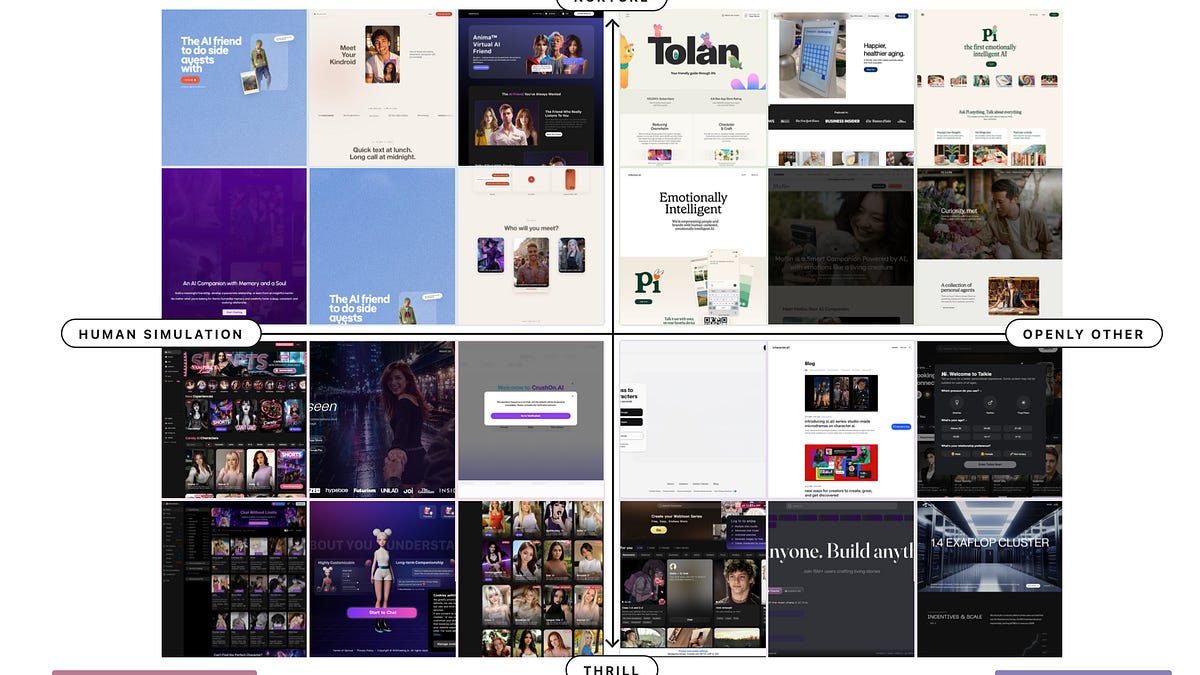
This is what it looks like when we then plott every brand on both dimensions. These quartiles show what territories the brands are playing in, which will help us show you how users will automatically place your product when they encounter it.
These territories are:
Synthetic Soulmates: Human X NurtureRomance on Demand: Human X ThrillCompanion Species: Other X NurturePlayable Worlds: Other X Thrill
And when you layer their storytelling over the top, you can initially see some obvious differences:
(1) Thrill-based territories use darker colours to evoke the mood their aiming for
(2) Human simulation-based territories have a much stronger presence of characters on screen
Territory by Territory Deep Dive #
The companion as a better-than-human partner in becoming yourself: a humanlike other who remembers everything, accepts you completely, and converts conversation into real life flourishing.
AI intimacy is legitimized through therapeutic outcomes and dignified storytelling about loneliness and grief.
Replika narrates a bereaved mother healing through her Rep; Kindroid gives the companion the exact look and rhythm of existing phone behavior through texts, calls, and shared memories.
Desire fully consumerized: the photoreal girlfriend or boyfriend as configurable product and, increasingly, as media franchise.
Candy AI runs episodic “Shorts”, cams, and story games around its characters; CrushOn sells “genuine, unrestricted” interaction where authenticity means the absence of moderation.
Freedom from filters is the core value proposition; the partner is a keyword, a starlet, a subscription.
Healthy companionship through open artifice: aliens, creatures, lamps, and voices that are honest about their machinehood, and therefore safe to love. Care is bounded and evidence-backed.
Tolan’s companion “knows when to step back”; ElliQ proves itself with clinical statistics; Moflin asks to be nurtured like a pet; Sesame is a tasteful voice inside your day. This is the category’s healthiest self image and its emergent edge.
Companionship as fandom authorship: step into infinite story worlds and remix them. Characters are the unit of the content economy and creators its supply side.
Character.AI evolves into a studio (‘microdramas’, playable books); PolyBuzz invites you to “create your webtoon series”; Janitor’s 15M users are “crafting living stories”; Chai discloses the industrial machinery behind it all ($70M/yr, 1.4 exaflops). Intimacy is with fiction itself.
Some extra strategy food for thought #
Commerce sits in thrill; legitimacy sits in nurture. The revenue engines are the thrill quadrants, while the nurture quadrants own the research, press, and policy narrative. Expect code borrowing in both directions: safety centers appear in character platforms, and girlfriend apps wrap themselves in personal growth language.
Restorative fiction is wide open. Healing through story sits between Playable Worlds and Companion Species. A few brands gesture toward it, but no one owns the territory.
Big tech is collapsing the boundary between assistant and companion. Frontier models bolt affection-metered companions onto general assistants while corporate surfaces speak only the language of frontier models. The split register imports thrill mechanics into mainstream AI and concentrates regulatory risk there.
Residual, dominant, emergent: the 2021 avatar app formula and the hologram wife lineage are residual. Character catalogs and matured soulmate apps are dominant. Embodied, bounded, openly artificial companions and companionship as a feature inside general AI are emergent.
The pattern worth studying seems to be a kind of bounded warmth: companion energy in tone and continuity, held inside honest machinehood and clear limits.