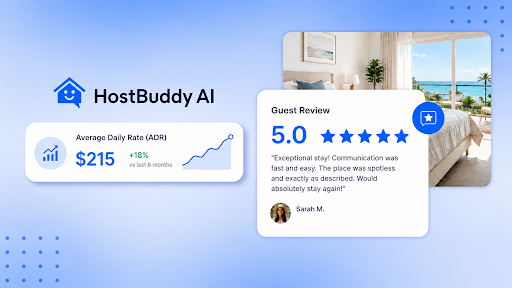
[Sponsored content] UK: In this feature, HostBuddy AI discusses why the value of automated guest communication may extend beyond time savings to stronger reviews and higher average daily rates.
For years, operators have evaluated AI by the hours it saves. A six-month analysis of HostBuddy properties suggests we have been watching the wrong number. Every operator who adopts a new tool asks the same question first: what will this save me? Hours. Headcount. The 11pm reply to a guest locked out on the doorstep. For a decade, that has been the lens through which short-term rental technology gets judged and, by that measure, automation has delivered.
But a recent analysis points to a return that has nothing to do with hours saved.
HostBuddy AI, a platform that helps short-term rental operators deliver fast, consistent guest communication across every stay, spent six months studying how its users actually performed. Working with market data from IntelliHost and KeyData, it compared those properties against carefully matched local comparables.
The result was worth explaining: HostBuddy users generally outperformed their comparables on both review scores and average daily rate [ADR].
Two numbers operators rarely connect, one about guest sentiment and one about revenue, appeared to move together. This article is about why that relationship may exist and what it suggests about the way the industry has measured the value of AI all along.
Because the efficiency case, real as it is, may be the least interesting return on the table.
The return nobody could price #
Ask an experienced host what actually drives the business, and few will say “response time”. They will talk about the guest who rebooked three years running. The review that mentioned a cleaner by name. The feeling a property leaves behind.
Everyone in hospitality knows this matters. Almost no one has been able to price it. Guest experience has lived in a strange category: universally valued, almost never assigned a number. We could count the messages we sent. We could not count what those messages did to a guest’s willingness to pay, to return or to tell the truth in a review. The most important lever in the business was also the least legible.
A chain of cause, not a single metric #
The logic is not complicated. Consistently excellent communication produces better guest experiences. Better experiences produce higher review scores. Higher scores build the one thing that lets an operator raise rates without losing bookings: trust.
Trust is pricing power. And pricing power, over time, is average daily rate.
Follow that chain to its end and review scores stop looking like a vanity metric and start looking like a leading indicator of revenue. The reviews are not the prize; they are the evidence that the experience was good enough to change what the next guest is willing to pay.
The open question has always been whether that chain holds in the real world, across real portfolios. So HostBuddy went looking.
What the data suggests #
Here is what that analysis actually involved. HostBuddy compared a six-month cohort of its users against market comparables built with IntelliHost and KeyData, using the same ZIP code and bedroom count, with enough comparable listings to make the comparison meaningful.
Two questions framed it: How did each property’s review score compare with its market? And how did its ADR compare?
The pattern was consistent enough to sit with. Across the cohort, a clear majority of HostBuddy properties outperformed their local comparables on both measures, recording stronger review scores and higher ADR than nearby listings of the same size.
It was not universal, and that matters. A handful of properties trailed their market on one dimension or the other, a reminder that location, pricing and property quality still do their part, and that no communication layer overrides them. But the direction was hard to miss: where review scores ran ahead of the market, ADR tended to as well.
[Review score vs. market comparison] We will not call this proof of causation. It is not a controlled experiment, and we will not pretend it is. What the data suggests is a strong, coherent relationship: the one experienced operators have always felt intuitively, now visible in the numbers.
Properties that communicate well appear to earn better reviews. Properties with better reviews appear to command higher rates.
The question underneath the numbers #
There is a wider conversation here, and it has nothing to do with software.
Parts of the industry have drifted towards a particular idea of optimisation: extract a little more from every guest, one line item at a time. Charge for the towels. Charge for the coffee. Charge for parking, early check-in and every small convenience. Each fee is defensible on its own. Each one nudges short-term revenue up.
But it is worth asking what those fees actually build. A resort fee has never once made a guest fall in love with a place. Unbundling can lift a quarter. It rarely creates the kind of stay someone talks about a month later.
The goal is not to become the Spirit Airlines of short-term rentals.
The goal is the opposite: a business guests are genuinely excited to return to. Those are two different strategies pointed at two different kinds of revenue. One squeezes the current booking; the other earns the next ten.
The data hints at which the market rewards because the properties pulling ahead on ADR were not the ones charging for more. They were the ones guests rated higher. Delight, it turns out, has better margins than nickel-and-diming.
Why consistency is the hard part #
Exceptional hospitality is easy to deliver once and brutally hard to deliver every time. One property, one attentive host and one great month: that is achievable through effort. Fifty properties, thousands of guests and every message answered with the same care at 2am as at 2pm: that is a different problem entirely.
This is where technology earns its place, and it is worth being precise about how. The value is not that a message gets sent automatically. The value is that the standard never slips.
Whether an operator runs five properties or 500, the guest receives the same considered, on-brand and genuinely helpful communication, the kind that used to depend on which human happened to be awake. Not automation as a labour-saving convenience, but as the mechanism that makes consistency at scale possible.
A better question to ask #
So maybe the question operators have been asking about AI is too small.
“How many hours can this save me?” is a fine place to start. It just is not where the value lives. The more revealing question is this: How much more valuable does my business become if every guest, consistently, has a five-star experience?
That is a harder number to calculate. It shows up in ADR before it shows up anywhere else, and it accrues over years, not weeks. But it is the number that has always separated good operators from great ones, and it is finally becoming something we can watch move.
HostBuddy exists to help operators create those outcomes, not by answering messages, but by making exceptional guest communication a reliable, repeatable part of how a portfolio runs.
The time saved is real. It may also be the least valuable thing HostBuddy does. The most valuable is the guest experience that consistency makes possible and the revenue that has always quietly followed it.
**Highlights: **
- HostBuddy AI’s six-month analysis found that most properties in its cohort outperformed matched local comparables on both guest review scores and average daily rate [ADR].
- The analysis compared properties using market data from IntelliHost and KeyData, matching listings by ZIP code and bedroom count.
- The findings suggest a relationship between consistent guest communication, stronger reviews and the ability to command higher nightly rates, although they do not prove causation.
- AI-powered guest communication can help short-term rental operators maintain a consistent standard of service across larger property portfolios.
- HostBuddy argues that operators should measure the return on AI through guest experience and revenue performance, alongside time and labour savings.