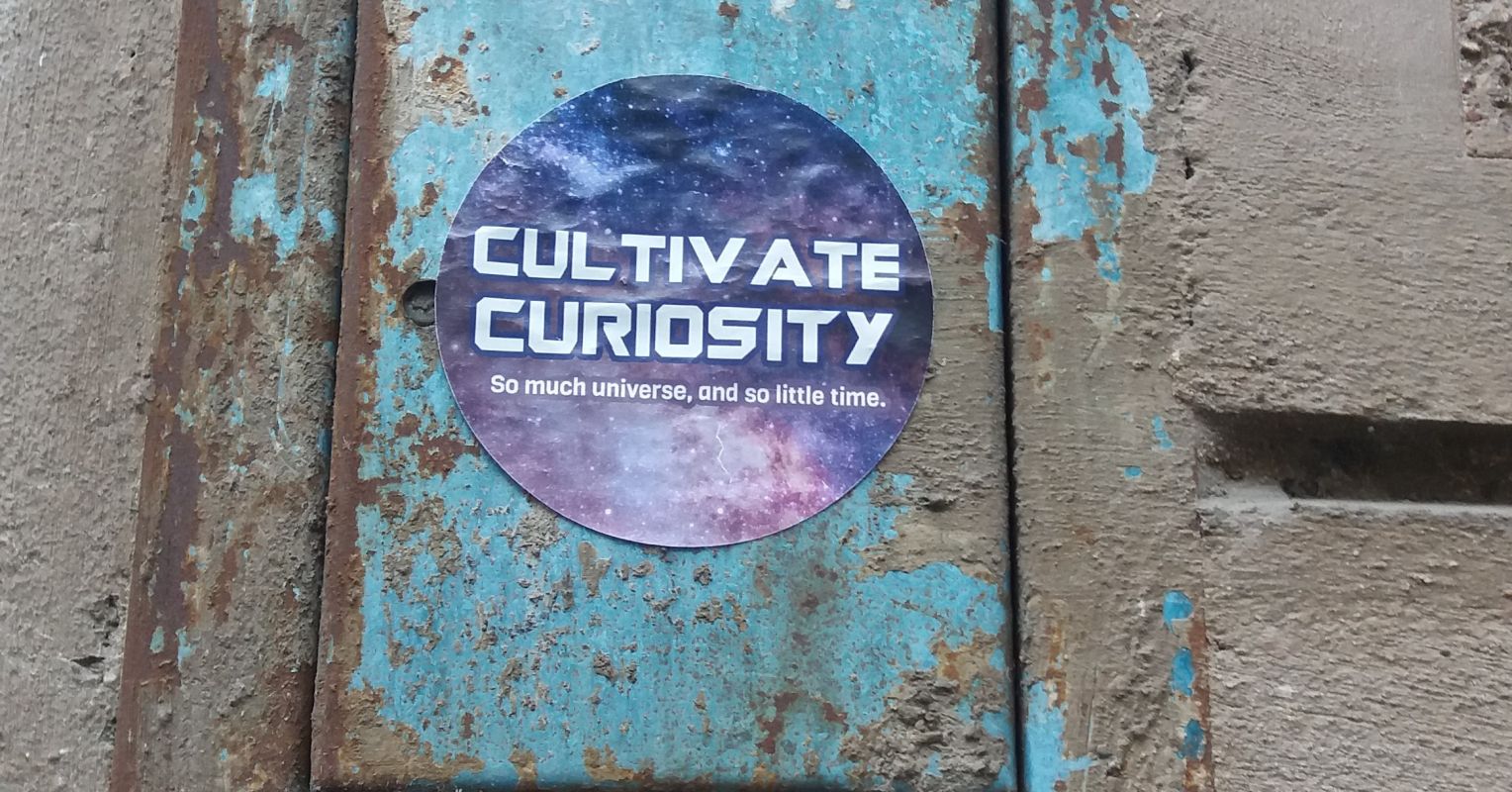
Cultivating inquisitiveness requires space that chatbots close off for us. #
Posted August 19, 2026 [ Reviewed by Monica Vilhauer Ph.D.
](https://www.psychologytoday.com/us/docs/editorial-process)
Key points
- Curiosity is a "superpower" linked to low anxiety, success at work, and a host of other pro-social behaviors.
- The "knowledge gap" between posing a question and finding answers is where true learning occurs.
- AI assistant design must better align with cognitive processes such as cultivating curiosity.
It’s hard to overstate how important the cultivation of curiosity is to our well-being. People who regularly make efforts to cultivate their curiosity “muscle” tend to be smarter, more creative, and more successful than their less curious cohorts. They tend to be more satisfied and successful in their careers. Curiosity also has been correlated with lower anxiety, emotional stability, self-esteem, persistence, conscientiousness, and openness to new experience (Fleischhauer et al., 2009; Spielberger & Starr, 1994). Philosophers ranging from Aristotle to Nietzsche have exhorted people through the ages to cultivate the virtue of curiosity. Indeed, recently one writer even called it a “kind of superpower” (Epstein, 2019).
So it is worrying that the design and use of AI assistants are arguably destroying our digital opportunities to cultivate curiosity. A predominant psychology theory of how curiosity works says that we are hard-wired to seek information because of “knowledge gaps” between what we know and what we want to find out, and that cognitive process is connected to the brain’s reward system. Neuroscience studies have shown that waiting for sought-out information activates the reward circuitry and enhances memory-making (Kang et al., 2009; Frede et al., 2026). And our information-seeking state of mind is quite fickle, as Kang and colleagues write:
“[T]he aspired-to level of knowledge increases sharply with a small increase in knowledge, so that the information gap grows with initial learning. When one is sufficiently knowledgeable, however, the gap shrinks, and curiosity falls. If curiosity is like a hunger for knowledge, then a small “priming dose” of information increases the hunger, and the decrease in curiosity from knowing a lot is like being satiated by information.”
But AI summaries, such as Google’s Overview, can short-circuit that process before it even begins. Silicon Valley pushes the idea that immediacy and completeness are virtues of their large language model-based tools. In fact, those features are likely strangling our inquisitiveness. “Curiosity opens a window, and while the window is open, learning deepens across the board,” writes neuroscientist Anne-Laure Le Cunff (2026).“ When an AI summary answers your search query in three seconds, the window closes before curiosity can deepen. You get what you came for, but you also lose what would have turned curiosity into learning: the adjacent article you might have read, the resulting tangent you might have followed, the connection between two ideas with no obvious relationship. Le Cunff warns that AI designers foolishly see the knowledge gap as something to be “engineered away” in the service of expediency and engagement, rather than the critical space for human flourishing that it is. “Our technology is increasingly treating the territory between the query and the answer as dead space to be eliminated, when that territory is where most of the learning actually happens.”
In addition to the worries of harmful cognitive de-skilling and manipulation, AI assistants may be threatening even more fundamental cognitive processes. It is not enough for tech leaders to roll out and then foist upon us cool, personable generative AI tools that have been single-mindedly optimized for short-term utilitarian goals and increased market share. Responsible design and use of AI assistants demands that we become much more deliberative and mindful of how an interface can fail to align with important human capacities, including curiosity. We must spend more time and energy on ensuring that our technologies support or even advance human capacities, and not displace or diminish them, as technology ethicist Andrew Zelny writes (2025). AI assistants should be better at “scaffolding” responses, highlighting competing or conflicting sources and, as Le Cunff suggests, they should “offer alternative search modes that reward exploration over speed.”
References
Epstein, D. (2019, July 20). Chances are, you’re not as open-minded as you think. The Washington Post. Available: https://www.washingtonpost.com/opinions/chances-are-youre-not-as-open-m…
Fleischhauer, M.; Enge, S.; Brocke, B.; Ullrich, J.; Strobel, A.; Strobel, A. (2009). Same or Different? Clarifying the Relationship of Need for Cognition to Personality and Intelligence. Personality and Social Psychology Bulletin. 36 (1): 82–96.
Frede, L., Bardach, L., Strittmatter, Y., Richter, E., Mueckstein, M. and Spitzer, M.W.H. (2026) ‘Knowledge Gap Illustrations Spark Curiosity’, <i>Journal of Cognition</i>, 9(1), p. 29. Available at: https://doi.org/10.5334/joc.501
Kang, M. J., Hsu, M., Krajbich, I. M., Loewenstein, G., McClure, S. M., Wang, J. T., & Camerer, C. F. (2009). The Wick in the Candle of Learning: Epistemic Curiosity Activates Reward Circuitry and Enhances Memory. Psychological Science, 20(8), 963-973.
Le Cunff, A.L. (2026, July 8). The space between a question and an answer has value. The New York Times. Available: https://www.nytimes.com/2026/07/08/opinion/ai-google-gemini-search-ques…
Speilberger, C.D., & Starr, L. (1994). Curiosity and exploratory behavior. In H.F. O’Neil Jr. & M. Drillings (Eds.), Motivation theory and research: Hillsdale, NJ: Lawrence Earlbaum Associates, 221-243.
Zelny, A. (2025). Off wisdom: Four technological relations that mediate phronesis. Philosophy & Technology 38 (56).