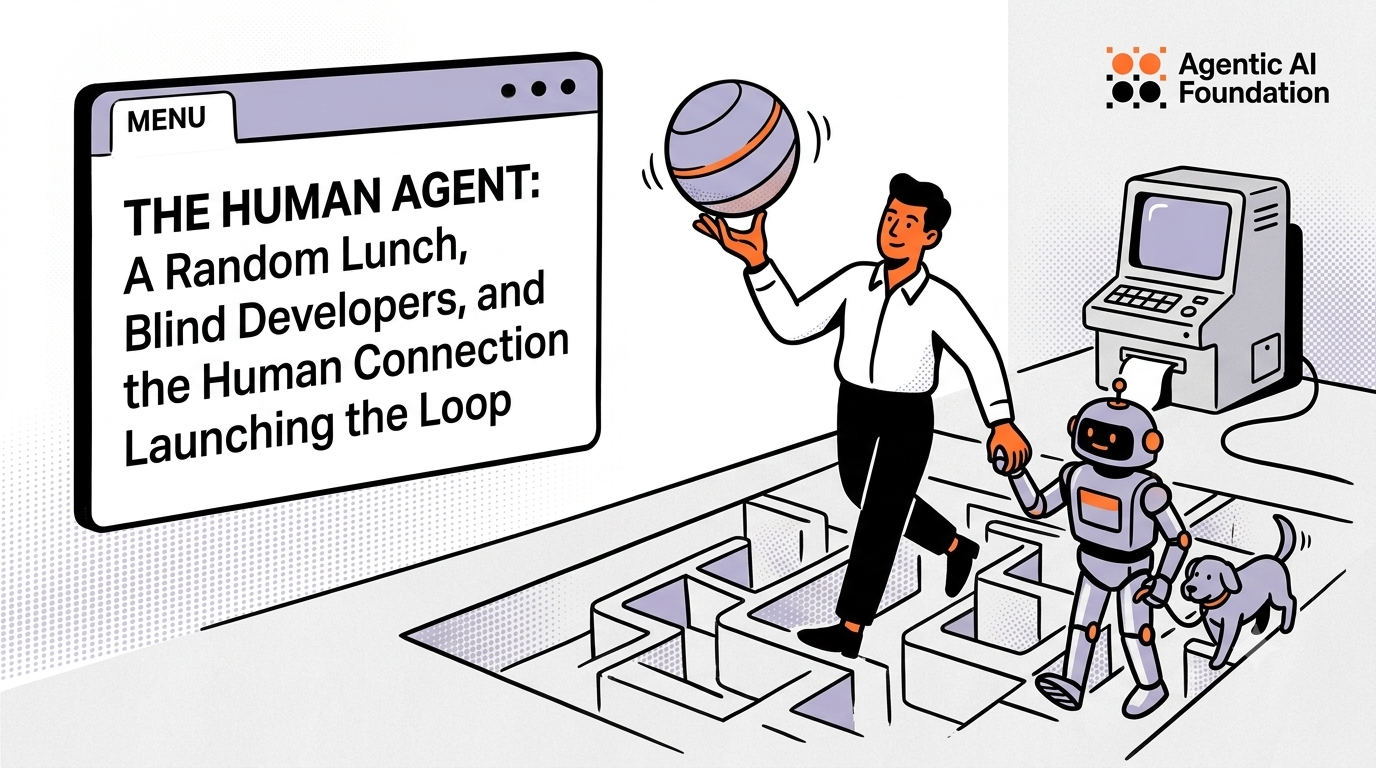
Humans remain the most creative and critical actors in the agent economy. Even in open-ended environments like OpenClaw, AI agents still operate within relatively constrained paths. Humans don’t. We wander, strike up unexpected conversations, and make connections no one could have planned. That kind of serendipity is a feature, not a bug. I hope we never lose sight of it, because those unplanned moments often lead to the most meaningful ideas and discoveries.
Seeing MCP Apps as an Accessibility Layer #
At MCP Dev Summit North America in New York City, I sat in the audience as developers Liad Yosef and Ido Solomon took the stage. They discussed MCP Apps, an emerging effort to give the protocol a scalable set of UX conventions to let applications respond to tool calls and context by dynamically generating rich user interfaces, not just returning text, video, or audio.
It was a great talk that struck a nerve with me. My sister is legally blind, and I have been covering technology accessibility for the blind community since very early in my career, including editing the assistive technology column for BusinessWeek, and even garnering some emails from a certain well-known individual at Apple… a story for another day.
Unfortunately, accessibility for people who are blind or have low vision has long lagged behind advances in technology, especially in web and mobile user experiences. Screen readers, still the dominant accessibility tool on phones and computers, have largely been bolted onto interfaces rather than designed into them.
They often work by traversing page elements in sequence and verbalizing what’s on the screen, with limited understanding of a user’s intent or the underlying meaning of the interface.
This meant that screen readers could perfectly read off the contents of a page, assuming the page had sufficient alt tags and was not overrun with JavaScript, but it was the equivalent of reading the contents of a bookstore’s shelves in sequence.
There was no way to intelligently search the catalog or ask a page to focus on specific information or themes. I have watched firsthand as my sibling struggles against this clunky harness that puts blinders on information.
In MCP Apps, I saw a potential solution. Liad’s presentation introduced a flexible UX layer for MCP that, if I understood it correctly, could support not only visual interfaces but entirely different interaction models. That opened the possibility of designing experiences specifically for people who are blind or have low vision, rather than expecting them to navigate interfaces built primarily for sighted users.
The Lunch-Table Connection #
My mind was churning with possibilities that day as I walked the exhibitor floor and, at the appropriate time, grabbed a sandwich for lunch. Most of the tables had already filled up, so I sidled up to a four-top with one seat open. I did not know the other three people, and we introduced ourselves. We shared our impressions of the talks and what we liked.
I mentioned Liad and Ido’s talk and how it sparked my imagination due to my sister. Sitting across from me was Phillip Lamb. Phillip remarked that he had actually filed an early issue in the MCP Apps community, requesting changes to the protocol extension that would provide better semantic capabilities for AI-powered responses for blind users.
We began chatting, and I learned more about him, his connections with the visually impaired and blind community, and his long-held interests in this area. I told Phillip we’d love to have him write a blog post on how blind users experience LLMs and agents, and the lessons we can learn. He graciously agreed. The chance encounter, I thought, could turn into a way to better educate the community during this critical early phase.
From Conversation to Collaboration #
When I got back to the Bay Area, I connected with Liad, introduced myself, and explained my interest in accessibility and MCP Apps. We agreed to meet and discuss. It turned out that Liad, too, was fascinated by the design challenges of accessibility and thinking deeply about how to adapt MCP Apps to accommodate the visually impaired. I mentioned to Liad that someone I met at MCP Dev Summit was very knowledgeable on the topic and was writing a post about how blind users interact with LLMs, and the challenges they face. Liad agreed to collaborate with Phillip on the post.
This became one of the posts I am proudest of on the AAIF.io blog: “Native Speakers: Why AI’s Most Powerful Users Are Blind.”
Phillip added rich detail about how blind and low-vision users and developers experience LLMs, underscoring both the promise and the problems. There was the story of a BITS member who can now talk to an LLM on a morning commute and arrive at the office with a ready-to-use document built entirely through dialogue, a huge quality-of-life gain for someone who previously had to fight a word processor through a screen reader.
That was juxtaposed against the story of a blind developer who built an accessibility tool entirely through AI-assisted coding, only to learn during a demo for GitHub that the bottom half of the letters were cut off screen. The AI had access to that visual information the entire time, but never mentioned it. That’s arguably worse than hallucinating, it omitted key information. This is a problem the developer community can actually solve.
Agent-Readiness Is Accessibility Work #
The bigger lesson from the post is that agent-readiness and accessibility are not separate problems. They are increasingly the same engineering problem approached from two directions. An agent and screen-reader user are in similar positions: neither can rely on the visual interface alone, and both need software to declare, in language, what it is, what it can do, and how its capabilities can be invoked. Every step that makes a site or app legible to an agent is also a step toward making it legible to someone who cannot see it.
That does not mean agent-readiness solves accessibility by itself. But it does mean the economic incentives are finally aligned in a new way. The industry is already spending enormous effort to make software agent-operable. If we are deliberate, that work can also become accessibility work. If we are not, we risk rebuilding the GUI mistake all over again: a visual-first world where accessibility is bolted on after the fact.
Accessibility as Opportunity Cost #
Both Liad and Phillip are looking forward to more collaboration on the topic, which I believe is critical for our community, not just on moral grounds but also on opportunity cost.
We know that employment among people with disabilities rose during the COVID era as remote work removed barriers that had long kept many qualified people out of jobs. Remote work alone did not solve disability employment, but it showed what happens when the environment changes enough for more people to contribute.
The lesson for agentic AI is similar: when we design the interface layer differently, we change who can participate.
The Human Agent at the Beginning of the Loop #
There’s a lesson in here for me as well. Three human agents — Phillip, Liad, and I — converged on a place and a time that allowed our proximity to fire creativity. I was merely a catalyst and take no credit for the output.
The connection could only have been made by humans, being human, and driving agency. Our applications and technology — in agentic AI and elsewhere — will always be a mirror image of our values.
The human in the loop is much more than verification or checking up on the agents. Yes, we collaborate with our agents as muses and intellectual sparring partners, and we increasingly rely on our agents to extend our intellectual reach.
Soon our agents will talk to each other. But at the beginning of each loop is a human agent and the types of serendipity and creativity that yield the kind of non-determinism behind so many wild and beautiful discoveries in our world.
Get involved #
The Agentic AI Foundation is entirely open, public, and built on community collaboration. Whether you are an enterprise strategist looking for architectural blueprints or a developer ready to jump into GitHub issues, there are several ways to get started:
- Stay Informed: Follow the AAIF social pages ( LI,X,BlueSky) andsubscribeto the community newsletter for highly condensed, curated updates on global AI innovation. - Read the Curated Content: Dive into The Daily Agenticfor quick, highly digestible insights on current trends. - Contribute Code: Visit the AAIF siteand navigate to the repositories to check out open issues, collaborate with maintainers, and help shape open source agent projects.