*Editor's note: The "Short of War" Podcast discussing this article is AI-generated.*Since 9/11, Special Operations Forces (SOF) have often been cast as the United States’ sharpest instrument: they hunt high-value targets, train partners, and operate at the seams where conventional forces cannot reach or persist. Thriving in permissive skies and largely uncontested electromagnetic spectrums against weaker foes, those conditions are waning if not already gone. The trends remaking warfare—saturated sensors, democratized precision, machine-speed competition below the threshold of war—are dissolving the advantages SOF have enjoyed. The question this raises is not whether SOF will survive the transition, but whether the qualities that made them indispensable during the War on Terror are the same ones that future conflicts will demand.
At the recent Special Air Warfare Symposium, I was asked to provide a glimpse into the future fight and what it means for SOF. Framed as an intellectual forecast, I curated trend cluster analyses from empirical factors of outsized influence in modern operating environments. In this context, I estimate that SOF will become more structural, central, and significant in future conflict provided they can shed the habits that worked in a forgiving era fast enough to meet a harsher one.
Technology Systems – How War Is Being Fought
Information Dominance
Information dominance is increasingly the sine qua non of modern warfare. Marked by sensor saturation, speed, context, and cunning, converting the right information to wisdom is the crux of warfare. The proliferation of space-based assets, unmanned systems, and persistent intelligence, surveillance, and reconnaissance platforms has driven data to unprecedented volumes and variety. The problems no longer lie in collection, but in processing, fusion, interpretation, and trust.
The main technology that can provide an edge in these actions is artificial intelligence (AI). AI can enable machine-speed data fusion, information processing, and pattern detection. This statement might seem obvious, but it is sandwiched between two oft overlooked factors. Preceding it is an entire ecosystem of computing power, information infrastructure, and digital networks. Sufficient computation that enables deft AI requires extraordinary amounts of server storage and power generation. Reliable AI also requires high data quality and integrity, implying colossal and vibrant data repositories secured from harvesting, hacking, and poisoning. Enter, among other things, chip wars, data wars, and supply chain insecurity. For these assets to be available on demand for warfighters, the military must have fast, supple, and resilient cyber networks despite adversary efforts to disrupt and shatter them.
On the back end of AI’s role in information management is the keystone of success in military employment of AI: human judgment. Operators employing AI must have the attention, discernment, and courage to question when the answers, recommendations, or conclusions AI generates do not ring true. The essence of maximizing AI is identifying what it can resolve standalone and how to partition the cognitive load in all other scenarios. Goldfarb and Lindsay’s framework sorting military tasks by data quality and the gravity of human judgment is a fruitful starting point. Tasks where high-quality data are abundant and judgments are routinized with high consensus are ripe for full automation. Conversely, AI should be nowhere near tasks where data are lacking or judgments are complex or contextual. The most interesting and challenging quadrant for future warfare features human-machine teaming, where data quality is rich and human judgment is vital.
Democratization of Destruction
Two long-running trends are converging. Open innovation, global supply chains, and commercial technology have lowered barriers to entry, while the precision warfare regime pioneered by the United States has matured and diffused. Intersecting, these trends are collapsing the binary between precision and mass, resulting in a new spread, density, and demography of warfare.
Contending with the proliferation of precise bursts of mass will require autonomy crystallized in physical AI like drone swarms and decoys, multidomain counter-drone solutions, and autonomous defense architectures with plot fusion. Amid episodes of pulsed or peaked precise mass, autonomous systems will redistribute risk, harden targets and kill chains, and enable persistent scale in warfare. For SOF, this means reevaluating the legacy organizational structures for multidomain units of action and embracing innovative systems and processes for the SOF core tasks.
Logistics
Mobility, logistics, and sustainment, often treated as background functions, are now front-line vulnerabilities. The very speed, scalability, and organizational endurance congruent with future warfare conditions hinge on short, agile logistical tails.
The U.S. military has become more effective by making greater use of a wide range of technologies in combat, but it comes with a considerable increase in energy consumption. Pulling from civilian grids can be fragile, vulnerable, and outside direct military control. Relying on liquid fuels can be exorbitantly costly and time-consuming, not to mention presenting exploitable vulnerabilities to missions and to forces extending down the logistical line. Micro and small modular nuclear reactors could provide safe, reliable forward-deployed energy with smaller footprints and rapid, flexible deployment timelines. For units radiating out into the fray, nano-enabled fabrics are nearing the ability to harvest electricity from solar, waste body heat, and kinetic motions, enabling self-sustaining power-generation without a cumbersome kit.
Another means of agile combat employment is additive manufacturing. Light, mobile equipment and computer-aided design makes it easier and faster for non-specialists to manufacture in the field. For larger demands like structures, the military could repurpose decommissioned platforms like amphibious assault ships or C5s as expeditionary logistics hubs. For smaller needs, unit-level printers could yield anything from custom replacement parts to armor with mechanical metamaterials. Combined with autonomous deliveries and retrievals of supplies, equipment, and personnel where germane and augmented reality that can bridge mechanical, medical, or other expertise gaps, units could erect, sustain, and relocate operational centers rapidly and under the radar.
Across these technological systems, advantage shifts from those who have the best things to the side that best manages the system and the seams. This is where SOF excel. Designed to operate with incomplete information and limited support, SOF specialize in working around systems and exploiting seams. Furthermore, as the very tip of the spear, new technologies in any domain are often played out first in the SOF community. Prizing human judgment, skilled amid cross-pressures like precise mass, and more tech savvy than conventional forces, SOF are the ideal force to navigate the tech systems of future war.
Coherence in Competition – What War is Becoming
Contemporary conflict continues moving from discrete tactical episodes toward persistent competition across systems and domains. Political warfare, influence campaigns, and gray zone activities blur boundaries. Adversaries diffuse, dodge, and distract military strength through surrogates and information campaigns. Cooperation and coercion blend. Phase transitions and escalation ladders become murkier. Military force is one tool among many, and military power is often not the most appropriate when legitimacy, narrative, and alignment eclipse firepower. Under such conditions, the challenge becomes linking tactical actions, operational campaigns, information activities, and strategic outcomes across incongruent timelines.
Spatially, modern war is increasingly of scale translation across levels and geography. Tactical actions reverberate operationally and strategically, while peripheral events can trigger geopolitical consequences, and vice versa. First, the entanglement of the levels of war puts a premium on vertical integration. Tacticians must understand how their actions construe in the operational picture, while strategists must more carefully consider how objectives narrow to point impacts across the competition landscape. The U.S. military is exceptional at producing tactical experts and strategic thinkers, but there are deficiencies in the middle (especially in the U.S. Air Force) that permit and empower operational art.
Second, practitioners must rethink deterrence and battlespace preparation considering adversaries’ preferences for gray zone and proxy warfare. Amid great power competition, irregular warfare is and will be the modal form, serving as both pressure valve and litmus test. Military forces must harness the linkages between irregular and conventional warfare if they are to prevail in future conflict situations.
Temporally, dissonance compounds these challenges. Machine-speed processes operate in seconds and minutes. Human organizations function over weeks and months. Political outcomes unfold over years or decades. Victory increasingly belongs to the side that can synchronize actions across jagged time horizons rather than optimizing performance at any single level. Doing so requires deep structures embedded over the long term – relationships, access, influence – that can snap to crises. To be clear, this includes long-term partnerships like security force assistance programs and organizations that the Air Force has opted to divest on the grounds of lethality. By my read, these are investments in future optionality and the very underpinnings of latent, long-term lethality.
Comfortable across levels of war, below thresholds, and inside long partnerships, SOF is positioned to be a coherence agent in future war.
Innovation Epicycles – How Advantage is (Re)Generated
The final trend cluster concerns how advantage is gained and maintained at the proper clip. Warfare has always been adaptive, but the pace and diffusion of these spirals are accelerating. This dynamic manifests as innovation epicycles – recurring loops in which technologies, tactics, and organizational responses interact, producing temporary advantages that are quickly challenged and reconfigured.
Consequently, war is increasingly a contest of learning and sensemaking within complex systems. In modern competition and conflict, cause-and-effect relationships are often obscure, and combatants must act without full information. The Cynefin framework captures this dynamic well: in complex systems, outcomes emerge from interaction rather than observation. The right approach is not analysis followed by action, but probing, sensing, and adjusting in real time. Under these conditions, the abilities to interpret ambiguous signals, contextualize events, and act without false confidence in simplified battlespace models are crucial. In short, judgment and command initiative.
Organizations that perform well in such environments function as adaptation engines. They experiment at the edges, generate operational feedback, and iterate quickly. Today these learning cycles are fed by more simultaneous sources than in the past: commercial industry, allied experimentation, state and nonstate adversary tactics, and operator creativity all contribute to a continuous stream of insight. SOF formations are unconventional by nature and thus tend to be adaptation engines because they are small, autonomous across diverse missions, and inherently operate at the frontiers and on the fringes of traditional military hierarchies. This unconventionality works in two directions. Successful innovations can be scaled outward to the broader force and unfavorable ones can be nixed at enormous cost and time savings.
There is a final step in innovation epicycles, imperative yet often taken for granted: assimilation. Innovation only produces strategic advantage when it is effectively integrated into existing doctrine, training, and operational concepts. This is usually more difficult than invention, especially in guarding against bias, brittleness, and overreliance in the race to incorporate emerging tech and tactics.
SOF again occupies a unique position in this process. Because of their operational agility, unconventional approach to sensemaking and problem-solving, and savvy with emerging technologies, they regularly serve as the interface between experimentation and institutionalization. At the same time, this is where SOF might be most prone to failure. Operating in permissive environments against overmatched adversaries for the past 25 years, SOF still revealed a tendency to over-optimize by leaning hard into technology-enabled actions like targeting. Indeed, the same biases that accelerate assimilation can also distort it, privileging the problems emerging technology solves cleanly over the messier ones it cannot. Without astute calibration of the adaptation engine, the contested and compressed conditions of future conflict will intensify SOF’s dysfunctions and exact a price.
In sum, the militaries that prevail in future conflicts will be capable of navigating complexity, sustaining rapid adaptation, and assimilating innovations into lucid systems of action. SOF can, and should, be the catalyst for creativity and incorporation of new technologies.
SOF’s Opportunities
These trend clusters point toward future conflict defined by the interaction of complex systems across scales and time horizons. In such environments, advantage accrues to those who can integrate systems, synchronize actions, and adapt faster than competitors.
This is where SOF can excel – not as a niche capability or elite raiding force, but as an instrument for managing complexity, wrangling coherence from intentional and haphazard chaos, and then adroitly adapting to the uncertainty. SOF’s enduring value lies in how it operates between technology and judgment, action and influence, and between learning and institutionalizing. As competition intensifies and the character of war evolves, the question is not whether SOF will remain relevant. It is whether leaders will fully recognize – and properly employ – SOF’s evolving capabilities in fragmented future war.
Kerry Chávez*, PhD, is the Fox Assistant Professor at the Institute for Future Conflict and serves as an advisor for Irregular Warfare Initiative's Project Air and Space Power. Her research centers on the politics, strategies, and emerging technologies of warfare and international security. She is a leading expert on military applications of unmanned systems, artificial intelligence, autonomy, and relevant enabling technologies. Her rigorous work bridges academic and practitioner spheres.*
The views expressed are those of the authors and do not reflect the official position of the Irregular Warfare Initiative, Princeton University’s Empirical Studies of Conflict Project, the Modern War Institute at West Point, Department of the Army, the Air Force, the Department of War, or the United States Government.
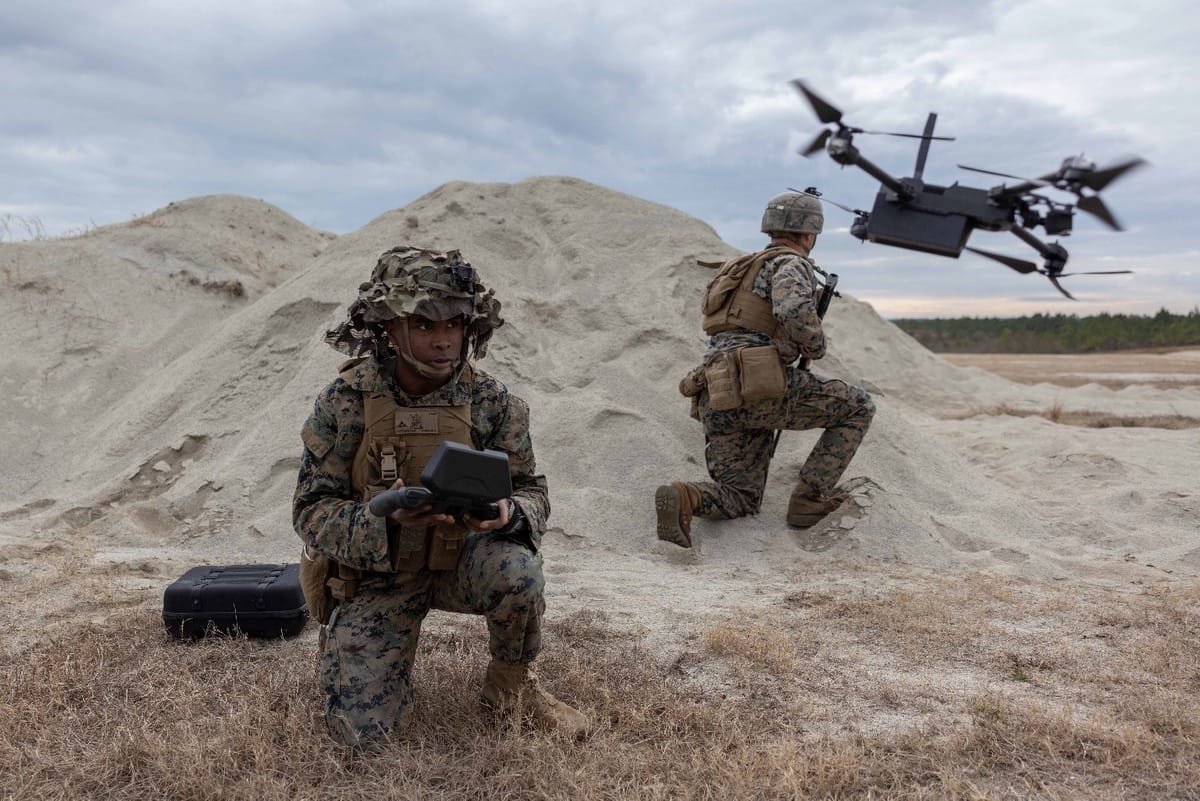
Main image: Marine Corps Lance Cpl. Donte Mathews flies an unmanned aircraft system during a mortar range event at Camp Lejeune, N.C., Jan. 17, 2023, courtesy of Dept. Of War.
*If you value reading the Irregular Warfare Initiative, please consider supporting our work. And for the best gear, check out the **IWI store *for mugs, coasters, apparel, and other items.