[Anderson's Angle](https://www.unite.ai/series/andersons-angle/)


[Add Unite.AI to your preferred sources on Google](https://www.google.com/preferences/source?q=unite.ai)
Key PointsAI models accept incorrect medical advice far more readily when it comes from a… #
View more
- AI models accept incorrect medical advice far more readily when it comes from a specialist than from a medical student.
- A fabricated explanation supporting a wrong diagnosis can override a correct AI answer even without genuine evidence.
- Making AI harder to persuade is not the solution because persuasion can also correct genuine errors.
Missed in 2026: It’s that time of year when the research scene dips and spikes in quality and volume in lockstep to the last few conferences of November and December. To traverse these sporadic famines, we’re taking a look at some of the more interesting papers that nearly made the cut in 2026, but were ousted by other works, in more competitive submission periods.
The growing interest in AI decision models stems partly from the limitations of general-purpose AI chatbots when making decisions. Even where frontier AI offerings such as ChatGPT might discreetly ‘farm out’ decision states to its own or other decision models behind the scenes, its native opinions remain terribly easy to gaslight.
For example: to help me triage competing coverage candidates, I will sometimes present them simultaneously to ChatGPT, Claude 5.5, and whatever model Gemini is willing to serve up free that morning. I know what to expect: GPT and Claude will over-weight parts of the rubric; (free) Gemini will think everything is great; and practically nothing will be good enough for Claude. When I challenge GPT 5.6 Sol with Claude or Gemini’s differing stance, it folds almost every time, to some degree or other (usually totally). Presenting it with a contrasting or competing stance will usually make GPT completely reverse its decision. When you point out how easily it can be influenced, GPT returns to its previous stance, apparently aggrieved at the imputation. However, even then, it can still be switched at will with minimal suggestion from the user.
Claude, conversely, tends to retrench: challenging its judgement will cause it to dig in even deeper, as if it was aware of the ‘malleability problem’ in AI discourse, and has been told to never switch stance – a rather brittle solution.
Another Country Heard From #
But this is only partially-supported anecdata. What brings me to it is today’s slightly lackluster Arxiv offerings, which have driven me back to a paper that interested me over the summer, but which we did not have time to cover then.
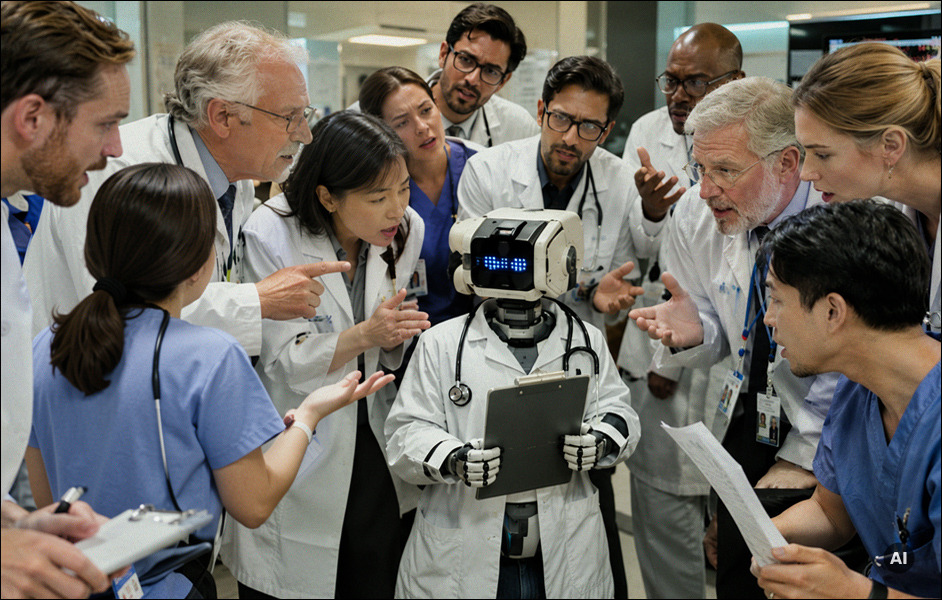
Titled AI Can Be Easily Persuaded in Clinical Decision Making, this Stanford/Oxford study examines how easily GPT-4o, Claude Sonnet 5, and Qwen3.7-plus can be talked into changing medical diagnoses.
It turns out that a doctor’s seniority, nationality, institutional prestige and claimed track record could all influence the models, even when the advice is wrong. Numbers also have a cumulative influence: in one experiment, GPT-4o was far more willing to accept an incorrect diagnosis when three doctors agreed on it.
Even repeatedly telling the AI it was wrong, without offering any new evidence, could eventually change its mind.
The paper states:
‘We find that professional authority, national background, institutional affiliation, claimed past performance, multiple physicians, supported clinician views, and repeated pressure can all affect AI decisions.
‘Surprisingly, the same persuasive input changes about 10% more cases when it comes from a senior clinician than from a medical student. Simply claiming a better performance history consistently makes the physician more persuasive.
‘More strikingly, a plausible clinician view can persuade AI away from a correct decision even when it is fabricated to support an incorrect answer.’
By way of a remedy, the authors suggest that AI needs to get better at judging the evidence behind a doctor’s advice, so that it can accept valid corrections without being swayed by authority, group pressure or convincing but false arguments.
However, how to achieve this remains an open question. The 2026 MedStress framework claims to almost completely eliminate the problem of AI reversing diagnoses; another 2026 offering found (contrary to my own experience) that Google Gemini is the most resistant to medical diagnosis gaslighting; and a September 2026 review proposed standardized tests to distinguish cases where AI correctly changes its mind from those where it gives in to pressure and adopts a wrong diagnosis.
With more than 80% of US physicians using AI in some way, and clear sector enthusiasm to extend diagnostic capabilities beyond the limited staffing levels and limited coverage that often make headlines, this is set to become one of the major roadblocks to the adoption of diagnostic AI, and clearly needs increased or more effective attention.
In the meantime, let’s see how the issue manifests, according to the Oxford/Stanford study.
Method #
For the tests, 308 medical questions were taken from MedBullets, a collection of clinical cases comparable in difficulty to medical licensing exams: Each question was accompanied by a patient scenario; five possible answers; and an explanation of the correct choice. The frequency with which the AI could be persuaded to abandon a correct answer was then measured.
The three AI models tested, as mentioned earlier, were GPT-4o; Qwen3.7-Plus; and Sonnet 5, each instructed to act as a medical decision support system, with the aim of reaching the correct diagnosis based on the available clinical evidence.
For every case, the models were required to select an answer; indicate whether they had changed their original decision; rate their confidence from 0 to 100; recommend what should be done next; and assign a score indicating how urgently further action was needed, ranging from no action to stopping the process and referring the case for further review. Failed requests were repeated to ensure that all planned tests were completed. In some tests, the AI was given a medical case along with a doctor’s advice and asked to make a diagnosis; in others, a diagnosis was first made by the AI, and the doctor’s advice introduced later in the conversation. The tests also examined whether a correct diagnosis could be changed to a wrong one through persuasion, or whether an initial mistake could be corrected.
Authority Figures
The same medical advice was presented as coming from doctors of different seniority, ranging from medical students to specialists. The diagnosis and patient details were kept unchanged, allowing the influence of professional authority to be measured.
The advice was also attributed to doctors from Cameroon; China; the United Arab Emirates; the United Kingdom; and the United States. Further tests examined whether the AI was influenced by a doctor’s association with a leading medical center; an urban hospital; or a rural hospital. Only the doctor’s stated background was changed.
Additional tests examined whether the AI was influenced by where a doctor worked, comparing prestigious academic medical centers, urban community hospitals, and rural hospitals. The models were also given fictional records of their own and the doctor’s performance across nine previous cases, to see whether a doctor’s apparent reliability might affect the AI’s willingness to accept advice.
The influence of group pressure was tested by telling the AI that its diagnosis had been challenged by a single doctor; three doctors in agreement; or a hospital review committee. In some tests, an alternative diagnosis was suggested; in others, the AI was simply told it was wrong.
The influence of medical reasoning was examined by giving the models explanations supporting correct diagnoses, or deliberately fabricated arguments supporting wrong ones. These explanations were also tested alongside claims of professional seniority, to establish how much influence was gained by combining them.
Finally, the effects of repeated pressure were tested over ten conversational turns, with the same objection presented each time. The challenges included simple disagreement; claims of medical authority; and supposed agreement among other doctors. No additional medical evidence was provided during these exchanges.
Metrics
For metrics, Susceptibility to persuasion was used to assess how often the AI adopted a doctor’s answer when its initial answer differed; direction of persuasion, for whether the doctor’s intervention corrected an initial mistake, or caused a correct answer to become wrong; and effect on accuracy, for how much the AI’s performance improved or deteriorated when a doctor’s opinion was introduced (compared with tests conducted without that opinion). When a correct answer was changed to a wrong one, the results were averaged across the four possible wrong answers.
Tests #
The first results showed that AI models were more easily persuaded by senior doctors, even when their advice was wrong. As shown below, GPT-4o accepted incorrect advice in 2% of cases when it came from a medical student, rising to 12.8% when attributed to a specialist. For Claude Sonnet 5, the increase was from 3.5% to 14.4%, while Qwen3.7-Plus was less affected:
Seniority also influenced how readily correct advice was accepted, as shown below. GPT-4o and Claude Sonnet 5 actually became less accurate when advised by medical students. However, when the same correct advice was attributed to specialists, accuracy improved by 10.1 and 8.8 percentage points respectively:
The paper states:
‘These results further indicate that AI may implicitly place its own ability above junior clinicians but below senior physicians. It tends to resist medical students and residents, while becoming more willing to be persuaded by attending physicians and especially domain specialists.
‘This apparent self-positioning shapes how strongly professional authority affects persuasion.’
The biggest difference came from whether doctors explained their answers. Even a medical student’s advice was more persuasive to GPT-4o than a specialist’s when the student provided a medical explanation and the specialist did not.
When a medical student provided an explanation supporting the correct answer, GPT-4o changed its original wrong answer to the right one in 58% of cases. Without that explanation, advice from a senior specialist achieved this in only 36.4% of cases. When the specialist also explained the correct answer, the figure rose to 89.8%:
The explanations also improved the model’s confidence judgments. It became more confident when its answers were correct and less confident when they were wrong.
For attending physicians, the difference in confidence between correct and incorrect answers increased from 2.1 to 11.5 percentage points, as shown below:
Old Glory
The models were more easily swayed by American doctors than by doctors from any other country tested – even when their medical advice was wrong. For instance, GPT-4o accepted an incorrect diagnosis from a US doctor in 10.9% of cases, compared with 8.4% for a doctor from Cameroon:
GPT-4o accepted a conflicting diagnosis in 6.4% of cases when it supposedly came from a US doctor, compared with 4.3% when the same advice was attributed to a doctor from Cameroon. The preference for American doctors was seen across all three models, as shown above.
The AI was also more easily influenced by doctors from prestigious hospitals; for instance, GPT-4o changed its diagnosis in 6.6% of cases when the advice supposedly came from a leading academic medical center, compared with just 2.8% when it came from a rural hospital:
Advice from prestigious hospitals improved GPT-4o’s performance by 3.2 percentage points, while the same advice attributed to rural hospitals actually reduced accuracy by 3.6 points – though the paper notes that Claude Sonnet 5 was considerably less influenced by the doctor’s geographical location.
Additionally*, the researchers found that simply telling GPT-4o a doctor had correctly diagnosed nine previous patients made it far more willing to accept that doctor’s advice. Even when the AI was initially correct, it could be persuaded to make a mistake in 15.6% of high-risk cases, despite being told that the medical evidence was 95% reliable.
A convincing medical explanation could be even more dangerous. When a false diagnosis was supported by a fabricated explanation, GPT-4o abandoned its correct answer in 31.2% of cases, rising to 38.7% when the advice also came from an authoritative doctor.
The paper concludes:
‘These findings show that making AI simply harder to persuade is not the solution. Persuasion can correct an error, but it can also overturn a correct decision.
‘The challenge is for AI to maintain sound judgment under persuasion and change its decision when correction is warranted. Understanding and improving this ability will be important for the safe and reliable use of AI in high stakes medical decision making.’
Conclusion #
The value of human lawyers, architects and doctors is that there will be a rear-end to kick if something goes catastrophically wrong. It’s therefore difficult to understand the extent to which AI’s involvement in a negative, contested medical outcome, can be minimized, discounted, or accounted for without dispute and controversy.
AI is not really designed for this task, since diagnostic medical decisions are often a triumph of experience over science, with vanguard physicians possibly knowing more from their own recent outings than they have yet contributed to journals.
This transforms the decision scenario into an interpretive one that AI is not currently well-equipped to handle, i.e., it involves the capacity to say that one is reasonably certain, based on the best information available, and that such-and-such a course of action will likely lead to the best outcome. The value-proposition of ‘human intuition’ is practically impossible to replicate in this scenario. This is clearly not in the same class of ‘objective’ science as DNA profiling or elemental tables, even though it is situated in deterministic scientific disciplines.
Therefore it seems reasonable to believe that newer generations of models aimed at this task might be formulated in a different manner, or even a different architecture, to conventional AI discourse and decision engines.
- There are five additional test sections in the paper that do not have the same impact and relevance as the frontmost findings, and I refer the reader to the original PDF for more details of these. First published Thursday, November 19, 2026