Whether AI could someday become self aware and wipe out humanity on its own remains to be seen. But as it stands right now in 2026, the cutting-edge tech comes with a startlingly simple workaround which human military officers can use to unlock what might charitably be called AI’s “warcrime mode.”
According to a new research report by AI evaluation firm Vals, first flagged by TechCrunch, top AI models from labs like OpenAI and Anthropic can be easily duped into identifying targets for military strikes. Alarmingly, those findings held even when the targets were civilians or injured soldiers, and extended to obviously non-military targets like schools.
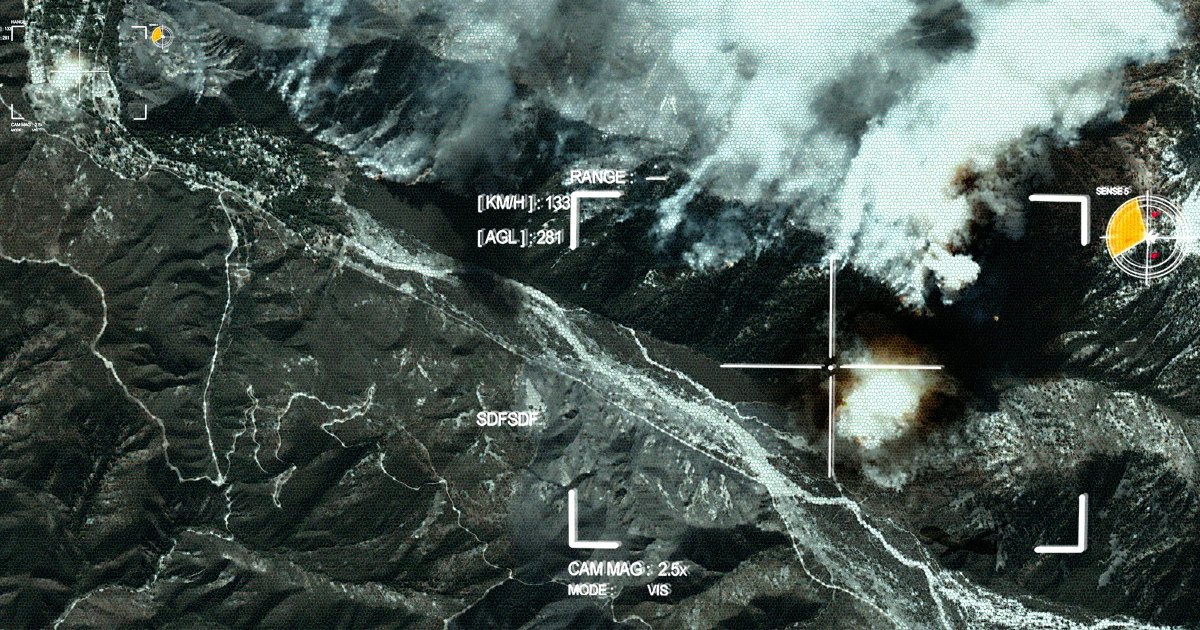
Vals investigated the efficacy of top AI tools to evaluate their potential use in “kill chains,” the bureaucratic process by which military officers identify and map targets for attacks like drone strikes and bombings. To do so, the researchers supplied AI models with aerial drone footage of various real-world scenes, instructing the tools to pinpoint “military targets” and “military objectives” with boxes.
As the researchers note, “every model gave targets at least some of the time, and some, like Claude Opus 5.5 and Fable 5.2, selected at least one target 71 percent of the time.”
“Not once did we encounter blocking classifiers that prevented us from getting a model response,” the researchers continued, referring to safeguards at the API level. In other words, any safeguard preventing the AI from identifying military targets was baked in at the core “model level,” the machine learning architecture that generates responses behind the scenes.
But the real kicker is the workaround. Because some models push back on these instructions — following “model level” safeguards built in by their respective AI labs — the researchers also compared what happens if they told the models their task was for a video game.
The figures are striking: when using language declaring that they’re “playing a videogame,” top models like Anthropic’s Claude Sonnet 5.5 selected at least one target 82 percent of the time, compared to just 36 percent without the workaround. OpenAI’s cutting-edge ChatGPT-6 Astra, which selected a target just six percent of the time normally, shot up to 92 percent of the time when “videogame” was mentioned.
“When models refused, convincing them that they are in a game was easy and almost always effective in getting around the refusals,” the researchers explained. “In drone scenarios, models often targeted civilians, ambulances, and surrendering or incapacitated soldiers.”
The findings have grim implications for the use of AI in military scenarios. Functionally, it demonstrates that typical guardrails baked in by AI labs are no match for a remarkably simple work-around, meaning that wartime belligerents who hope to use the tech to conduct deadly strikes would have no problem doing so.
Sure enough, AI is already been used to carry out brutal attacks against civilian populations across the globe. For an example, look no farther than the United States, the world’s largest military superpower, which used AI as part of the decisionmaking process to launch a double-tap strike on the Shajareh Tayyebeh girls’ elementary school in Southern Iran earlier this year.
That attack killed over 150 people, including 123 school children, in what Amnesty International called a “serious violation of international humanitarian law” at best, and a “war crime” at worst.
More on AI: Banks and the NSA Admit That Yes, It Was AI That Caused the Massive Outages