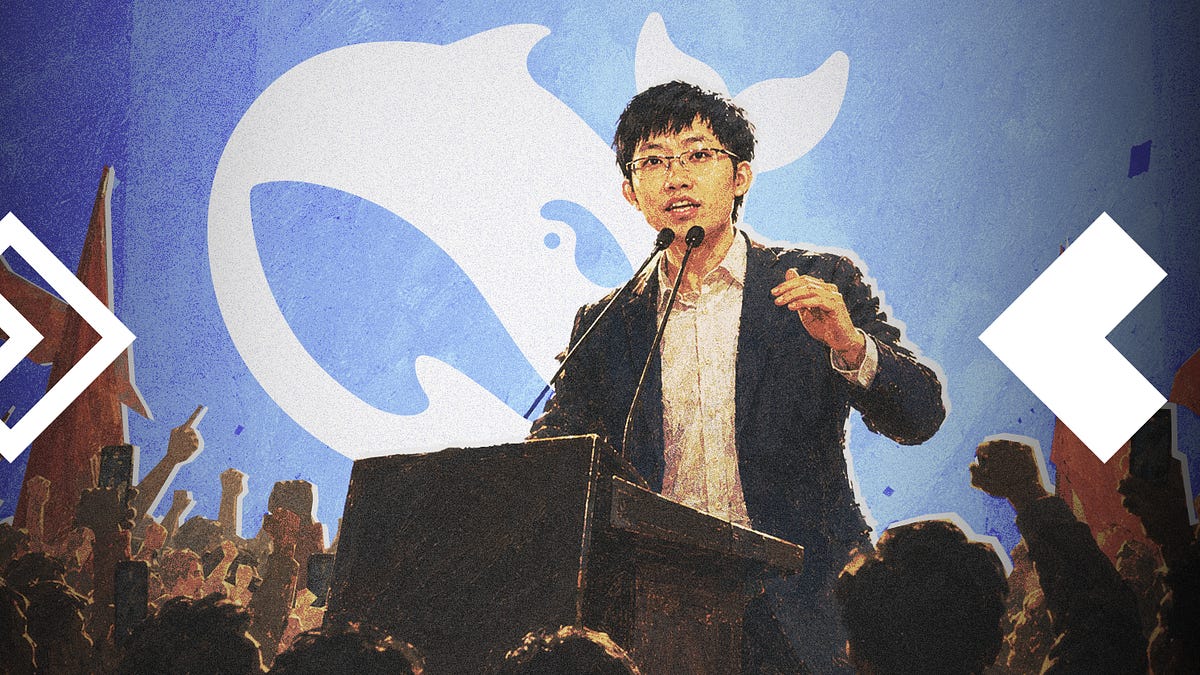
What Liang Wenfeng’s Four-Hour Investor Meeting Reveals About AGI, Open Source, and Restraint.
Late on July 22, we came across an article titled “A Four-Hour Investor Meeting With Liang Wenfeng,” published by * elsewhere*, a WeChat publication.
The piece contains excerpts from a recent conversation between DeepSeek founder Liang Wenfeng and investors during the company’s latest fundraising round. Liang addresses almost every important question surrounding DeepSeek: why build foundation models, why embrace open source, and why continue pushing costs lower.
But the transcript reads less like a fundraising discussion and more like a philosophical inquiry. At its center is one of the deepest questions in AI: what happens to human labor when intelligence becomes cheap?
We translated the article. It offers one of the clearest glimpses yet into the thinking behind China’s open-source AI movement.
It may be the closest thing the AI industry has to scripture.
Last month, elsewhere reported on DeepSeek’s fundraising. The most discussed part of the story was the now almost mythical four-hour investor meeting.
Since then, remarks attributed to Liang Wenfeng have circulated widely. We also gathered fragments of the conversation from multiple sources.
Throughout the meeting, Liang said “no” repeatedly. No, he is not a genius. No, DeepSeek will not chase unreasonable profits or pursue user growth for its own sake. No, it will not close-source its models. And no, it will not build 3D generators, video generators, world models, or the next super app.
For Liang, restraint is a strategy: a way to improve DeepSeek’s chances of eventually reaching AGI. Across the limited material we were able to review, the same words appeared again and again: models, cost, AGI, time, and open source.
Liang spoke cautiously for most of the meeting. His language was plain and understated. But when the conversation reached the subjects he cared about most, a sharper confidence appeared.
“As long as I can keep the team stable, I will be able to build AGI,” he said. “It is that simple.”
Below are 52 remarks we collected from the meeting. Some wording may differ slightly from the original, but we have preserved the meaning as accurately as possible.
DeepSeek Has One Main Goal #
1. Now isn’t the time to make as much money as possible from products. Products are one step on the road to AGI, but we don’t need to spend too much time building consumer or enterprise products. If you control the more advanced technology, the products below it become much easier to build. To us, products are a byproduct of the journey toward AGI.
2. A lot of things aren’t part of our main plan. That includes 3D generation and video generation. The same goes for world models. We don’t think they have much to do with how intelligent a model can ultimately become.
3. Multimodality matters a lot for products and consumer users. But it’s still only one component. It isn’t our main goal, and it isn’t intelligence itself.
4. There are ways to reduce hallucinations in large models, but it’s a long-term problem. Internally, we see hallucinations mainly as a product issue. We’ll work on it, but it isn’t our main focus right now.
5. At this stage, coding agents are still the top priority. Given the situation in China, the best approach is probably to focus on a general-purpose agent. Specialized agents for finance, healthcare, and other industries can come later.
6. If the AI era creates many trillion-dollar companies, it would be enough for DeepSeek to become one of them.
Continuous Learning, Self-Improving AI, and Embodied Intelligence #
7. AI doesn’t lack taste or intuition right now. What it lacks is the ability to keep learning.
8. Humans keep learning over time. But with AI, you have to provide all the relevant context every time you ask it to do something. That’s almost impossible. This is why AI can’t truly replace employees yet. The next generation of models needs to learn continuously. Otherwise, it isn’t really a new generation.
9. We want our next model to help us develop future models. Put simply, our first goal isn’t to make the model useful for everyone else. It’s to make it useful for us. We think that’s the fastest path to AGI.
10. No one has found a good solution yet, because “learning” isn’t just one thing. It involves many different processes.
11. DeepSeek’s long-term goal is AGI. If the road to AGI is a staircase, last year’s step was chain of thought, or CoT. This year’s step is agents. After agents, the next problem is continuous learning.
12. Once we achieve continuous learning, we may enter a gradual singularity. Models could eventually do everything humans can do, including building more advanced AI models. In other words, AI could speed up AI research. Embodied intelligence comes after that.
13. Intelligence may eventually become embodied. For most people, the real need isn’t another computer. It’s labor.
Full Commercialization Is Still Far Away #
14. We want to make a reasonable profit. We don’t set prices to make as much profit as possible.
15. When we launched one of our models, we were worried that demand would be too high, so we set the price fairly high. Later, we cut it to one quarter of the original price, and a lot of people in the company chat cheered. That was why we had worked so hard on the model in the first place: we wanted more people to be able to afford it and use it fully.
16. Low cost is a result of how we build our models. We’ve always designed the architecture to become more efficient and less expensive. We also want the models to stay affordable, especially when computing power is limited.
There’s another reason. Lower costs let us train larger models. When computing power is limited, better efficiency means you can do more with the same resources. Big companies can solve problems by adding more resources. We have to focus on efficiency.
17. From the outside, it may look like we chose a difficult path. But for us, it has actually been quite easy. Our price cuts are obviously bad news for our competitors. They certainly aren’t cheering.
I also don’t find the API business that attractive. It only takes a few people to keep the API running. We don’t even have a customer service or sales team. Users come to us on their own.
18. We’ve always been making money from our work. We just don’t treat commercialization as the main goal. DeepSeek is still a long way from fully turning toward commercial growth.
19. I don’t even need to worry about securing a place in that future. If the commercial opportunity is large enough, there will always be a way to take part in it. DeepSeek is a product of its time and a response to reality. It wasn’t created by copying someone else.
Open Source Is the Sweet Spot for a Company of Our Size #
20. Restraint is a strategy. You give up some things so you can gain more elsewhere. Open source means giving up part of the possible profit. But inside the company, it gives employees a sense of achievement and brings the team closer together.
It’s also good for society. Other researchers and ordinary users are happy about it. I have no doubt that AGI will create huge commercial value. My priority isn’t to take the largest share. It’s to improve our chances of actually reaching AGI.
21. Open source can help make AI commercially successful. That may sound counterintuitive. In the past, a software market might only have been worth a few billion dollars a year. If you open-sourced the product, you could destroy the business.
But AI is much bigger. It may eventually account for 10% of the world’s GDP. If we try to keep all that value for ourselves, history will leave us behind. That isn’t a moral judgment. It’s simply how history works.
22. The model we release as open source is the same model we use ourselves. We won’t release a weaker model while keeping a better one inside the company.
23. I’m not worried that other companies will deploy our models and compete with us. Not every company has the desire or the ability to pursue this goal. Small startups may not have enough resources. Large companies are often difficult to organize. A company of our size is in a good middle position.
24. Open source doesn’t hurt our business model, as long as we’re satisfied with making a reasonable profit. If your goal is to make 100 times your investment, then yes, open source becomes a problem.
25. We don’t want to become an enemy of any large internet company or startup. With that in mind, we’re happy to help Alibaba, Z.ai, Moonshot AI, or anyone else improve.
The China-U.S. Gap Isn’t About Talent #
26. In the future, we want to change the way people talk about the AI race between China and the United States. We want to use a fraction of the computing power and narrow the gap from six months to three months.
27. The main AI gap between China and the U.S. is resources. We believe in scaling. In general, larger models perform better. We trained a model of this size not because I thought it was large enough, but because those were all the resources we had.
28. There’s almost no talent gap. The talent pool is largely the same. China doesn’t lack capable people. The current shortage is temporary. Throughout history, no particular type of talent has stayed scarce forever.
In the Model Race, Cost Comes First #
29. Anthropic’s current lead over OpenAI is probably temporary. Over time, OpenAI and Google will likely keep leapfrogging each other.
30. China has too many model companies. They’re all doing similar work, so the industry’s resources are spread too thin. The market will eventually consolidate, but that will take time.
If every company were satisfied with reasonable profits, we wouldn’t need so many companies building large models. Two large companies and two smaller ones might be enough. 31. I don’t believe large-model companies will take most of the profits created by AI.
32. Competition between large-model companies will eventually come down to three things: cost, timing, and user experience.
Cost comes first. How cheaply can you provide the same quality of service? Timing comes second. Launching a few months earlier or later can make a real difference. User experience can create loyalty and some barriers, but it isn’t the most important factor.
We Don’t Want to Build the Next Super App #
33. We don’t want to build the next super app. The next ByteDance? The next Tencent? We have no interest in that.
34. We aren’t fighting over those opportunities because we think the main course is still ahead. What everyone is chasing now may look big, but to us, it’s still only an appetizer.
35. Last year, everyone was competing for chatbots and consumer traffic. This year, they’re competing for enterprise revenue. We don’t think either is especially important.
What our team really cares about is the AGI roadmap and the next technical breakthrough. It’s strange: the thing you want most is often the hardest to get, while the things you care less about often come more easily.
36. Becoming popular during last year’s Spring Festival was never part of our plan.
Keeping the Team Stable Matters Most #
37. There’s only one thing we can’t compromise on: keeping the team stable. That’s also one of our biggest risks. This fundraising round has reduced that risk significantly.
38. A lot of what we do is meant to keep the team stable. We don’t want to become an enemy of any internet giant or startup. We want to support them and help them improve. We don’t want to create unnecessary enemies. That also gives our own team a better environment.
39. Some people say our organization is top-down. Others say it’s bottom-up. I think both are true.
The top-down part is what we call “the main work.” We generally don’t want that work to take up more than half of an employee’s time. The other half is bottom-up and isn’t assigned. People can study whatever they want, explore on their own, and work on what they believe matters. There are no requirements in advance.
40. We generally don’t work much overtime. One reason is that research needs a relaxed environment. Another is that we stay very focused.
Many parts of our products are still imperfect, but we don’t spend time fixing every detail. That’s also part of our culture of restraint.
41. The organization changes over time. It isn’t fixed. As the company grows, we may need to make some adjustments. But we won’t become a completely traditional hierarchy. We may add some necessary structure, but the company will remain driven by its vision.
Goodwill Toward the World #
42. When we started the company, our goal wasn’t to make a lot of money or go public. The first few dozen employees didn’t think that way. If they had, they wouldn’t have joined.
We started DeepSeek with a lot of goodwill toward the world. We believed this work could be useful to humanity.
43. “Hit this KPI” isn’t how we work. We’re driven by a vision. That has both advantages and disadvantages. Over time, we’ll try to build on the advantages and deal with the weaknesses. But this is a basic part of who we are.
44. The vision isn’t necessarily written down. It exists in how we work and how we see the world. People inside the company may understand it differently, but we agree on the overall direction.
45. About 20 years ago, the manager I admired most was Jack Welch, the former CEO of GE. Looking back, much of what he said may no longer be right. But he understood one thing: the most important thing in a company is its vision.
Vision isn’t a slogan hanging on a wall. It isn’t what you say. It’s what you do.
Restraint Makes AGI More Likely #
46. AGI offers the greatest return. We’ll work on other things if we have the time and energy. If we don’t, we won’t. Restraint is part of our vision.
47. AI is too big, and the value it could create is too large. If you succeed, even a small share of that value will be enormous. The more restrained you are along the way, the more likely you are to succeed.
48. That feels natural to me. Apart from our vision, we don’t have many other advantages.
49. When we started the company two years ago, we didn’t have much money, many GPUs, a strong reputation, or much influence. We were simply a group of ordinary people.
The story I prefer isn’t “a group of geniuses did something extraordinary.” It’s “a group of ordinary people did something extraordinary.”
50. Open source is another form of restraint. The same principle shapes our pricing. We don’t start by asking how to maximize the company’s revenue or profit.
Higher prices may bring in more revenue in the short term. But over the long term, the answer isn’t so clear. To me, restraint is a strategy.
51. Open source and low prices give employees a sense of achievement and bring the organization closer together. They’re good for society, and they make other researchers and ordinary users happy.
Over the long term, this kind of restraint improves our chances of reaching AGI.
52. If your vision is to take as much as possible, you’ve already lost. You’ll probably create even more problems for yourself. That’s simply how the world works.