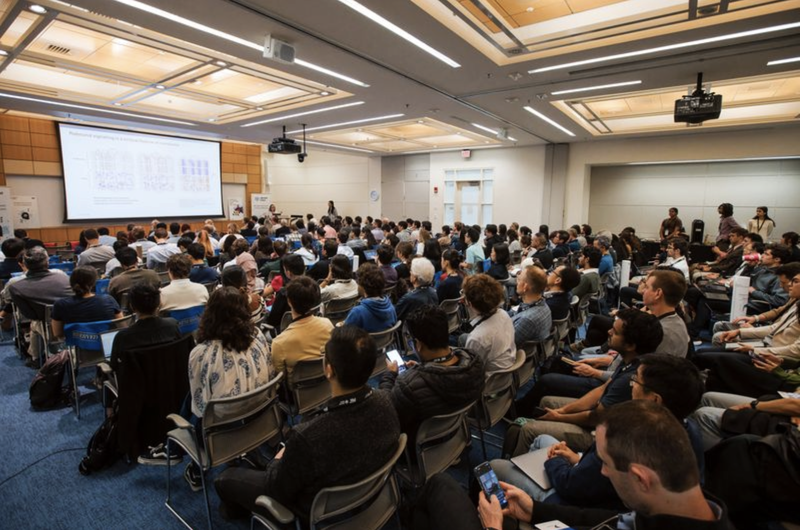
MIT’s Molecular Machine Learning Conference explores how AI is transforming drug discovery #
On Oct. 14, researchers gathered around rows of posters at MIT’s Koch Institute, drinking coffee and exchanging ideas amid the buzz of the crowd. By midmorning, the institute was alive with conversation.
This lively event marked MIT’s eighth annual Molecular Machine Learning Conference (MoML). The conference, organized by the Institute’s Abdul Latif Jameel Clinic for Machine Learning in Health, brings together researchers and industry leaders to explore the rapidly evolving intersection of artificial intelligence and drug discovery.
The conference honors the late Octavian-Eugen Ganea, an MIT researcher whose work brought together deep learning and the study of molecular structures. His research explored how AI could better understand the three-dimensional structures and interactions of molecules, questions that continue to shape the field today.
From AI models that uncover hidden drug-binding sites to tools that predict molecular interactions, the conference offered a glimpse into how advances in AI are opening new possibilities for understanding molecules and developing medicines. From prediction to discovery
Where on a protein might a drug bind? Finding these tiny pockets is one of the many challenges in drug discovery.
At MoML, MIT PhD student Tally Portnoi ’17, MEng ’18 presented the zPocket model, which earned the conference’s Best Paper Award. The model tackles what’s known as blind pocket identification: finding potential binding sites on a protein without knowing where to look. Instead of building a model from scratch, Portnoi and her collaborators took advantage of recent developments in AI models that predict the structures of proteins and other molecules.
During their research, the team discovered that these models have learned much more than how to predict molecular structures.
“The structure prediction task actually is a really good pre-training task for teaching these models about molecular interactions,” Portnoi explained.
Pre-training allows AI models to learn broadly useful patterns from one task before applying that knowledge to a more specialized problem. In this case, learning to predict molecular structures helps the models recognize how molecules interact, providing a foundation for identifying potential drug-binding.
Using this knowledge, the team developed zPocket to identify potential binding sites. They also designed a new benchmark, PocketWatch, to test how well pocket-finding models perform on unfamiliar proteins and challenging binding sites. On this benchmark, zPocket outperformed several existing methods, suggesting that the tool could be effective in helping researchers study protein function and develop drugs. Making these models accessible, however, is only one part of the challenge. Translating them into scalable applications raises a different set of questions, a transition that Saro Passaro, co-founder of the AI-driven drug discovery company Boltz, has navigated firsthand.
Born out of research at MIT’s Jameel Clinic, the company began with Boltz-1, an open-source AI model designed to help researchers understand how molecules interact by predicting their three-dimensional structures. The model achieved accuracy approaching that of Google’s AlphaFold 3. Its successor, Boltz-2, went a step further, predicting not only how molecules fit together, but also how strongly they bind, a crucial consideration in developing new drugs.
Training a model like Boltz-1 can cost around $150,000 to $200,000, Passaro estimated, a considerable expense for academic researchers. Developing larger models also requires substantial engineering work, from managing computational resources to scaling increasingly complex systems.
The move from academia to entrepreneurship has also changed how Passaro approaches research. He described Boltz’s work today as more “goal-driven,” with the team’s priorities increasingly shaped by the needs of its biotechnology and pharmaceutical partners.
The questions AI can’t yet answer
For all the progress in predicting molecular structures and interactions, a more fundamental challenge remains: understanding how these individual components work together to produce the complexity of life. Institute Professor Phillip A. Sharp, a Nobel laureate whose discovery of RNA splicing transformed scientists’ understanding of genes, emphasized that despite AI’s growing role in biological research, the fundamental questions scientists seek to answer remain unchanged.
“Yes, it’s accelerating what we can do, but it’s not changing what we do,” Sharp said.
While advances such as AlphaFold and Boltz have made it increasingly possible to predict molecular interactions and design drugs, identifying which biological targets to modify is still very difficult. For example, when trying to develop a new treatment for a disease, figuring out which proteins are involved and how they can be manipulated remains a much harder problem.

For Sharp, addressing that challenge requires moving beyond individual molecules toward a more integrated understanding of biological systems, including how proteins interact with DNA and RNA, how cells communicate with their neighbors, and how these relationships give rise to complex functions within the cell.
Sharp also pointed to neuroscience as one of biology’s most intriguing frontiers. Despite rapid advances in artificial intelligence, fundamental questions about how the brain processes information and gives rise to consciousness remain unanswered.
“We still have only primitive ideas as to how consciousness exists,” he remarked.
As the founding director of MIT’s McGovern Institute for Brain Research, Sharp has long recognized the potential of molecular approaches to neuroscience. He suggested that a deeper understanding of the brain could, in turn, reshape how machine learning itself works.
While the possibilities for AI in biology extend far beyond molecular modeling, researchers are also exploring how to make existing tools more useful. Portnoi, for instance, is particularly excited about AI agents that could help scientists tackle specific tasks throughout the drug development process. “On the modeling side, there’s still huge gaps in how we model protein-protein interactions and dynamic proteins and function,” Portnoi said.
Whether the next breakthroughs come from new sources of data or model architectures, there’s still plenty left to discover.
Beyond the science
For students hoping to enter this rapidly changing field, Portnoi had a simple piece of advice: stay curious, and don’t be afraid to explore. “There’s a ton of different ways to make an impact,” she said. From developing new algorithms to understanding biological problems and bringing discoveries into practice, healthcare and biotechnology need people with many different interests and skills.
Rather than following a particular path simply because its potential impact sounds exciting, Portnoi encouraged students to find work they genuinely enjoy doing.
“Learn as much as you can, but also learn what you like,” Portnoi advised.
Hannes Stärk PhD ’26, a founding scientist at Boltz, shared a similar perspective. Having been mentored by Ganea, Stärk recalled a piece of advice that has stayed with him. “Get as much feedback as possible from everyone,” he recommended, while learning to recognize which feedback is worth taking.
Reflecting on his own journey, Stärk noted that becoming a researcher is about identifying problems to solve, not just learning how to solve them. Learning which problems are worth solving is a skill that he believes will matter even more as AI becomes increasingly capable of handling technical tasks.
Stärk also shared some of Ganea’s own words, offering a glimpse into the humility with which he approached his work.
“We are all pretty small,” Ganea once reflected. “There are very, very few discoveries that are extremely groundbreaking… but even then, it makes a lot of sense to kind of stay humble.”
Five years on, MoML continues to bring together researchers pursuing ambitious questions, many of which may take years to answer. Amid the excitement of new models and scientific breakthroughs, Ganea’s words offer a reminder that discovery is rarely the work of one person alone.