MIT’s financial records show they can afford to give graduate students fair wages and benefits, but they choose not to #
Over the course of May 2026 — the final weeks of the GSU’s first contract — MIT repeatedly claimed an inability to give graduate workers rights, benefits, and protections due to a time of financial stress. Here, an analysis of MIT’s recent financial decisions and reports will be presented to explore the information behind these claims.
Funds for AI cameras while closing libraries
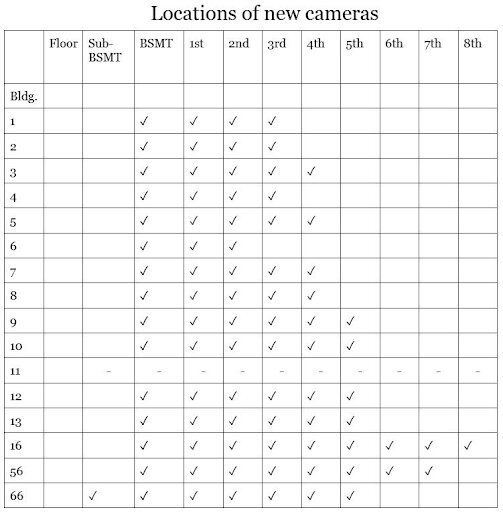
Beginning in Fall 2025, MIT spent $3 million on cameras with AI capabilities. According to The Tech, these cameras are capable of “automatically [classifying individuals] on the basis of clothing color, gender, and age, up to a distance of 35 feet (11 meters) from the camera.”
Figure 1 lists all of the on-campus locations where MIT has invested in using these cameras.
While this project was being developed, President Sally Kornbluth announced in November 2025 that federal funding cuts would lead to the closure of MIT libraries and the termination of vital academic resources, including the conservation of printed materials, along with the abrupt and unjust firing of many MIT library workers. At 6 p.m. on June 12, Dewey Library — one of five libraries at our world-class educational institution — closed permanently. MIT instructor Elizabeth Cavicchi ’78 SM ’80 described these closures in the MIT Faculty Newsletter as “a significant retreat from [the] commitment to truth and knowledge.”
MIT financials, bond rating, and cash flow
Not only has MIT’s demonstrated a willingness to commit funds to AI-enabled cameras, but its credit ratings and asset appraisals show a very favorable financial outlook.
From the 2025 Treasurers’ Report, we read that MIT’s finances and endowment are among the strongest in the country, and that MIT enjoys a remarkably favorable bond rating. In fact, MIT’s net assets — $37,675.7 million at the end of fiscal year (FY) 2025 — were 12.3% higher than the previous year’s. Furthermore, S&P and Moody’s rated MIT bonds as AAA and Aaa in May 2025, respectively, based on a strong financial outlook. AAA is the highest rating assigned by S&P Global Ratings, while an Aaa Moody’s rating indicates that a borrower’s interest payments are “of the highest quality subject to the lowest level of credit risk.” Accordingly, the Treasurers’ Report states that “the stable outlook reflects our expectation that in the near term, MIT will maintain its excellent demand characteristics, positive operating performance, and robust financial resources.”
Enlightening statistics from the FY2025 audit and FY2024 taxes
In October 2025, PricewaterhouseCoopers published an independent financial audit for the 2024-2025 FY. This is a requirement under the Uniform Guidance, which mandates audits of entities that expend significant federal funds in the U.S.
Curious graduate workers should become acquainted with MIT’s financial practices using these reports. Historically, documents detailing the donation sources of MIT’s principal investigators (”Brown Books”) were public until they were silently taken down in 2025. It is a priority of many graduate workers that access be reinstated so that they can fully understand the impacts and purposes of their research. If you share this interest, many GSU members are interested in codifying access to these reports in their next contract. Reach out to your department stewards for more information.
Figure 2 depicts Table 3 — Student Support under Chapter I — Financial Reports, Notes to Consolidated Financial Statements from PricewaterhouseCoopers’s audit, which shows that “student support” in the form of tuition, fellowship, and employment across undergraduate and graduate students cost a total of $829 million, of which $638 million came from Institute sources.
Another way to understand MIT’s finances and to put these values into perspective is to see how much the highest-paid MIT employees make.
As reported from the Institute’s Tax Form 990 and listed in Figure 3, the highest-compensated employee in 2025 was Seth Alexander, president of the MIT Investment Management Company (MITIM Co.) since 2006. The company was created in 2004 to “steward MIT’s long-term investments.”
We also find from Form 990 that MIT’s mission is “to advance knowledge and educate students in science, technology, and other areas of scholarship that will best serve the nation and the world in the 21st century.”
MIT graduate workers make 76% of the Boston/Cambridge living wage
MIT pays their graduate workers a minimum of $51,226, which is only 76% of the living wage in Boston by MIT’s own living wage calculator.
Another way to estimate a living wage is in reference to rent. A person is “rent-burdened” if they pay more than 30% of their gross income in rent. A cost of living survey conducted by the MIT Graduate Student Council (GSC) reported that the median single graduate student spent $1,500 in rent in January 2025. Given this data, the median single graduate worker would have to make a minimum of $60,000 to clear the rent burden threshold.
A third estimation of what a reasonable wage would be in the Cambridge area is in reference to how much fellow graduate workers at peer institutions make. Across the eight private, research-focused graduate schools listed in Table 4 — Brown, Princeton, Yale, Johns Hopkins, Cornell, University of Pennsylvania, Northwestern, and University of Chicago — graduate workers make between 86% and 104% of the living wage in their respective cities.
To pay graduate workers 87% of Boston’s living wage (by the living wage calculator estimation), MIT would have to pay about $7,500 more per graduate worker, or about $38 million total, which is less than the money MIT made in tuition alone from graduate workers with external fellowships ($59.3 million) in the 2024–2025 FY.
A raise of this magnitude would represent 0.8% of MIT’s total expenses in 2025 ($4.7 billion), a year in which MIT’s net assets increased by $4.2 billion.
MIT makes more money ($112 million) from executive and professional education programs than it spends on either fellowship stipends ($70 million) or student employment ($65 million, including undergraduate and hourly appointments). In other words, MIT makes over 20% more from executive programs than all internal and external fellowship stipends, combined.
Despite these realities, MIT insists that standard raises and quality healthcare are outside the bounds of affordability for the Institute. Further, MIT has refused to codify raises and protections for graduate workers labelled as fellows, despite the financial benefit that fellowships bring to the Institute.
An analysis of the 3% fellows raise
With knowledge of MIT’s financial status, graduate students can better understand MIT’s financial decisions. One decision that has spurred great confusion is the fellows' raise.
On May 18, David Darmofal, Vice Chancellor for Graduate and Undergraduate Education, sent out an email titled “AY27 stipend levels, health insurance, and additional support” to undergraduate and graduate students. In this email, Darmofal announced that MIT would be giving a 3% raise for fellows only.
Beyond the fact that this raise is only granted to some graduate workers — based on a designation that arbitrarily separates workers doing the exact same work (e.g. the separation of teaching assistants vs. teaching fellows) — there are many inconsistencies between the value of this raise and the financial environment that graduate workers are experiencing. First, this raise is less than any of the three previous raises gained through the GSU’s first contract (5.4%, 3.5%, and 3.25% over the past three years, respectively). Second, going into AY27, MIT reports that they will raise graduate housing rent by a weighted average of 3.5%, varying by unit type. And third, the Bureau of Labor Statistics reported a 4.2% rate of inflation for the twelve months ending in May 2026. This number will likely remain high through the year as effects from the U.S. war on Iran percolate to other sectors.
A 3% raise for every graduate worker (not just fellows) totals an additional $7.7 million per year (around 5000 graduate workers times $51,266 times 3%).
To put this in perspective, MIT spent $2.09 billion on total salaries and wages in 2025, including those for staff and faculty. $7.7 million per year represents just 0.37% of this amount.
Additionally, the 2025 operating expenditure (i.e. the total money spent by the institution) was $5.1 billion. In other words, $7.7 million per year is just 0.15% of all the money that the Institute spent in 2025. And finally, $7.7 million is 0.03% of MIT’s total endowment of $27.4 billion, or 0.1% of the $7.21 billion in unrestricted endowment funds, as of 2024.
Furthermore, on June 1, MIT rejected the GSU’s proposal to extend their contract through the summer, with the 3% raise extended to all graduate workers.
MIT has repeatedly excluded fellows from the bargaining unit to unpredictably change their pay structures and to deny them the use of the collective power of graduate workers to have a voice in their working conditions. Examples in the past have included the roughly $100 difference between fellows’ and research assistants’ stipends in the Department of Mathematics, the removal of the Department of Chemical Engineering monthly fellows bonus without notice, and the denial of IDHR process to fellows. Without fellows inclusion, MIT can spontaneously choose to grant and rescind arbitrary percentage raises for workers outside the bargaining unit, as they did for Math and Chemical Engineering.
In conclusion
These financial reports, compensation statistics, and policy articles are publicly available to every MIT community member. In a time where reality seems to conflict with MIT’s communications on their ability and willingness to provide for students and employees, it becomes the responsibility of students and employees to read, analyze, and discuss.
If you feel like the inconsistency is troubling, graduate workers have the means to take action through the GSU. In bargaining for their second contract, the GSU is putting forward proposals for industry-standard raises and for fellows inclusion in the bargaining unit to ensure financial security for all graduate workers. But to hold MIT accountable and to convey that graduate workers actually care about their compensation, benefits, and protections, there has to be visibility of collective interests and a willingness to stand by them. Zahmiria Johnson is a PhD candidate in Chemical Engineering and an NSF GRFP fellow. They are currently a GSU steward for the School of Engineering.