← all posts The best AI agent evaluation tools in 2026: 10 compared on trajectory and tool-call evals, CI gates, self-hosting and price, checked against their docs.
The best AI agent evaluation tool depends on what you need it to catch. As of November 2026, of the platforms, LangSmith ships the most ready-made trajectory evaluators, Promptfoo and Pydantic Evals check tool calls with deterministic code, Langfuse, Arize Phoenix and Opik let you self-host tracing with agent evals, Inspect AI runs agents in sandboxes, and EvalShift gates a model upgrade under an agent that is already in production. One line per tool:
- +Braintrust: best for teams that iterate through experiments and want trace-level scoring on a commercial platform.
- +LangSmith: best for LangChain and LangGraph agents, and for trajectory matchers and thread-level judges you don't have to write.
- +Langfuse: best for self-hosted agent tracing with evals, where trajectory checks are code you write.
- +**[DeepEval](https://www.evalshift.dev/blog/best-ai-agent-evaluation-tools#deepeval):** best for agent metrics inside a pytest suite.
- +**[Promptfoo](https://www.evalshift.dev/blog/best-ai-agent-evaluation-tools#promptfoo):** best for deterministic tool-call and trajectory assertions in a config
file, with red teaming in the same tool.
- +Arize Phoenix: best for OpenTelemetry tracing with ready-made evaluators for tool selection, tool arguments and tool-result handling.
- +Inspect AI: best for agents that act in a real, reset environment, with error bars on the results.
- +Pydantic Evals: best for typed Python evals with deterministic tool-call checks, especially on Pydantic AI.
- +**[Opik](https://www.evalshift.dev/blog/best-ai-agent-evaluation-tools#opik):** best for a fully Apache-2.0 platform with agent judges and simulated users.
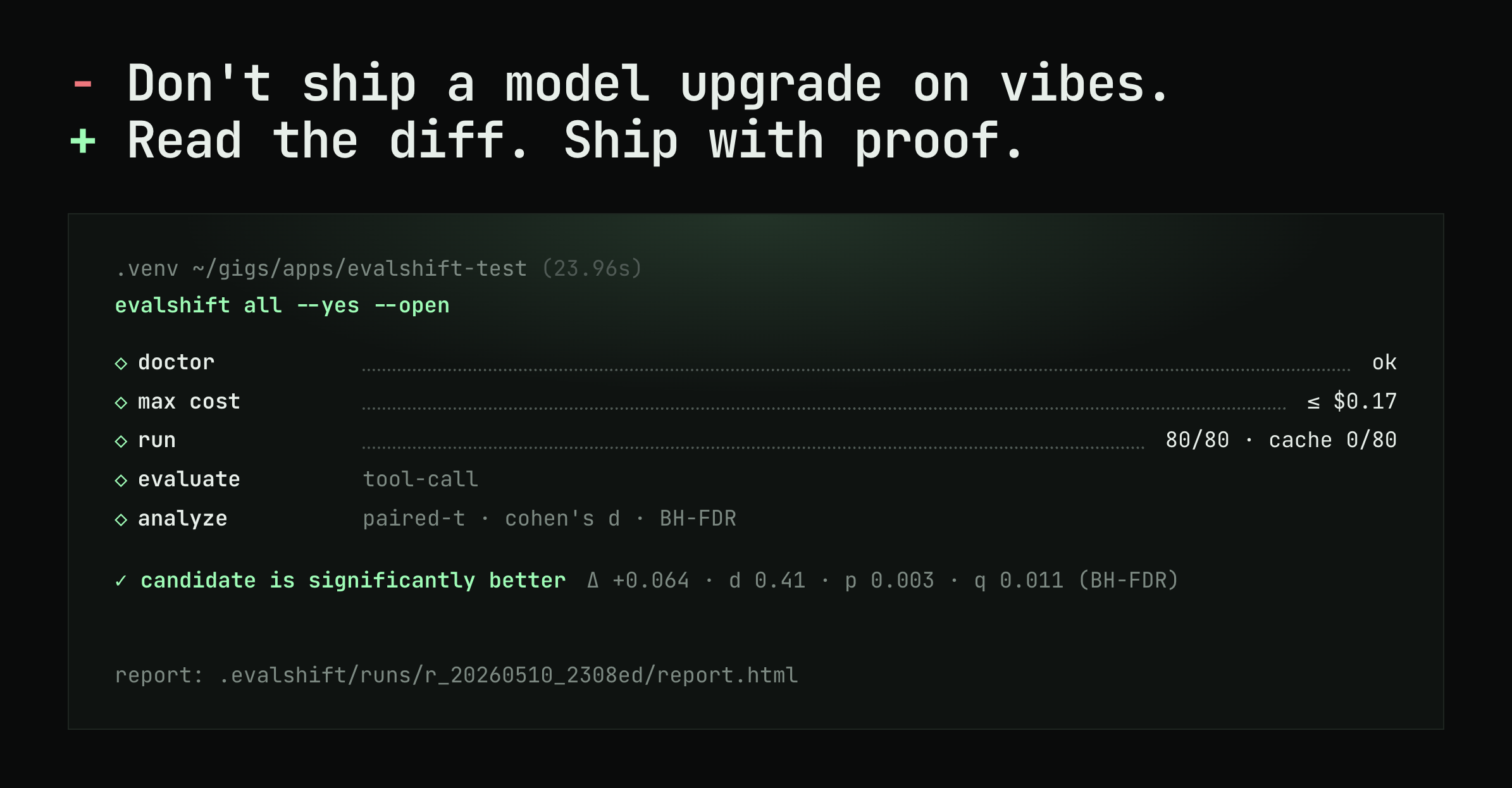
- +**[EvalShift](https://www.evalshift.dev/blog/best-ai-agent-evaluation-tools#evalshift):** best for testing an agent before a model swap, and for gating model
upgrades in CI.
Most teams end up with two or three of these, not one: something that traces production, something that runs checks on every change, and something that decides whether a change can ship. This post compares the ten on what they check in an agent run, how they plug into CI, where they run and what they cost. Every claim about another tool links to that tool's own documentation, read between November 18 and November 25, 2026.
A disclosure: I build EvalShift, which is on this list. More on that at the end.
What to evaluate in an AI agent #
An agent run is a chain of model calls and tool calls, so a tool that grades only the final reply misses most of what can go wrong. Seven things are worth checking, and the tools differ in which ones they cover out of the box:
| What to check | The question | Ready-made in |
|---|---|---|
| Task completion | Did the agent do what was asked? | DeepEval, Opik and Promptfoo, as LLM judges; Inspect AI, by checking the sandbox state |
| Tool selection | Did it call the right tools? | Promptfoo, Pydantic Evals, DeepEval, Phoenix, Opik, LangSmith's matchers, EvalShift |
| Tool arguments | Did it pass the right values? | Promptfoo, Pydantic Evals, DeepEval, Phoenix, LangSmith's matchers, EvalShift |
| Trajectory | Was the sequence of calls acceptable, without waste? | LangSmith's matchers, Promptfoo, Pydantic Evals, DeepEval, Opik, EvalShift |
| Recovery | Did it handle a failed or empty tool result? | Phoenix's Tool Response Handling evaluator; Opik's Agent Tool Correctness judge, in part; elsewhere, a check you write |
| Safety and policy | Did it break a rule that must always hold? | Promptfoo and DeepEval's DeepTeam for red teaming; EvalShift's trace rules; Braintrust's denylist recipe |
| Latency and cost | What did each run cost, in time and money? | Every tracing platform records it; Promptfoo's latency and cost assertions and EvalShift's budgets can fail on it; Pydantic Evals caps tool calls and model requests |
"Ready-made" means the tool's docs describe a built-in metric, assertion or evaluator. Every tool here lets you write the missing ones yourself. For what each of these means and how to measure it,
see [agent evaluation metrics](https://www.evalshift.dev/blog/agent-evaluation-metrics); for the process around them, see
[how to evaluate AI agents](https://www.evalshift.dev/blog/how-to-evaluate-ai-agents).
AI agent evaluation tools at a glance #
| Tool | Agent support | Trajectory evals | Tool-call evals | CI | Self-host | Best for |
|---|---|---|---|---|---|---|
| Braintrust | Span and trace scorers over agent traces | Trace scorers you write; agentAssertionScorer in TypeScript |
Recipes for required, forbidden and failed tools | eval-action posts a PR comment |
BYOC on Enterprise, operated by Braintrust | Experiment comparison on a commercial platform |
| LangSmith | Tracing, thread-level evaluators, simulated users | Trajectory match (strict, unordered, subset, superset) and trajectory judge | Argument matching inside trajectory match | pytest, Vitest, Jest | Enterprise add-on | LangChain and LangGraph agents |
| Langfuse | Tracing with nested observations, agent graph view (beta) | Code you write | Code evaluators read structured tool calls | experiment-action , fails onRegressionError |
Free, MIT except ee |
Self-hosted tracing and evals |
| DeepEval | Agent and conversation metrics | Task Completion, Step Efficiency, Plan Adherence, Plan Quality | Tool Correctness, Argument Correctness | deepeval test run under pytest |
Library runs locally | Agent metrics in pytest |
| Promptfoo | Assertions on traced agent runs | Tool sequence, step count, goal-success judge | Tool used, argument match, tool-call F1, schema validity | Exit code on a failed test or below a pass-rate threshold; Action comments on the PR and can fail on a threshold | Local CLI, MIT | Deterministic assertions and red teaming |
| Arize Phoenix | OpenTelemetry tracing, tool-use evaluators | Cookbook pattern: a judge over the trace's tool spans | Tool Selection, Tool Invocation, Tool Response Handling | pytest plugin | Free, Elastic License 2.0 | OpenTelemetry teams |
| Inspect AI | ReAct agent, agent bridge, sandboxes | Custom scorers; transcript scans with Inspect Scout | Custom scorers | Not documented | Runs locally, MIT | Agents in sandboxes, with error bars |
| Pydantic Evals | Span-based evaluators, online evaluation | TrajectoryMatch (exact, in order, any order) |
ToolCorrectness ,ArgumentCorrectness , call budgets |
Assert on the report in pytest | Library runs locally, MIT | Typed, deterministic checks |
| Opik | Tracing, agent judges, simulated users | Trajectory Accuracy judge | Agent Tool Correctness judge | llm_unit pytest decorator; test suites return a pass rate |
Free, Apache-2.0 | A fully open-source platform |
| EvalShift | Replays recorded production runs on two models | Call structure and trace rules, on both models | Tool selection and per-field arguments, on both models | Official GitHub Action fails the PR on a fail verdict | CLI and SDK run locally | Gating a model upgrade |
"Not documented" means the tool's documentation does not describe the feature as of November 2026, not that it cannot be built on top.
Braintrust #
Braintrust ↗ is a commercial eval and
observability platform built around experiments: an Eval() with a dataset, a task and scorers,
compared against a base experiment row by row. For agents, the unit that matters is the scorer's
input. A span-level scorer grades one operation, such as one tool call, and a
trace-level scorer ↗ runs once after the trace
finishes and can read all of its spans. Online scoring rules take the same choice, and can also
score a group of related traces together.
There is no catalog of agent metrics. Instead, the
custom code docs ↗ give trace-scorer recipes in
TypeScript and Python for the common checks: a required tool was called, it was called with the
right argument, a forbidden tool was not called, every tool call finished without an error, and
the run stayed inside a step budget. The TypeScript SDK packages tool-call, ordering and budget
checks as an agentAssertionScorer; the docs name no Python equivalent.
The eval-action ↗ runs evals in GitHub Actions and keeps one comment on the pull request up to date with scores and counts of improvements and regressions. Its README does not describe failing the job on a regression. Starter is free and Pro is $249 a month ↗, metered on processed data and scores. New organizations get SaaS, or BYOC on Enterprise, where Braintrust operates the data plane in your
cloud (deployment options ↗). Choose it when your team works through experiments, wants agent traces scored offline and online in one commercial product, and does not need to run the platform yourself. Braintrust alternatives covers the cost of an agent workload on it.
LangSmith #
LangSmith ↗ is LangChain's platform for tracing, evaluating and deploying agents, and it traces code outside LangChain too. Of the platforms here, it ships the most ready-made trajectory evaluation. The trajectory evaluators ↗ compare an agent's messages and tool calls with a reference in four modes: strict (same calls, same order), unordered (same calls, any order), subset (no tools outside the reference) and superset (at least the reference tools). Argument matching ↗ is configurable per tool. A trajectory judge grades the path against a rubric, with or without a reference. These evaluators are MIT-licensed, in
[agentevals ↗](https://github.com/langchain-ai/agentevals) and in
[openevals ↗](https://github.com/langchain-ai/openevals), which also ships a simulated user for
multi-turn runs.
For production, multi-turn online evaluators ↗ judge a whole conversation thread once it goes idle. Choosing the trajectory input gives the judge the tool calls and their results across the thread, and that choice is fixed when you create the evaluator.
Evals run in CI as pytest ↗, Vitest or Jest tests, where a failed assertion fails the test. The Developer plan is free for one seat and 5,000 traces a month, Plus is $39 per seat a month ↗, and self-hosting is Enterprise only.
Choose it when you build on LangChain or LangGraph, or want trajectory matching and thread
judges without writing them. [LangSmith vs Langfuse](https://www.evalshift.dev/blog/langsmith-vs-langfuse) and
[EvalShift vs LangSmith](https://www.evalshift.dev/compare/evalshift-vs-langsmith) go deeper.
Langfuse #
Langfuse ↗ is an open-source tracing platform, MIT-licensed outside its
ee folders, that records each request as nested observations on OpenTelemetry. Its evaluators,
LLM judges and code, now target observations; trace-level evaluators are
deprecated in v4 ↗ and
stopped running on Langfuse Cloud on November 16, 2026. An evaluator sees the observation it
targets, so a verdict on a whole agent run goes on the root observation and sees only what your
application wrote there.
Code evaluators ↗, in Python or TypeScript, read the observation's tool calls as a structured list with parsed arguments, and run on live traffic and on experiments. They must finish in two seconds with no network access and only the standard library. Langfuse's own agent evaluation guide ↗ puts trajectory checks such as step counts, loops, required steps and budgets in code evaluators you write; it describes no built-in trajectory evaluator, and its agent graph view, in beta, is for reading a trajectory, not scoring it.
The experiment-action ↗ runs your experiment script
on a pull request, comments the result and fails the job when the script raises a
RegressionError. Self-hosting is free; the cloud Hobby tier is free and Core is $29 a month.
Choose it when traces must stay on infrastructure you run, and you are happy to write trajectory checks as code. EvalShift vs Langfuse covers how the two fit together.
DeepEval #
DeepEval ↗ is an Apache-2.0 Python library that
runs evals as pytest tests with deepeval test run. It has six agent metrics: Task Completion,
Step Efficiency, Plan Adherence and Plan Quality over the whole trajectory, and Tool Correctness and
Argument Correctness at the component level. Its docs say almost all of its 50+ metrics are LLM
judges, so a suite needs a model key and pays a judge call per metric per case.
Tool Correctness ↗ is the exception worth knowing. It compares the tools called with the expected tools in code: names by default, input parameters and outputs if you ask, with ordering and exact matching off unless you turn them on. A model call is added only when you pass the list of available tools, to judge whether the choice was the best one. DeepEval also has conversation metrics for multi-turn agents, and red teaming in a separate project, DeepTeam ↗. Results and production tracing go to Confident AI, the proprietary platform from the same team, whose free plan covers 2 seats.
Choose it when your agent checks belong in the pytest suite the team already runs, and you
would rather pick a metric than write one. [Promptfoo vs DeepEval](https://www.evalshift.dev/blog/promptfoo-vs-deepeval)
and [EvalShift vs DeepEval](https://www.evalshift.dev/compare/evalshift-vs-deepeval) compare it in detail.
Promptfoo #
Promptfoo ↗ is an MIT-licensed CLI driven by a YAML file. Its acquisition by OpenAI was announced in March 2026, and it is still open source per its
[README ↗](https://github.com/promptfoo/promptfoo). Its
[trajectory assertions ↗](https://www.promptfoo.dev/docs/configuration/expected-outputs/deterministic/)
are the most complete set of deterministic agent checks here: trajectory:tool-used with minimum
and maximum counts, trajectory:tool-args-match in partial or exact mode, trajectory:tool-sequence
in order or exact, and trajectory:step-count by step type. They read trace data, so tracing has
to be on and the provider has to emit tool spans. tool-call-f1 and is-valid-openai-tools-call
check the tool calls in the response itself, with no trace needed.
The one judged agent check is
trajectory:goal-success ↗,
which summarizes the traced run and asks a model whether it reached the goal you wrote. Red teaming
is built in. In CI, promptfoo eval
exits with code 100 ↗ when a test fails or the
pass rate drops below PROMPTFOO_PASS_RATE_THRESHOLD, so it fails the job on its own. The
GitHub Action ↗ comments pass and fail counts on the
pull request, and fails the job too if you set fail-on-threshold.
Choose it when you want tool-call and trajectory checks in a config file that run locally with no judge, plus red teaming in the same tool. EvalShift vs Promptfoo goes dimension by dimension.
Arize Phoenix #
Phoenix ↗ is Arize's tracing and evaluation tool, built on OpenTelemetry and the OpenInference conventions, and free to self-host with pip, Docker or Helm. Its license is the Elastic License 2.0, which is source-available, not OSI open source.
Of the tools here, it is the only one with a dedicated evaluator for tool-result handling. Its pre-built evaluators include Tool Selection ↗, which grades the choice of tool and deliberately ignores arguments, Tool Invocation ↗, which grades arguments and formatting, and Tool Response Handling ↗, which grades what the agent did with a tool's result: whether it used the data accurately, retried a transient error and kept sensitive values out of its reply. Opik's Agent Tool Correctness judge covers part of that ground, since it also asks whether the agent read tool outputs accurately. All three of Phoenix's tool evaluators are LLM judges by default. Grading a whole run is a cookbook pattern ↗: pull the spans, group them by trace, rebuild the tool path and write a judge for it.
A pytest plugin ↗ records each marked test as a run in a Phoenix experiment, and a failed assertion fails the job. Arize AX is the commercial product.
Choose it when you are standardizing on OpenTelemetry, want tool-use evaluators you don't have to write, and will host the platform yourself.
Inspect AI #
[Inspect AI ↗](https://inspect.aisi.org.uk/) is an
[MIT-licensed ↗](https://github.com/UKGovernmentBEIS/inspect_ai/blob/main/LICENSE) Python framework
from the UK AI Security Institute and Meridian Labs. It is built for running agents, not only
grading them: [agents ↗](https://inspect.aisi.org.uk/agents.html) include a built-in ReAct loop,
multi-agent handoffs, and an agent bridge for agents written with the OpenAI Agents SDK, LangChain or Pydantic AI. Sandboxes ↗ run in Docker out of the box, and in Kubernetes, Modal, Daytona, Proxmox and others through extensions, so an agent can act on a real environment that is reset between samples.
Its built-in scorers ↗ grade the final output against a target; trajectory and tool-call checks are custom scorers you write. Inspect Scout ↗, a companion tool, scans agent transcripts with LLM or pattern scanners, and reads logs from Inspect and from several tracing platforms. Results carry standard errors ↗, and repeated epochs can be reduced to pass@k. Its docs describe no pull-request gate.
Choose it when the agent must act in an environment you can inspect afterwards, or you run capability and safety evals and want error bars on the numbers.
Pydantic Evals #
[Pydantic Evals ↗](https://github.com/pydantic/pydantic-ai/blob/main/docs/evals.md) is the
[MIT ↗](https://pypi.org/project/pydantic-evals/) eval package from the Pydantic AI repository, and
installs on its own. An eval is typed Python: a dataset of cases, evaluators, and the function
under test. Its
agent evaluators ↗
make no model call: ToolCorrectness checks the expected set of tools, duplicates included,
TrajectoryMatch scores the ordered call sequence in exact, in-order or any-order mode,
ArgumentCorrectness checks one call's arguments, and MaxToolCalls and MaxModelRequests enforce
budgets.
They read OpenTelemetry spans through the logfire SDK, with no Logfire account needed. The limit
to know: they see only tools Pydantic AI executes itself, so a provider's native tools, such as
web search, are invisible to them. Evaluators can also grade a sample of live traffic through
online evaluation ↗.
It has no CLI or pytest plugin. The docs'
pytest example ↗
runs the dataset inside a test and asserts on the report, so a failed assertion fails the job.
Choose it when your agent runs on Pydantic AI, or you want deterministic tool-call checks as plain typed Python.
Opik #
Opik ↗, from Comet, is Apache-2.0, and the full platform is free to self-host with Docker Compose or Helm. It has 43 built-in metrics ↗. The agent ones, Agent Task Completion, Agent Tool Correctness and Trajectory Accuracy ↗, are LLM judges; Trajectory Accuracy takes the goal, the steps as thought, action and observation, and the final result. For multi-turn agents, a simulated user ↗ with a persona generates the follow-up messages, and conversation metrics score the result.
Opik 2.0 ([changelog ↗](https://www.comet.com/docs/opik/changelog/2026/5/5)) adds
[test suites ↗](https://www.comet.com/docs/opik/evaluation/advanced/building-test-suites):
natural-language assertions checked by a judge, with an execution policy that runs each item
several times and sets how many runs must pass. opik.run_tests returns a pass rate, so gating on
a suite means checking a threshold in your own script. For plain pytest, the
llm_unit ↗ decorator
logs each test to an Opik experiment, and a failed assertion fails the job. Online evaluation
rules score production traces.
Choose it when you want a platform like Langfuse or Phoenix under a permissive license, with agent judges, simulated users and repeated runs built in.
EvalShift #
EvalShift tests an agent before a model swap. The capture SDK records real model and tool
calls from your production agent, through wrappers for the OpenAI, Anthropic and Google GenAI
clients or a LangChain callback, and evalshift capture sync promotes them into a golden suite.
One run replays every example through the current model and the candidate. Cases synced with
--rounds all replay each recorded round of the agent loop with its recorded tool results, so
both models see the same context at each step, up to the first round whose tool call has no
recorded result.
Both sides are scored on tool selection, per-field tool arguments and call structure, and held to trace rules you write: forbidden and required tools, call order, call counts and argument schemas, with violations budgeted as a count. Each difference is tested for significance with a paired t-test or Wilcoxon signed-rank test, an effect size with a confidence interval, and a false-discovery-rate correction across the run. A migration policy, with budgets for regressions, cost and latency, turns that into one verdict (pass, conditional pass, fail or inconclusive), and by default the GitHub Action fails the pull request only on a fail.
It does not execute tools against a live system, drive conversations with a simulated user, red team, or trace production for monitoring, so it sits next to a tracing platform rather than replacing one. It runs offline, in Python. The CLI is Apache-2.0 and the SDK and Action are MIT; the hosted gate, which the Action uses, is $49 a month on Starter and $199 on Pro.
Choose it when you are switching or upgrading the model under an agent that is already in production, and want the pull request to fail when the candidate behaves worse. LLM regression testing for a model upgrade walks through one.
An example agent evaluation stack #
The tools above answer three different questions, and a working setup usually puts one tool on each:
| Layer | Question | When it runs | Tools that fit |
|---|---|---|---|
| Tracing and online evals | What is the agent doing in production right now? | Continuously, on live traffic | Langfuse, LangSmith, Phoenix, Opik, Braintrust |
| Automated evals | Does this version pass the checks we wrote? | On every change | DeepEval, Promptfoo, Pydantic Evals, Inspect AI, or the platform's own experiments |
| Release gate | Is the candidate worse than what runs today, beyond noise? | Before a model or prompt change merges | EvalShift |
A concrete version for a support agent: Langfuse traces every production run, with a code evaluator that flags runs over a step budget and a judge on a sample of replies. Promptfoo runs trajectory assertions on hand-written edge cases on every pull request: the refund tool is called once, with the order ID, after the policy lookup. When the team wants to move to a new model, EvalShift replays a few hundred recorded production runs on both models and fails the pull request if tool selection, arguments or trace rules regress by more than noise, or cost or latency rise past their budget.
A failure found in production becomes a case in the automated suite, and the release gate keeps the next change from bringing it back.
[Build a golden dataset from production traffic](https://www.evalshift.dev/blog/build-a-golden-suite-from-production-traffic)
covers that loop, and [LLM regression testing in CI](https://www.evalshift.dev/blog/llm-regression-testing-in-ci) covers
what to block on.
Disclosure #
I build EvalShift, so I am not a neutral judge of where it belongs on this list. I have tried to keep its section to what its docs say it does and does not do, and to describe the other nine from their own documentation rather than their marketing or mine. If something about another tool is wrong or out of date, tell me and I will correct it.
FAQ #
What are the best AI agent evaluation tools? It depends on the job. As of November 2026: LangSmith for the most ready-made trajectory evaluators of the platforms, Braintrust for experiment comparison on a commercial platform, Langfuse, Phoenix or Opik for self-hosted tracing with agent evals, DeepEval or Promptfoo for agent checks in a test suite, Pydantic Evals for deterministic tool-call checks in Python, Inspect AI for agents in sandboxes, and EvalShift for gating a model upgrade.
What should an AI agent evaluation tool measure? The trace as well as the reply: task completion, which tools were called, the arguments passed, the order and number of calls, how the agent handled a failed tool result, whether it broke a rule, and the latency and cost of each run. A tool that grades only the final reply will pass an agent that skipped a tool call.
**Which AI agent evaluation tools are open source?** Promptfoo (MIT), DeepEval (Apache-2.0),
Inspect AI (MIT), Pydantic Evals (MIT), Langfuse (MIT except its ee folders) and Opik
(Apache-2.0). Arize Phoenix is source-available under the Elastic License 2.0. LangSmith and Braintrust are proprietary, with MIT evaluator libraries. The EvalShift CLI is Apache-2.0, and its SDK and GitHub Action are MIT.
Which agent evaluation tools check tool calls without an LLM judge? Promptfoo's trajectory assertions, Pydantic Evals' ToolCorrectness, TrajectoryMatch and ArgumentCorrectness, LangSmith's trajectory match evaluators, DeepEval's Tool Correctness by default, and EvalShift's tool selection, argument and trace rule checks. Opik's agent metrics and Phoenix's tool evaluators are LLM judges.
Which agent evaluation tools can fail a pull request? Promptfoo's CLI exits with code 100 when a test fails or the pass rate drops below a threshold, and its GitHub Action can fail on a pass threshold. Langfuse's GitHub Action fails the job when your experiment script raises a RegressionError, and EvalShift's fails the pull request when the migration verdict is a fail. LangSmith, DeepEval, Phoenix and Opik gate through pytest exit codes, and Pydantic Evals through a pytest assertion on its report. Braintrust's action comments results on the pull request.
Do I need more than one agent evaluation tool? Usually. A tracing platform shows what the agent does in production, an eval framework checks each change against cases you wrote, and a release gate compares the current and candidate versions before a model or prompt change ships. Most of these tools run side by side without integration.
Keep reading #
- +How to evaluate AI agents : what to measure, at which level and against which environment, whatever tool you pick.
- +Agent evaluation metrics : how each metric is computed, and the agent benchmarks that report them.
- +Evaluating agent tool calls : what a tool-call check has to get right, field by field.
- +[AI evals for agents](https://www.evalshift.dev/blog/ai-evals-for-agents) : how to write one agent eval, step by step.
- +[The best LLM evaluation tools](https://www.evalshift.dev/blog/best-llm-evaluation-tools) : the wider field, including RAG
and prompt evaluation.