Azure OpenAI retires gpt-4o 2024-05-13 on January 14, 2027 and GPT-4o mini and GPT-4.1 on April 14. Every date, what auto-upgrades, and how to migrate.
The next big Azure OpenAI model retirement is gpt-4o version 2024-05-13 on January 14, 2027. On
that day, Global Standard and Data Zone Standard deployments of it are upgraded to gpt-5.1
version 2025-11-13 automatically, and Provisioned deployments stop serving. Three months later, on
April 14, 2027, Azure retires gpt-4o versions 2024-08-06 and 2024-11-20, gpt-4o-mini,
gpt-4.1, gpt-4.1-mini and gpt-4.1-nano. Every o-series model still on Azure's schedule ( o1,
o1-pro, o3, o3-pro, o3-mini, o4-mini and o3-deep-research) was scheduled to retire on
November 19, 2026.
Four things about Azure's retirements catch teams that know OpenAI's:
- +The dates are Azure's own.
gpt-4o2024-08-06 shuts down on OpenAI's API on January 14, 2027 and on Azure on April 14, 2027. The o-series is mixed:o3ando3-prowere scheduled to retire on Azure on November 19, 2026, three weeks before OpenAI's December 11, whileo1,o3-miniando4-minishut down on OpenAI's API first, on October 23. - +A retirement can swap the model under you. Standard deployments are upgraded at retirement
by default, under the same deployment name. A Global or Data Zone Standard deployment of
gpt-4o2024-05-13 is upgraded in place, region by region, from January 14, and starts answering with a reasoning model your code never called. - +Deprecated means closed to new subscriptions. Once a model is Deprecated, only an Azure subscription that has already deployed that exact version can create new deployments of it. A new subscription in the same tenant can't.
- +The replacement is named late, and the date can't move. Microsoft picks the official replacement about 90 to 120 days before retirement, and its FAQ says retirement dates aren't extendable.
The rest of this post is every upcoming Azure OpenAI date for text and reasoning models, what
happens to each deployment type on the day, what changes when gpt-4o becomes gpt-5.1, the
fine-tuned model dates, and a six-step migration. The facts come from Microsoft's
model retirement schedule ↗
(last updated November 18, 2026), its
lifecycle and support policy ↗,
its model versions ↗
and reasoning models ↗
pages, all read on November 19, 2026. Azure OpenAI is now documented under Microsoft Foundry, and
Microsoft revises the schedule often, so check it again before you act on a date.
Azure OpenAI retirement dates, November 2026 to July 2027 #
These are the chat, reasoning and Codex models. Each row is one model version, which is how Azure retires models: a deployment pins a version, and the version is what retires.
| Retirement date | Model and version | Stage today | Listed replacement |
|---|---|---|---|
| November 17, 2026 (past) | codex-mini 2025-05-16;gpt-chat-latest 2026-05-05 and 2026-06-24 |
Retired | None listed |
| November 19, 2026 (past) | o1 2024-12-17,o1-pro 2025-03-19,o3 2025-04-16,o3-pro 2025-06-10,o3-deep-research 2025-06-26 |
Retired | gpt-5.6-sol |
| November 19, 2026 (past) | o3-mini 2025-01-31,o4-mini 2025-04-16 |
Retired | gpt-5.6-terra |
| December 8, 2026 | gpt-chat-latest 2026-05-28 |
Preview | None listed |
| January 12, 2027 | gpt-chat-latest 2026-08-06 |
Preview | None listed |
| January 14, 2027 | gpt-4o 2024-05-13 |
Deprecated | gpt-5.1 2025-11-13, applied automatically on Global Standard and Data Zone Standard |
| February 2, 2027 | gpt-chat-latest 2026-10-07 |
Preview | None listed |
| February 9, 2027 | gpt-5 2025-08-07,gpt-5-nano 2025-08-07 |
GA | None listed |
| March 17, 2027 | gpt-5-codex 2025-09-15 |
GA | None listed |
| April 7, 2027 | gpt-5-pro 2025-10-06 |
GA | None listed |
| April 14, 2027 | gpt-4o 2024-08-06 and 2024-11-20 |
Deprecated; Legacy | gpt-5.1 |
| April 14, 2027 | gpt-4o-mini 2024-07-18,gpt-4.1 ,gpt-4.1-mini andgpt-4.1-nano 2025-04-14 |
Deprecated | None listed yet |
| May 15, 2027 | gpt-5.1-codex andgpt-5.1-codex-mini 2025-11-13 |
GA | None listed |
| May 18, 2027 | gpt-5.1-codex-max 2025-12-04 |
GA | None listed |
| June 8, 2027 | gpt-5.2 2025-12-11 |
GA | None listed |
| July 13, 2027 | gpt-5-mini 2025-08-07,gpt-5.1 2025-11-13,gpt-5.2-codex 2026-01-14 |
GA | None listed |
"None listed yet" on the April 14 row is expected. Microsoft names the official replacement about
90 to 120 days before a retirement, so the gpt-4o-mini and GPT-4.1 targets should appear
between mid-December and mid-January. Don't wait for it: the policy says the listed replacement
"doesn't limit your manual migration choices."
The audio and speech models have their own dates. whisper, tts and tts-hd retire on
December 15, 2026, the March 2025 gpt-4o-mini-transcribe and gpt-4o-mini-tts versions on
January 20, 2027, gpt-4o-transcribe 2025-03-20 on February 26, 2027, and gpt-audio and
gpt-realtime 2025-08-28 on March 2, 2027. The embedding models, text-embedding-3-large,
text-embedding-3-small and text-embedding-ada-002, run until February 9, 2028.
For the same dates side by side with OpenAI, Anthropic, Google and AWS Bedrock, see the LLM model deprecation schedule.
What happens to a deployment on the retirement date #
A retired model version returns 410 Gone on every inference request. Whether your deployment is
still on that version when the date arrives depends on two things: its deployment type and its
version upgrade policy.
| Deployment | What happens at retirement |
|---|---|
Global Standard, Data Zone Standard or Standard, upgrade policy OnceCurrentVersionExpired (the default) |
Upgraded under the same deployment name, on a rolling region-by-region schedule: to Microsoft's listed replacement where it's offered for that deployment type and region, otherwise to the current default version |
Same, upgrade policy OnceNewDefaultVersionAvailable |
Already moves to each new default version within two weeks of it becoming the default |
Same, upgrade policy NoAutoUpgrade |
Stops working. Requests fail until you point the deployment at a supported version |
| Global, Data Zone or Regional Provisioned | Never upgraded automatically. Stops serving unless you migrated it first |
| Global Batch | Not covered by the automatic upgrade. Deploy the new model and resubmit jobs to it |
| Preview models, any type | Force-upgraded to a newer version or retired, with at least 30 days' notice. There's no staying on a retiring preview |
Two details in the upgrade path matter. First, a deployment that never had its policy set shows
no versionUpgradeOption at all, and Microsoft documents a missing value as equivalent to
OnceCurrentVersionExpired. So unless someone chose otherwise, your Standard deployments will be
upgraded. Second, the upgrade doesn't wait for the replacement to exist in your region. Microsoft's
model versions page says that if the new version isn't available in a region yet, it deploys it
there as part of the upgrade.
gpt-4o 2024-05-13 has a third wrinkle: its Regional Standard deployments already retired on March
31, 2026. The January 14 date covers Global Standard, Data Zone Standard, the three Provisioned
types and Global Batch.
What changes when gpt-4o becomes gpt-5.1 on January 14 #
Microsoft's listed replacement for every gpt-4o version is gpt-5.1, pinned to version
2025-11-13 for the 2024-05-13 retirement. For that version, Global Standard and Data Zone Standard deployments switch to it automatically
on January 14. The deployment keeps its name, your code keeps calling the same endpoint, and the
answers now come from a different model. Here is what differs:
- +
gpt-5.1is a reasoning model. On Azure itsreasoning_effortdefaults tonone, so after the upgrade it answers without reasoning unless you send a higher effort. Microsoft's reasoning page calls this out as a migration note for code coming from older reasoning models. - +Some request parameters are listed as unsupported. Azure's reasoning models page says
reasoning models other than GPT-6 Astra don't support
temperature,top_p,presence_penalty,frequency_penalty,logprobs,top_logprobs,logit_biasormax_tokens, and that Chat Completions needsmax_completion_tokensinstead ofmax_tokens. The page makes no exception fornone, so test the exact request your code sends: agpt-4orequest withtemperatureandmax_tokensis the most common shape there is. - +Azure's feature table lists streaming as unsupported for
gpt-5.12025-11-13. OpenAI's own model page lists streaming as supported, so this may be a gap in Azure's table, but test your streaming requests against agpt-5.1deployment before January 14 rather than find out on the day. - +Reasoning tokens are billed as output. At
nonethere are few or none. If you raise the effort to recover quality, the cost per request rises with it, andmax_completion_tokenscaps reasoning and visible output together. - +The upgrade buys six months.
gpt-5.12025-11-13 itself retires on Azure on July 13, 2027, and OpenAI's API already listsgpt-5.1as deprecated, with an April 1, 2027 shutdown. A deployment that rides the January 14 upgrade will face another migration by July.
That last point is the reason not to treat the automatic upgrade as the migration. It keeps the endpoint up. It doesn't test the new model on your traffic, and it lands you on a version with its own date.
The April 14 retirement of gpt-4o 2024-08-06 and 2024-11-20 also lists gpt-5.1 as the
replacement. For gpt-4o-mini and the GPT-4.1 models, no replacement is listed yet, so nobody can
tell you today which model a Standard deployment of them will be upgraded to.
Azure OpenAI and OpenAI retire the same models on different dates #
Azure and OpenAI each run their own schedule for the same model families:
| Model and version | OpenAI API | Azure OpenAI |
|---|---|---|
gpt-4o 2024-05-13 |
Shut down October 23, 2026 | January 14, 2027 |
gpt-4o 2024-08-06 and 2024-11-20,gpt-4o-mini ,gpt-4.1 ,gpt-4.1-mini |
January 14, 2027 | April 14, 2027 |
gpt-4.1-nano |
Shut down October 23, 2026 | April 14, 2027 |
o3 ,o3-pro |
December 11, 2026 | November 19, 2026 |
o1 ,o3-mini ,o4-mini |
Shut down October 23, 2026 | November 19, 2026 |
gpt-5 ,gpt-5-nano |
December 11, 2026 | February 9, 2027 |
gpt-5-mini |
December 11, 2026 | July 13, 2027 |
gpt-5.1 |
April 1, 2027 | July 13, 2027 |
Two consequences follow. A team on both platforms can't plan from one page, because a fallback
from Azure to OpenAI (or the reverse) can point at a model that is already gone on the other
side. And the replacements differ: OpenAI's listed replacement for gpt-4o and gpt-4.1 is
gpt-6-luna, while Azure's is gpt-5.1. The
GPT-4o and GPT-4.1 shutdown guide covers OpenAI's side.
Fine-tuned models outlive their base model on Azure #
On Azure, a fine-tuned model retires in two phases: training, when you can no longer create new fine-tunes of that base, and deployment, when existing fine-tuned deployments stop serving. The deployment dates run months past the base model's retirement:
| Base model and version | Base model retires | Training retires (existing customers) | Fine-tuned deployments retire |
|---|---|---|---|
gpt-4o 2024-08-06 |
April 14, 2027 | No earlier than April 1, 2027 | October 1, 2027 |
gpt-4o-mini 2024-07-18 |
April 14, 2027 | No earlier than April 1, 2027 | October 1, 2027 |
gpt-4.1 2025-04-14 |
April 14, 2027 | No earlier than April 14, 2027 | October 14, 2027 |
gpt-4.1-mini 2025-04-14 |
April 14, 2027 | No earlier than April 14, 2027 | October 14, 2027 |
gpt-4.1-nano 2025-04-14 |
April 14, 2027 | No earlier than April 14, 2027 | April 13, 2028 |
o4-mini 2025-04-16 |
November 19, 2026 | No earlier than May 19, 2027 | November 19, 2027 |
For customers who haven't fine-tuned that base before, training retires with the base model. The
o4-mini row is the one to double-check: the retirement schedule says November 19, 2027, but the
lifecycle policy page, last updated July 24, 2026, still says October 16, 2027 for deployments and
April 16, 2027 rather than May 19 for training.
This is the biggest difference from OpenAI's API, where fine-tunes of gpt-4o and gpt-4.1 stop
serving on January 14, 2027 together with their base. If you run fine-tunes on both platforms, the
Azure copy is the one you can still record a baseline from in mid-2027.
How Azure's model lifecycle works #
Microsoft's lifecycle policy gives every model one of five stages:
| Stage | New deployments | Existing deployments |
|---|---|---|
| Preview | Yes | Work, but weights and API can change, and the model can be force-upgraded or retired with 30 days' notice |
| Generally available (GA) | Yes | Work |
| Legacy (optional) | Yes, until deprecation | Work |
| Deprecated | Only subscriptions that have deployed this exact model version | Work |
| Retired | No | Every request returns 410 Gone |
A GA model's retirement date is set when it launches, normally 18 months out, and Microsoft says
there is no separate announcement: the date is set at launch and readable from the Models API.
Not every model gets 18 months (gpt-6.1-terra 2026-10-26 is listed to retire after 12), so read
the date rather than assume it. The standard pattern is deprecation at 12 months, the replacement available on Global Standard about
90 days before retirement and on Provisioned about 30 days before, and retirement at 18 months.
GA models from Anthropic, DeepSeek, Fireworks and Mistral AI on Foundry follow a 12-month
lifecycle instead.
The Deprecated stage is where teams get caught. "Existing customer" is decided per Azure
subscription: whether that subscription has ever deployed that model version. A new subscription
for a new environment or region, even under the same tenant, can't deploy a Deprecated model. That
is why gpt-4o 2024-11-20 matters: it is Legacy, not Deprecated, so it is the one gpt-4o
version a new subscription can deploy today, until Microsoft moves it to Deprecated. Microsoft
can also limit new customers in specific regions.
Microsoft notifies subscription owners with active deployments by email at least 60 days before a GA retirement and at least 30 days before a preview one, and posts Azure Service Health advisories. Service Health has no "Microsoft Foundry" service: filter on Azure OpenAI Service. Security or compliance problems can trigger an emergency retirement with shorter notice, and the policy FAQ says retirement dates can't be extended. Azure Government clouds usually run one version of a model at a time, with a 30-day overlap when a new one arrives.
Step 1: Inventory every deployment and its upgrade policy #
The retirement schedule lists models, but what retires for you is deployments. List them per Azure OpenAI resource with the Azure CLI:
az cognitiveservices account deployment list \
  --resource-group my-rg --name my-openai-resource \
  --query "[].{deployment:name, model:properties.model.name, version:properties.model.version, sku:sku.name, upgrade:properties.versionUpgradeOption}" \
  --output table
An empty upgrade column means the policy was never set, which behaves as
OnceCurrentVersionExpired. Then check each model's lifecycle from the Models API, which is
subscription-scoped and per region:
az rest --method get \
  --url "https://management.azure.com/subscriptions/$SUBSCRIPTION_ID/providers/Microsoft.CognitiveServices/locations/eastus2/models?api-version=2024-10-01" \
  --query "value[?model.name=='gpt-4o'].{version:model.version, status:model.lifecycleStatus, retires:model.deprecation.inference}" \
  --output table
The response is paged, so follow its nextLink if a model you deploy doesn't appear. The Models
API names the stages differently from the docs and the portal. The API's
Deprecating is what the docs call Deprecated (still serving, closed to new subscriptions), and
the API's Deprecated means Retired. Microsoft's own advice is to also compare
deprecation.inference with today's date, because lifecycleStatus can lag. A check that alerts
on Deprecated alone fires after the model is already gone.
Deployment names hide the model. A deployment called chat-prod tells you nothing, so record the
model and version next to every deployment name your code, Terraform and eval harness use.
Step 2: Decide what each deployment should do on the date #
For each Standard deployment on a retiring version, pick one of two paths:
- +Let it auto-upgrade, deliberately. Fine for internal tools where an endpoint outage is worse
than a behavior change. Know the target (
gpt-5.1forgpt-4o) and its own July 13, 2027 date. - +Migrate it yourself before the date. For anything customer-facing, deploy the target model as
a new deployment, test it, and move traffic yourself. You choose the model, the
reasoning_effortand the day.
If you take the second path, set versionUpgradeOption to NoAutoUpgrade on the old deployment
only if you'd rather have requests fail loudly than be silently answered by a model you didn't
test. Microsoft's docs note that the Azure CLI can show the setting but can't change it; use the
portal, the REST API or Azure PowerShell.
Provisioned deployments get no automatic path at all. Plan an in-place migration, which Microsoft says moves traffic over a 20 to 30 minute window without downtime, or a side-by-side one, and confirm you have PTU quota for the target model before the date.
Step 3: Record a baseline while the old version still answers #
After the retirement date, the old version returns 410 Gone, and with an auto-upgraded deployment
you can't even tell from the endpoint when it changed. Record real production inputs now, 100 to
300 per route, with the tools each one called, their arguments, the structured fields returned and
the refusals. That record is the only way to compare the new model against what your users actually
got. Log the model field of each response too: on Azure it normally carries the model name and
version, such as o1-2024-12-17 in Microsoft's samples, which is how you see an upgrade land.
Step 4: Deploy the target side by side and replay real traffic #
Create a new deployment of the candidate, gpt-5.1 or anything newer that is available in your
region and deployment type, next to the old one. Replay the recorded inputs through both and
compare per route:
- +tool selection and arguments, compared deterministically, not by eye;
- +structured output fields and refusals;
- +the request errors from parameters the new model rejects;
- +cost per request and reasoning tokens, at each
reasoning_effortyou are considering; - +latency at the percentiles you alert on.
For a reasoning model, sample each case more than once: the answers vary from run to run, and a single pass can't tell a regression from noise.
Step 5: Move traffic and remove the old version from every fallback #
Switch one route at a time behind a flag, starting with the lowest-risk one. Remove the retiring
deployment from every fallback list and retry chain before the date, because a fallback to a
retired version fails exactly when you need it. Watch error rates, cost, latency and the response
model field for a week after each switch.
Step 6: Put the next retirement date in CI #
Every GA model on Azure has a retirement date from its first day, so the next migration is
already scheduled. Add a CI check that reads deprecation.inference from the Models API for every
model version you deploy and fails when one is less than 90 days away. Set up an Azure Service
Health alert on Azure OpenAI Service as well, since the email goes to subscription owners, who are
often not the engineers running the deployment.
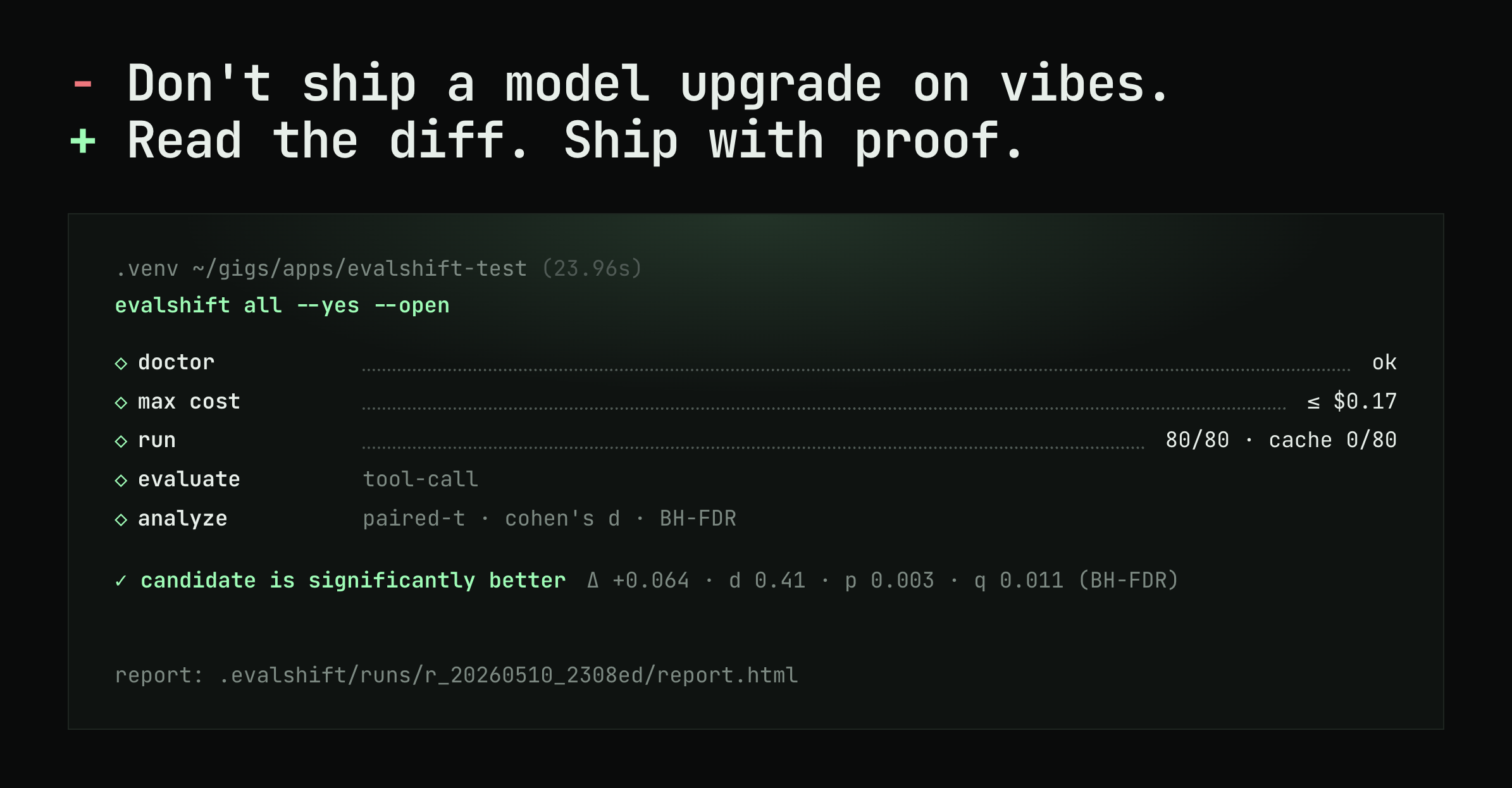
Doing this with EvalShift #
Disclosure: I'm the founder of EvalShift, and steps 3 and 4 are the part it automates. The capture
SDK's wrap_openai wraps any OpenAI client, including one pointed at your Azure resource's
/openai/v1/ endpoint, and records the deployment name you pass as model:
from openai import OpenAI
from evalshift import capture
from evalshift.adapters.openai import wrap_openai

client = wrap_openai(
    OpenAI(base_url="https://my-openai-resource.openai.azure.com/openai/v1/", api_key=AZURE_KEY)
)

@capture.agent(suite="support", redact=True, tools=TOOLS)  # no-op unless EVALSHIFT_CAPTURE=1
def handle_ticket(message): ...
compare calls models through LiteLLM, which addresses an Azure deployment as
azure/<deployment-name> and reads AZURE_API_KEY, AZURE_API_BASE and AZURE_API_VERSION:
evalshift capture sync
evalshift compare --suite-name support --from azure/gpt-4o-prod --to azure/gpt-5-1-test
One limit as of EvalShift 1.6.2: tool-call scoring maps a model ID to the OpenAI, Anthropic or
Gemini response shape by its name, and azure/ IDs aren't mapped yet, so a suite that offers tools
fails on them. Until that ships, run tool-calling suites against the same versions on OpenAI's API
while both still serve there, for example --from gpt-4o-2024-08-06 --to gpt-5.1-2025-11-13, and
smoke-test the Azure deployment itself before the switch. EvalShift sends temperature=0; when a
model rejects it, EvalShift resends without it and marks the run as non-deterministic in the
report, so set defaults.samples_per_example above 1 for the reasoning model. Docs:
/docs/sdk-adapters, /docs/captures,
/docs/migration-policy.
FAQ #
When does GPT-4o retire on Azure OpenAI? gpt-4o version 2024-05-13 retires on January 14,
2027, and versions 2024-08-06 and 2024-11-20 retire on April 14, 2027, together with gpt-4o-mini
2024-07-18. Regional Standard deployments of 2024-05-13 already retired on March 31, 2026.
Fine-tuned gpt-4o and gpt-4o-mini deployments keep serving until October 1, 2027.
What happens to my Azure OpenAI deployment when its model retires? Global Standard, Data Zone
Standard and Standard deployments are upgraded under the same deployment name, to the listed
replacement where it's offered for that deployment type and region, unless their upgrade policy is NoAutoUpgrade, in which case they stop working. Provisioned
deployments are never upgraded automatically and stop serving. A retired model version returns
410 Gone on every request.
What replaces GPT-4o on Azure OpenAI? Microsoft lists gpt-5.1 for every gpt-4o version,
pinned to version 2025-11-13 for the January 14 retirement. It is a reasoning model whose reasoning_effort defaults to none on Azure, and
it retires on Azure on July 13, 2027. No replacement is listed yet for gpt-4o-mini or the GPT-4.1
models, which Microsoft usually names 90 to 120 days before the retirement date.
Are Azure OpenAI retirement dates the same as OpenAI's? No. Azure runs its own schedule. gpt-4o
2024-08-06, gpt-4o-mini, gpt-4.1 and gpt-4.1-mini shut down on OpenAI's API on January 14,
2027 and on Azure on April 14, 2027, while o3 and o3-pro were scheduled to retire on Azure on
November 19, 2026, before OpenAI's December 11 date.
Can I get an extension on an Azure OpenAI model retirement? No. Microsoft's lifecycle policy says retirement dates aren't extendable. The only way to keep a workload running past the date is to move it to a supported model version, or to accept the automatic upgrade on a Standard deployment.
Can a new Azure subscription still deploy gpt-4o? Only the 2024-11-20 version, which is in the
Legacy stage, until Microsoft moves it to Deprecated. Version 2024-08-06, gpt-4o-mini and the GPT-4.1 models are Deprecated, which means
only subscriptions that have already deployed that exact version can create new deployments of
it, and a new subscription in the same tenant doesn't inherit that access.
How do I find out about Azure OpenAI model retirements? Subscription owners with active
deployments get an email at least 60 days before a GA model retires and 30 days before a preview
model does, and Azure Service Health shows advisories under Azure OpenAI Service. The Models API
returns each model's lifecycleStatus and deprecation.inference date, which a CI check can read.
Keep reading #
- +LLM model deprecation schedule 2026 — every OpenAI, Anthropic, Google, Azure and Bedrock shutdown date side by side.
- +GPT-4o and GPT-4.1 API shutdown on January 14, 2027 — the
OpenAI side of the same models, and the move to
gpt-6-luna. - +How to catch LLM regressions before a model upgrade ships — step 4 in full, with code and the failures it caught.
- +What actually breaks when you switch LLMs — why the worst regressions from a model swap read as correct.
- +LLM drift — how a model can change under a name you never edited.