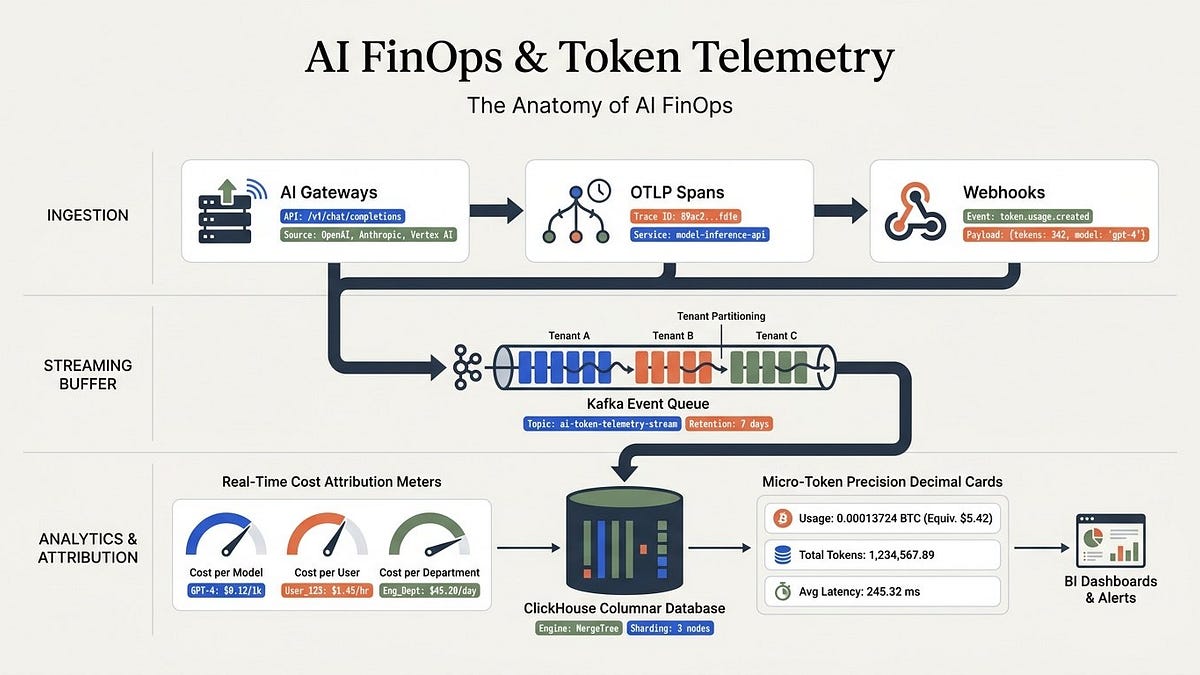
TL;DR: Traditional cloud FinOps fails for LLM workloads because costs are probabilistic, bursty, and decoupled from standard CPU/RAM metrics. To achieve real-time cost attribution without degrading model latency, engineering teams must decouple telemetry ingestion with streaming buffers (Kafka), enforce sub-cent precision in analytical engines, and normalize heterogeneous gateway metrics across caching, reasoning, and standard token taxonomies.
For the last decade, cloud infrastructure budgeting operated on predictable heuristics: provision an instance, measure vCPU and memory utilization, set an auto-scaling policy, and anticipate your invoice at month-end.
Autonomous agents and large language model APIs have broken this model completely.
AI workloads introduce consumption-based, probabilistic spending. A single recursive agent stuck in an unhandled edge-case loop, or a silent library update that enables chain-of-thought reasoning tokens by default, can burn tens of thousands of dollars in hours. When an issue occurs in production, you are no longer just dealing with latency degradation or elevated error rates—your outage is an immediate, compounding financial loss.
Solving this requires more than slapping basic logging wrappers around your API client. You need a dedicated AI FinOps telemetry pipeline capable of ingesting high-throughput streaming events, enforcing tenant-level cost attribution, and maintaining sub-cent precision without impacting Time-to-First-Token (TTFT).
Here is the architectural blueprint for designing and building an enterprise-grade LLM token spend and attribution engine.
1. The Telemetry Ingestion Bottleneck #
When integrating AI model observability, the instinct of many engineering teams is to perform synchronous writes to a relational database immediately following an LLM completion.
In production, this approach collapses under two failure modes:
- Latency Overhead on Critical Paths: Writing full token logs, prompt metadata, and trace attributes synchronously adds 20–80ms to the request cycle. For user-facing chat and agentic workflows where TTFT is the defining UX metric, this overhead is unacceptable.
- Traffic Burstiness & The Thundering Herd: Unlike web traffic, agentic loops generate massive bursts. A multi-agent orchestration pipeline executing a parallel fan-out can emit thousands of token events in seconds. Direct analytical database writes will rapidly exhaust connection pools and trigger backpressure.
The Decoupled Streaming Pattern
To maintain zero impact on user-facing latency, telemetry emission must be asynchronous and decoupled via a distributed commit log.
Key Ingestion Invariants
- Asynchronous Fire-and-Forget Buffers: Gateways (e.g., LiteLLM custom callback hooks, OpenTelemetry collector exporters) should batch telemetry in memory and flush periodically (e.g., micro-batches of 50–100 events or every 500ms).
- Idempotency Keys (
event_id): Every completion event must emit a deterministic hash or UUID. If an upstream network glitch causes a retry during webhook delivery, the pipeline must converge to exactly-once semantics at the storage layer rather than duplicating billed amounts. - Tenant-Scoped Partitioning: Kafka topics should use the
business_idortenant_idas the message key. This guarantees in-order event processing per tenant while distributing bursty agent workloads across partitions.
2. Storage & Numerical Precision Engineering in ClickHouse #
Token analytics queries are fundamentally aggregations over time-series data: computing cumulative costs grouped by department, project, model family, and date ranges. Standard OLTP databases (like PostgreSQL) choke when aggregating hundreds of millions of sparse token records across real-time dashboards.
Columnar engines like ClickHouse are uniquely suited for this workload, but they require strict schema discipline around deduplication and floating-point math.
The Sub-Cent Precision Trap (Float vs Decimal)
A standard blunder in AI cost tracking is storing per-token costs using floating-point types (Float32 or Float64).
Model pricing operates at microscopic decimal scales. For example:
- Input tokens for modern lightweight models:
$0.00000015per token ($0.15 / 1M tokens) - Cached input reads:
$0.0000000375per token
Floating-point arithmetic introduces binary rounding errors. When aggregating 500 million token events across a large enterprise, these rounding discrepancies compound into significant budget drift, creating irreconcilable discrepancies between internal dashboards and upstream vendor invoices (OpenAI, Anthropic, Google).
Rule: Always enforce fixed-point arithmetic using Decimal(20, 10) or store micro-cents as 64-bit integers (UInt64).
CREATE TABLE ai_token_events (
    business_id         UUID,
    event_id            String,
    source              LowCardinality(String), -- 'litellm', 'openrouter', 'internal'
    model               LowCardinality(String), -- 'gpt-4o', 'claude-3-5-sonnet', 'gemini-1-5-pro'
    provider            LowCardinality(String), -- 'openai', 'anthropic', 'google'

    -- Token breakdown
    prompt_tokens       UInt32,
    completion_tokens   UInt32,
    cached_tokens       UInt32,
    reasoning_tokens    UInt32,

    -- Financial Precision
    total_cost_usd      Decimal(20, 10),

    -- Attribution Dimensions
    team_id             LowCardinality(String),
    user_id             String,
    project_id          String,
    environment         LowCardinality(String), -- 'prod', 'staging', 'dev'
    metadata            String, -- Arbitrary JSON for tag extraction

    created_at          DateTime64(3, 'UTC')
) ENGINE = ReplacingMergeTree(created_at)
ORDER BY (business_id, source, event_id);
Why ReplacingMergeTree Matters
Network retries and gateway reconnects inevitably produce duplicate events. By ordering the ClickHouse table by (business_id, source, event_id) with created_at as the version column, ClickHouse automatically deduplicates rows in the background during merge operations.
To guarantee deduplicated reads in real-time before background merges finish, queries simply append the FINAL modifier or use argMax() aggregations:
SELECT
    team_id,
    model,
    sum(prompt_tokens) AS total_prompt_tokens,
    sum(reasoning_tokens) AS total_reasoning_tokens,
    sum(total_cost_usd) AS total_spend_usd
FROM ai_token_events FINAL
WHERE business_id = 'c7e84a2d-1144-48f1-8254-0b1a1134a6e8'
  AND created_at >= now() - INTERVAL 30 DAY
GROUP BY team_id, model
ORDER BY total_spend_usd DESC;
3. Gateway Normalization: Resolving the Telemetry Babel #
In an enterprise environment, teams rarely use a single provider or interface. One engineering squad might route requests through a self-hosted LiteLLM proxy, while another uses OpenRouter, and a data science team connects directly via custom SDKs.
Each gateway produces distinct telemetry structures:
- LiteLLM: Standard custom JSON webhooks with nested dictionaries (
litellm_call_id,response_cost,model_parameters). - OpenRouter & Modern Proxies: OpenTelemetry (OTLP) GenAI semantic convention traces (
gen_ai.request.model,gen_ai.usage.input_tokens,gen_ai.usage.output_tokens.reasoning).
Your ingestion layer must normalize these payloads into a unified canonical event schema.
The Token Taxonomy Shift: Beyond Input & Output
Token accounting is no longer a simple two-variable equation (Cost=Input×Pi+Output×Po). Modern production LLMOps must track four distinct token classes:
- Uncached Input Tokens: Full-price input context parsed on the forward pass.
- Cached Input Tokens: Discounted context (often 75–90% cheaper on Claude/OpenAI/Gemini) read from KV cache storage.
- Completion Tokens: Standard output generation returned to the user or downstream service.
- Reasoning / Thought Tokens: Tokens generated internally during chain-of-thought processing (e.g., OpenAI o1/o3, DeepSeek R1, Gemini 2.0 Flash Thinking). These count against output token pricing and latency limits, but may be hidden from final user text responses.
4. Five Production LLMOps Traps (And How to Fix Them) #
Real-world telemetry pipelines frequently uncover surprising operational anomalies. Here are five failure modes common to production systems:
1. The Phantom Reasoning Token Regression
The Incident: An infrastructure upgrade to an intermediate routing proxy (such as LiteLLM) accidentally enabled reasoning flags by default on models with thinking capabilities.The Impact: Every simple classification and routing query suddenly generated 2,000+ internal reasoning tokens before outputting a one-word answer. Latency skyrocketed 4x and costs surged 10x before being caught.The Mitigation: Instrument automated anomaly alerts that trigger when the ratio of reasoning_tokens / completion_tokens spikes above baseline thresholds for non-reasoning task tags.
2. The Mid-Stream Disconnect (SSE Token Leakage)
The Incident: When users cancel a chat request or an HTTP connection drops during a Server-Sent Events (SSE) stream, client SDKs terminate the socket. However, upstream LLM providers continue generating tokens on the server until the generation reaches max tokens or an internal cancellation propagates.The Impact: Your application thinks the request was aborted and records 0 output tokens, but the provider bills for 4,000 generated tokens.The Mitigation: Always read provider usage headers returned in the final chunk or rely on gateway-level termination hooks rather than client-reported lengths.
3. Geographic Routing Multipliers
The Incident: Several frontier providers (e.g., Anthropic) assess a geographic premium (e.g., 1.1x multiplier) for requests pinned specifically to US data centers.The Impact: Standard static pricing tables in internal billing tools calculate cost based on base list prices. At the end of the billing cycle, invoices arrive 10% higher than tracked spend.The Mitigation: Model pricing engines must evaluate routing metadata (region, data_residency_policy) dynamically when calculating total_cost_usd.
4. Recursive Agent Retry Storms
The Incident: An autonomous agent encounters a structured output schema validation error. It wraps the error in a retry prompt and re-submits the entire 30,000-token context. In an infinite error loop, it executes 50 retries in two minutes.The Impact: Hundreds of dollars burned on a single user interaction.The Mitigation: Do not rely solely on asynchronous post-hoc alerts. Implement gateway-level rate limits and per-session hard token ceilings that actively reject calls once an interaction exceeds a predetermined budget cap (Figure 2).
5. Accumulated Prompt Bloat
The Incident: Over months of feature development, developers continually add edge-case instructions to system prompts without deprecation audits. System prompts grow to 12,000 tokens per request.The Impact: For an endpoint processing 100,000 requests/day, prompt bloat costs thousands of dollars monthly in pure overhead.The Mitigation: Track input-to-output ratios across endpoints. When prompt_tokens / completion_tokens > 20:1 on non-RAG endpoints, flag the prompt for compression, prompt caching, or fine-tuning.
5. Architectural Checklist for Internal AI Gateways #
If you are designing or upgrading an internal AI gateway and spend-tracking engine, ensure your system checks every box:
- Asynchronous Decoupling: Telemetry emissions use in-memory buffers and stream to an event bus (Kafka/Redpanda/SQS) with zero impact on TTFT.
- High-Precision Storage: Columnar database stores costs in
Decimal(20,10)or integer micro-cents, completely avoiding IEEE floating-point drift. - Multi-Class Token Taxonomy: Metrics explicitly isolate uncached input, cached input, output completion, and internal reasoning tokens.
- Idempotent Ingestion: Every trace includes a unique event identifier; analytical tables use
ReplacingMergeTreeor equivalent deduplication keys. - Attribution Dimensions: Every payload captures
team_id,project_id,user_id,environment, and functionaltask_tags. - Active Gateway Circuit Breakers: Telemetry is paired with synchronous, token-bucket budget caps at the proxy level to prevent runaway agent loops.
- Automated Anomaly Detection: Real-time detectors flag sudden drift in cache hit ratios, reasoning token volume, and prompt-to-completion ratios.
Further Reading & Sources #
- Ramp Engineering:Building a Unified Pipeline for AI Token Spend
- OpenTelemetry:GenAI Semantic Conventions Specification
- LiteLLM Architecture:Custom Callback Hooks & Enterprise Logging
- ClickHouse Documentation:ReplacingMergeTree Table Engine Best Practices