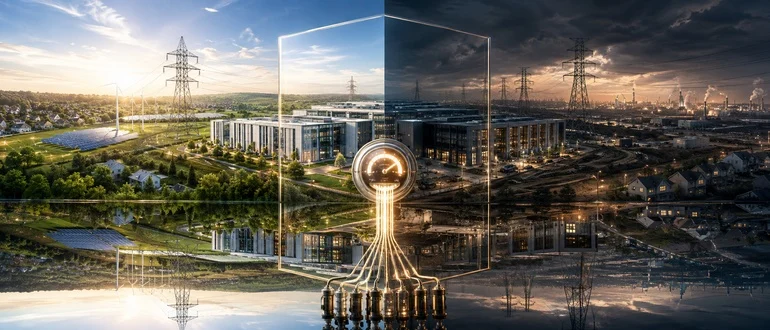
Virginia spent twenty years courting data centers. This June it started taxing their electricity instead. That reversal is a clue to something bigger, and it’s not really about Virginia.
Here’s the thing about Virginia. For twenty years the state did everything short of building a shrine to get data centers to move in: tax breaks, fast-tracked zoning, red carpet the whole way. Loudoun County alone ended up with something like 200 of them. And this June, that same state became the first in the country to turn around and tax the electricity those data centers use to run.
Same legislature. Mostly the same politicians. Complete reversal.
I kept coming back to that one because I don’t think it’s really a Virginia story. I think it’s a tell. It tells you we still don’t agree on what AI actually is, not the technology, everybody’s clear enough on that part, but the story underneath it. Ask ten smart people what the AI future looks like and you’ll get three different answers, and most of the time they’re not even disagreeing about what the technology can do. They’re disagreeing about who’s going to own it when it’s done.
That’s the question I spent the last few weeks trying to actually answer, instead of just having an opinion about it over coffee. The result is a full Techstrong special report, “The AI Mirror: Riches, Ruin and the Indispensability Trap.” This is the appetizer. If you want the whole meal, the link’s at the bottom.
I built it around three reflections, because that’s honestly how the argument kept breaking apart on me every time I tried to write it as one story.
Reflection one is the case for AI Utopia, and I mean the real case, not the strawman version people knock down to feel smart. Dario Amodei isn’t hand-waving when he says AI could compress a century of biological progress into a decade. Jensen Huang isn’t just selling chips when he calls AI essential infrastructure. I took both of them seriously and then asked the question almost nobody bothers to ask: how much of this actually needs AGI, and how much is just a deployment problem we’re choosing not to solve yet? The answer isn’t what either side wants to hear, and it comes down almost entirely to one word: robots. Not the AI. The physical machines. That gap is bigger than the hype cycle admits.
Reflection two flips it over. Same technology, same capability, and the outcome is still bad, because the gains pile up with a handful of owners while everybody else eats the disruption. I didn’t want vibes here, so I went and found the actual data: Stanford’s entry-level hiring numbers, the Challenger layoff figures with the caveat they deserve (companies blaming AI for cuts isn’t the same as AI causing them), Betsey Stevenson’s work on why a monthly check doesn’t replace what a job actually gives people. Bernie Sanders’ sovereign wealth fund idea is in there too, argued fairly, including by people who think it’s a terrible idea and why they think that.
Reflection three is the one I actually built the whole report around, because it’s mine. I call it the Indispensability Trap, and it’s the pattern from my forthcoming book, the one I’ve watched play out for four decades in this business. A technology becomes essential during a period of real scarcity. Everybody assumes that scarcity is permanent. And then, almost every single time, engineers figure out how to make it not scarce anymore, faster than anyone building a business model around the shortage ever expects. Railroads. Electricity. Fiber. Cloud. And now, I’d argue, the AI chip market, where NVIDIA’s grip on training is genuinely strong and its grip on inference is already slipping in ways the headline market-share number doesn’t show you.
None of this is theoretical. The report walks through what’s colliding right now: what’s actually happening inside companies deploying AI agents versus what a vendor survey wants you to believe, the data center backlash that’s now blocking something like $130 billion in projects a quarter, and a crosstab in the polling data that stopped me cold: conservative Republicans oppose data centers in their backyard at higher rates than moderate Republicans do. I did not see that coming, and once you sit with it, it tells you something real about how this fight is actually going to play out politically, not how the talking points say it will.
And I get into the money, because most AI coverage skips the money. Hyperscalers are sitting on a capex-to-depreciation gap that’s worth understanding before you decide whether this is a bubble or a foundation. I laid out the numbers. I’m not going to pretend I know which one it is, and neither should anyone selling you certainty either way.
Here’s where I land, so you’re not guessing: I don’t think Utopia or Serfdom shows up fully intact. I think AI works better than the skeptics expect and disrupts harder than the optimists admit, and I think a few companies betting the balance sheet on permanent chokepoints are in for some uncomfortable years, because that’s what chokepoints do once the rest of the industry gets a good look at them.
But whether we come out the other side with something closer to shared prosperity or something closer to a very small number of people owning a very large share of everything: that’s not a question AI is going to answer for us. That’s tax policy, antitrust, ownership structure, and whether we make those calls on purpose or by accident while everybody’s staring at the next model release.
The report has the receipts on all of it: the Berkeley Lab electricity numbers, the actual text of the Sanders bill, what’s really deployed in humanoid robotics versus what’s just been announced for a press cycle.
Go read it. If you only click on one AI piece this month, make it this one. I think it changes how you read every other AI headline for a while after.