One of the ten briefs in our AI taste study asked for a New York street-skate brand. No reference design, no palette, no art direction.
Each model worked the brief in two separate passes. First it wrote a creative direction as structured JSON, with no tools and no code, and explained every color choice. Later, independently, it built an actual site. The written rationales were never handed to the build step, so the two passes are two independent samples of the same model's instinct.
In both passes, the designs converged.
Eight of the ten named a construction orange accent, in the band from #C45A1A to #FF5A1F. Two of them named the identical hex.
They also explained it the same way.
Traffic cones, construction barriers, MTA, DSNY. Ten independent labs, one referent set.
The same pass converged on the ground, too. Eight of ten put a near-black asphalt tone in the primary slot and left the color wheel entirely: #101010, #111111 twice, #111214, #121314, #141412, #161513, #1A1917.
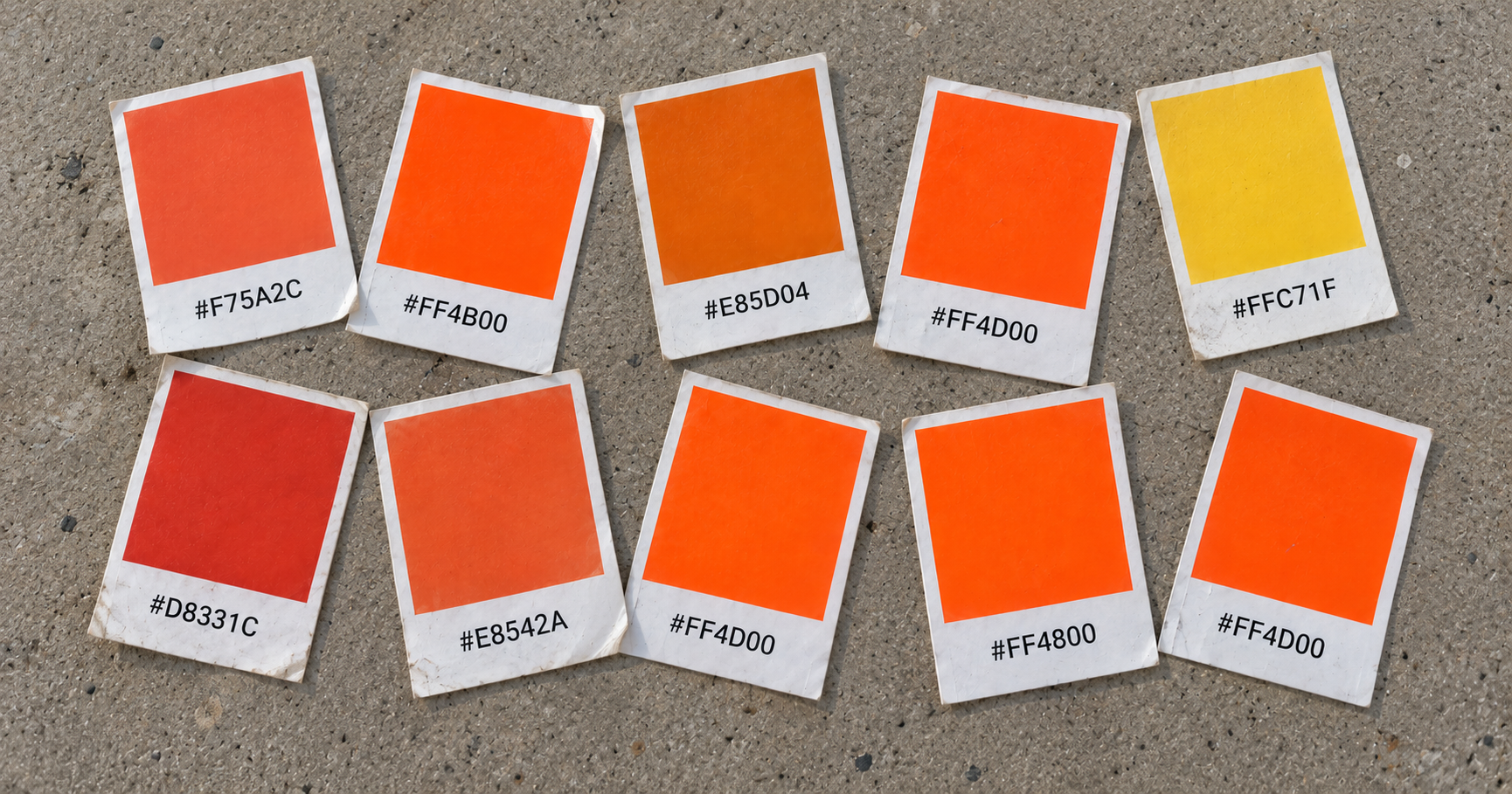
We pulled the stylesheet out of all ten shipped sites and read the palette each model actually declared. Here are the colors, visualized as skateboard decks:
Nine of ten shipped a safety orange. Three of them, built by three different labs, shipped the byte-identical #FF4D00. Four of the ten named their variable --orange outright.
The tenth did not break the pattern so much as change which piece of city infrastructure it pointed at. deepseek-v4-pro shipped --taxi: #FFC71F, a cab yellow.
Two models that never named orange in writing shipped it anyway: gpt-6-astra and muse-spark-1.3, at #F75A2C and #FF4B00. muse-spark-1.3's is two hex units from the #FF4D00 that three other labs arrived at.
The written pass and the built pass never touched, and both landed in the same place. Convergence is not coming out of the model's stated reasoning, because the reasoning was not in the room when the site got built.
Reading the shipped CSS of all 100 sites gives the same picture across the study. On the italian-soda brief, all ten models built a blood orange between #C8401F and #FF6B35. On telemedicine, eight of ten built a teal between #0D9488 and #155D64. A row that reads as a single block is ten independent labs choosing the same color.
A note on method: this measures the most-used saturated color in each shipped stylesheet, which is our own analysis of the build, not the study's published metric. The study's hue-concentration scores describe the written directions, a different artifact. Where the two disagree, they are measuring different passes rather than contradicting each other.
Nine of ten models chose a bold, condensed, or extended grotesque for display: Neue Haas Grotesk twice, Archivo three times, Anton, Oswald Condensed, Monument Grotesk, one Druk-alike. All ten added a monospace for prices and labels. The rationales share a lineage again: wheatpaste posters, subway service notices, hand-painted storefront signage, receipts, skate zines, camcorder timecodes.
The holdout was glm-5.3, which chose an editorial serif and said why: grotesques are the cliché, and a serif "sets the brand apart from generic streetwear grotesques." Even the escape from the convention was reasoned from the convention.
Your model holds a reference for your customer's category, and the narrower the category, the stronger the reference. Three things follow from what we found.
The only way to find out what your users actually get is to look at the output, in volume, and compare it to what everyone else's model produces. We put all 100 sites and every stated direction in a public dashboard so you can.