TL;DR — Key Takeaways
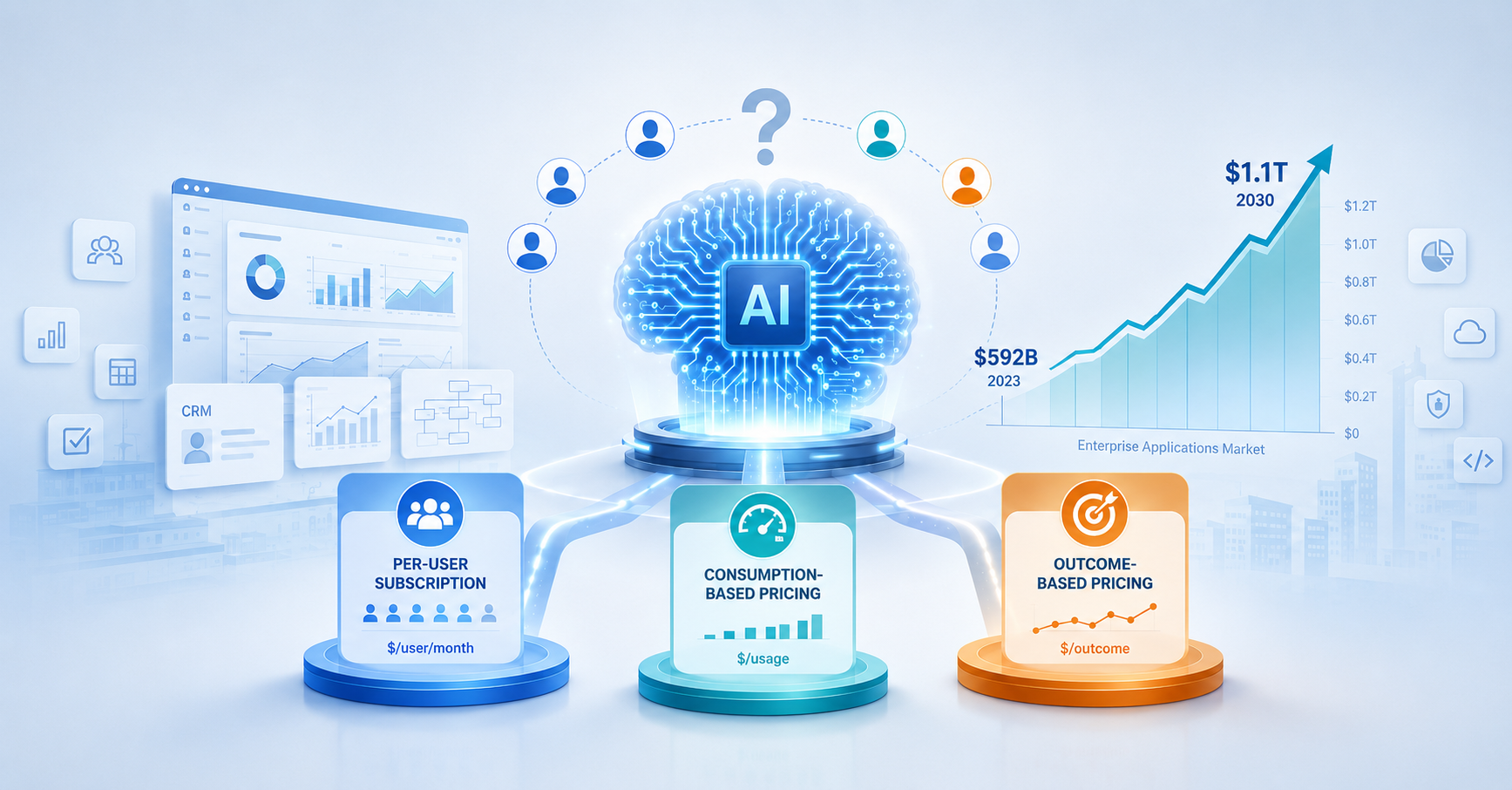
AI pricing remains unsettled: Enterprises are split between per-user, consumption-based and outcome-based models for AI-enabled applications.Enterprise software spending is still growing: Futurum projects the enterprise applications market to rise from $592.4 billion in 2025 to $1.1 trillion by 2031.AI could strengthen packaged software: Easier customization with AI may reduce the need for organizations to build entire applications from scratch.
A global survey of 833 IT decision makers conducted by the Futurum Group finds there is little consensus on how the cost of artificial intelligence (AI) should be factored into the cost of application licenses.
The largest share of survey respondents (42%) favor per-user, per-month pricing, while 58% prefer either consumption-based (37%) or agreed-upon business outcome (21%). “The industry’s answer to how do we charge for this still isn’t settled, as you’ve got consumption-based models now preferred by 43% of buyers, outcome-based at 27%, and vendors such as Salesforce and Pega experimenting with consumption- and outcome-tied pricing rather than a clean bolt-on AI fee,” says Keith Kirkpatrick, vice president and research director for enterprise software and digital workflows for the Futurum Group.
“Enterprises are still trying to understand the value proposition for AI across their organization, and pricing optionality is a way to ensure that buyers can find the right model for a specific business or use case,” he adds.
While there has been a significant amount of debate over the degree to which coding using AI might reduce the need to rely on packaged applications, the Futurum Group is predicting the enterprise applications market will grow from $592.4 billion in 2025 to $1.1 trillion in 2031. The largest single submarket is the industry/vertical-specific segment at $135.7B in 2025, with a projected growth rate of 12% to reach $263 billion in 2031. Customer relationship management (CRM) and business intelligence/analytics applications are similarly projected to see compound annual growth rates of 13% and 12%, respectively.
Overall, the percentage of organizations that build their own applications (56%) remained flat year over year, notes Kirkpatrick. Many of the providers of applications are now leveraging AI to make it simpler for both end users and professional developers to customize their applications, which reduces any inclination to build an entire application from the ground up when a packaged application is already readily available, he adds.
The degree to which each organization will decide to build or buy an application often comes down to use case and the amount of internal expertise available. While building an application can reduce licensing fees, many organizations lack the expertise and resources needed to maintain an entire custom application. For those organizations, using, for example, an AI agent to customize an existing workflow provides the benefits of a custom application without having to invest in the tools, platforms and personnel needed to build, deploy, secure and manage a custom application.
Ultimately, there may not ever be a one-size-fits-all approach for any organization. As it becomes easier to build applications using AI tools, many organizations will, at the very least, encourage end users and developers to experiment. Some organizations have even gone so far as to require teams to prove they can’t use AI to provide a new capability before approving any budget outlay.
Regardless of approach, there is little doubt AI is here to stay. The most pressing issue to resolve now is determining how best to actually pay for it as the total cost of using AI continues to rise.