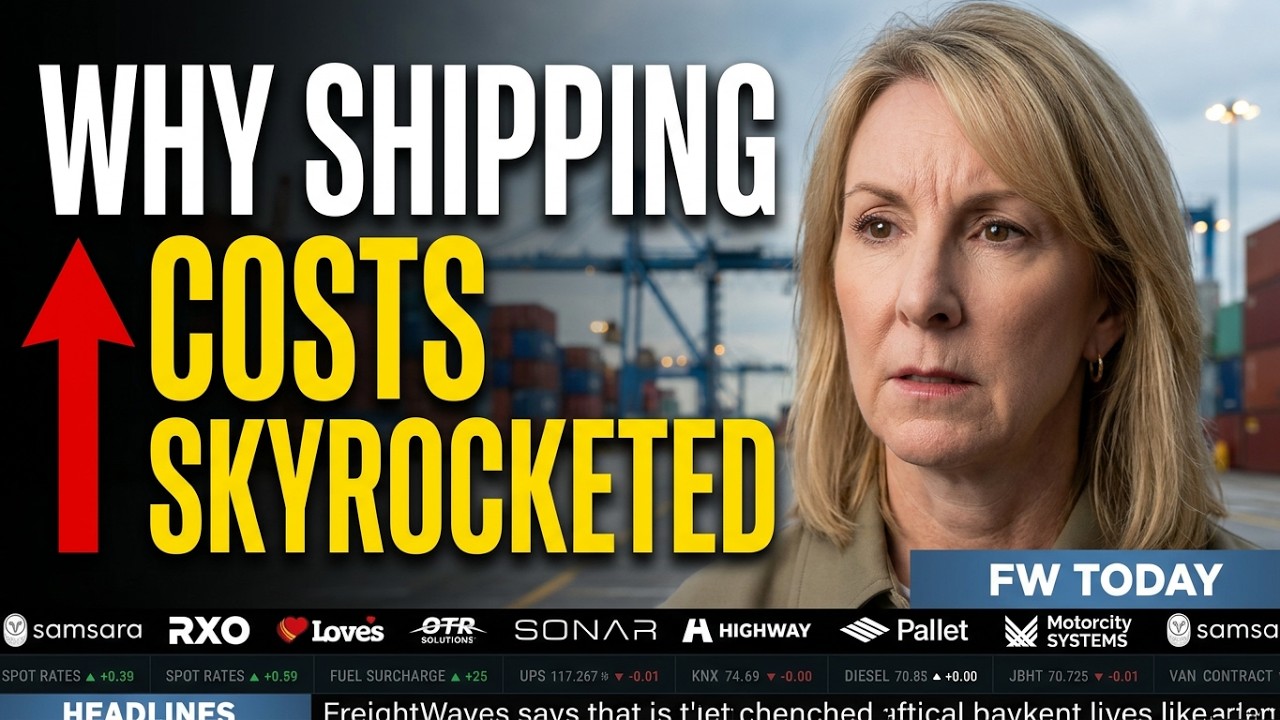
GEODIS Americas CEO Laura Ritchey reveals the stark reality of today’s “uneven” economy and its impact on supply chains. While some sectors thrive, others grapple with extreme ocean shipping delays, surging freight rates, and emerging challenges from data center infrastructure. Learn how companies navigate unprecedented backlogs and leverage new tech like AI for predictive logistics.
Ocean spot rates have surged more than 300% over the past five months, and shippers are feeling the squeeze, according to GEODIS President and CEO Laura Ritchie. Blank sailings, port congestion, and ongoing threats in the Red Sea and Strait of Hormuz have combined to create a backlog that is straining manufacturing supply chains, Ritchie told FreightWaves Today.
“We have product that we’ve been trying to book since March that’s still rolling in July,” Ritchie said. “And for people in the manufacturing space where they need these things on their assembly line, they’re not too happy.”
“We aren’t seeing quite the COVID levels, but a container is a lot more expensive than it was just a few months ago.”
— Laura Ritchie, President and CEO, GEODIS
Ritchie said air freight capacity exists as an alternative but comes at a cost shippers must be willing to absorb. She noted that big tech customers are navigating chip shortages and semiconductor import constraints simultaneously, compounding pressure on both ocean and air modes. GEODIS, which employs 20,000 workers across 230 U.S. sites, is staying close to customer forecasts to help manage the uncertainty.
Despite uneven demand across sectors, Ritchie pointed to pockets of strength. Some GEODIS customers are posting sales growth of 30% to 40%, while others are flat. Apparel is a bright spot, with unit volumes rising even on an inflation-adjusted basis, while housing improvements and new housing starts remain soft. The bifurcation, she said, largely depends on each customer’s end-market exposure.
On the technology front, Ritchie said GEODIS is deploying AI to manage shipment data and trucker oversight, and is using the tools to train and upskill warehouse associates who collectively speak more than 30 languages. The company is also piloting drones for inventory management inside warehouses, citing both accuracy and worker safety benefits over traditional cycle counting. Ritchie added that supply chain orchestration — using predictive data to autonomously respond to disruptions — will define the next two to three years for third-party logistics providers.
Ritchie, who completed her first year at GEODIS’s Nashville headquarters, said she created a client experience organization earlier in 2024 by consolidating previously fragmented functions: continuous improvement, data and analytics, and account management. She modeled the structure partly on changes made at American Airlines, which reorganized its customer journey after identifying internal silos that prioritized operational convenience over the passenger experience. The new group reports directly to Ritchie to ensure organizational neutrality.
Looking ahead, Ritchie said she is most encouraged by a broader shift in how shippers are approaching outsourcing decisions. “People are back to actually thinking about supply chain as partnerships instead of transactional,” she said, adding that shippers are more deliberately defining which core functions — product, marketing, manufacturing — they want to control and which they will entrust to a 3PL. GEODIS is owned by SNCF, the French national railroad, which Ritchie said provides financial stability and compliance infrastructure that has become increasingly valuable following the Supreme Court’s Bisected Freight ruling and tightened broker liability scrutiny.
- Ocean spot rates have climbed more than 300% in five months, with cargo booked in March still rolling into July due to blank sailings and Red Sea disruptions.
- GEODIS CEO Laura Ritchie consolidated continuous improvement, data analytics, and account management into a new client experience organization reporting directly to her.
- GEODIS is piloting drones for warehouse inventory management and using AI to train associates across 30-plus languages as automation expands.
Speaker 1 [0:00] We have Laura Ritchie here from Nashville. She is the president and CEO of Geotis. She just completed her first year. Geotis is a massive company, 20,000 employees in the US, 230 sites. Laura, welcome to FreightWaves Today.
Speaker 2 [0:13] Thank you. Thanks, Craig. Thanks, Julie.
Speaker 1 [0:15] We’re so excited to have you. So tell us a little bit about, you know, this reconfiguration of the economy. ISM’s manufacturing data is incredibly robust. A lot of that is AI data centers and big infrastructure buildout. But what are you guys seeing right now?
Speaker 2 [0:29] You know, we’re scratching our head because we’re seeing all sorts of things. So we have customers who are doing really well, they’re seeing sales up double digits, 30, 40%. And then we have others who, you know, maybe aren’t seeing the same thing. And I think a lot of it depends on who their customers are. So we’re staying really close to those forecasts. We definitely see in big tech the challenges about the shortage of chips and the ability to get things over here. So we’re planning To help them manage that.
Speaker 1 [0:57] Now, is it hard to get airlift capacity? Is that tight right now due to just all of the semiconductors and memory chips that are coming over?
Speaker 2 [1:04] It is, although I would say what we’re still seeing is ocean continues to be a challenge as well. So with all the blank sailings that are happening, the port congestion, we’re seeing things actually get stuck more on the ocean side, and then air capacity’s there, you just have to be willing to pay for it.
Speaker 1 [1:21] It’s all, there’s a price for everything. The interesting thing on the ocean side is that ocean spot rates are up, you know, over 300% in just the last 5 months. What is it? Obviously, blank sailings are a big piece of that. The international ocean container lines have such market power. Is it just that they are just trying to control price or at least manage price? Is that really what’s happening?
Speaker 2 [1:42] I think there’s that, but I do think obviously with what’s happening in the Strait of Hormuz, that’s impacting it. Threats in the Red Sea are impacting it as well. So, you know, we saw the Port of India very congested, and it’s taken some while to clear that out. We just have a huge backlog now of goods. You know, we have product that we’ve been trying to book, you know, since March that’s still rolling in July. And for people in the manufacturing space where they need these things on their assembly line, they’re not too happy.
Speaker 1 [2:13] And that’s international shipping just doesn’t have capacity to provide it?
Speaker 2 [2:17] It is and/or it’s the spot market. spot rate you’re willing to pay, as you talked about, right? So we aren’t seeing quite the COVID levels, but, you know, a container is a lot more expensive than it was just, just a few months ago.
Speaker 1 [2:28] Well, the ocean container lines, no crisis averted, they always have, uh, take the opportunity to, to raise price. It does create a significant, um, issue and strain. One of the things that is coming through some of the survey data, you’re on the board of the Federal Reserve out of Nashville, the Atlanta Fed, uh, a lot of conversation about this sort of the have and have-nots economy. Housing is down significantly, or at least soft compared to where it has been. But then you get into these electronic components, into heavy, heavy manufacturing. We covered every week with just how strong the railroad volumes are. What are other parts of the economy that are doing well outside of this big electronic AI data center buildout?
Speaker 2 [3:09] I still think we’re seeing strength in retail, certain areas of retail. So apparel has actually been up even on an inflation basis. adjusted basis. We have customers that are telling us, you know, they were, they were making it on price, but they’re actually seeing more units start to move through. So I think if your brand is well positioned and you have value, you’re personalizing the customer experience, customers are staying. You know, some people say that they’re shopping, right, to kind of alleviate the sadness about the economy in general. And we’re definitely seeing some of that. They’re trading off on, you know, how often they fill up their gas tank to maybe have a splurge. We do see in housing improvements though, that is a little bit down. New housing starts are obviously down. So, so that’s something we see. But, but yeah, it’s very uneven and it makes it hard to predict across the board.
Speaker 3 [4:04] I will tell you that the number of packages arriving to my house each week, absolutely, if you graphed it in tandem with my stress level, like you could tell last week must have been tough because there’s a lot.
Speaker 1 [4:15] You guys must be really stressed out because we get a lot of those packages.
Speaker 2 [4:18] Statistical correlation there. Speaker 3 [4:20] I think people are getting— Craig’s favorite topic— people are getting skinny, so they have to buy new clothes.
Speaker 1 [4:24] I’m glad you mentioned that. We’re a big fan of the GLP-1s here. It’s a big recurring topic. We, a couple of weeks ago, one of our guests is in a retail liquidation, particularly CPG as well as retail. And it was interesting because what she described is that apparel is doing exceptionally well as people downsize.
Speaker 2 [4:42] Yes. Speaker 1 [4:43] But the foods products are actually, particularly the unhealthier food or foods that we all kind of love to splurge on, are not doing as well. And it was interesting to sort of see the fact that apparel, like as a GLP-1 user, I have gone through a number, that’s the worst part of this whole thing.
Speaker 3 [4:59] I said it’s the best part. First I was like— What, new clothes?
Speaker 1 [5:02] Yeah. Except when you get the bill. Like I, like it is, how many times, the problem is like—
Speaker 3 [5:09] You know how much worse it would be to have to keep buying new clothes because you were outgrowing them though?
Speaker 1 [5:12] Yeah, well, it’s true, but the problem is, as soon as I buy a jacket, it feels like a couple months later it’s too big as you continue to slim out.
Speaker 2 [5:20] So, well, but we all needed a clothing refresh, I feel like, after COVID, right? When you had the sweatpants on.
Speaker 1 [5:25] That’s true. Speaker 2 [5:26] And you had to say, okay, is this stuff I was wearing in ’19 really worth it anymore?
Speaker 1 [5:29] It feels like at first people were still in the COVID casual mode.
Speaker 3 [5:33] Yes, yes. Speaker 1 [5:34] And then over time, the more professional people come back to the office, just how different it is. So you’ve been in Nashville for a year.
Speaker 2 [5:40] Yes. Speaker 1 [5:41] What exactly has that experience been like at GEODIS in terms of, this is a, you know, you’ve been at a number of different companies across the supply chain. What has specifically attracted you to GEODIS?
Speaker 2 [5:51] Well, I think, you know, one, when you say I’ve been in Nashville for a year, I’m like, I visit once in a while, but mostly I’ve been on the road, right? So, but when I looked at GEODIS, what I really liked is we have the international ownership. So we’re owned by SNCF, which is the French railroad. And that really gives us a stability, right? A financial stability, a solid base from which to grow, and then scale. So the ability to work with customers across all 3 regions, which is how we divide up the country, and then finally meeting the teammates. So I always insist that you do in-person interviews, even during COVID I did that when I changed roles, because I think it’s meeting people and saying, is this a place I wanna work? Do I think that, you know, I can add value here?
Speaker 1 [6:34] Mm-hmm. Speaker 2 [6:35] and see myself as part of the team. And so, so it’s been a lot of fun. It’s, it’s a surprisingly vast, though, amount of warehouses, right? So 230 locations counting freight forwarding and warehousing. And so trying to tackle that has been a bit of a challenge. I’ve made a dent in a year, but certainly more to go.
Speaker 1 [6:52] The scale of it is quite— how do you, how do you prioritize in terms of your time, in terms of what you’re focusing on with so much scale? Is your goal to visit all the locations or the main offices, or how do you, how do you think about it?
Speaker 2 [7:05] Yeah, for me, it’s really understanding the business. And so what I kind of laid out is we have freight forwarding, we have the contract logistics and the transportation business. So what do I need to know? Do— is going to a freight forwarding office giving me the ability to learn the business? Sort of yes, sort of no, right? But I have the ability to do that more remote. The warehouses you really have to see because we have a scale of automation.
Speaker 1 [7:30] Mm-hmm. Speaker 2 [7:30] And so seeing from the least automated to the most automated, And then our transportation hubs obviously operate sort of like warehouses, but also as transportation around, you know, cross-docking and things. So I wanted to make sure I could see and touch all of that. But my favorite thing to do is go and don’t do anything they’ve said, right? So don’t follow the tour path. Don’t talk to the associates that they’re pushing out in front. You know, certainly make nice, but to make sure you go the places where maybe somebody didn’t want you to go more because I just want to learn what’s happening. What are their challenges? I appreciate the, the nice red carpet that gets rolled out for the CEO, but how do you really get your, your fingers on the pulse?
Speaker 1 [8:12] Are we gonna see you on Undercover Boss?
Speaker 2 [8:14] Is that coming? Yeah, I did think of that because now they do start to know you after a year, so it’s a lot harder. You definitely would have to do more disguises.
Speaker 1 [8:22] I watched that show. Have you seen it, Julie?
Speaker 3 [8:24] Yeah. Yeah. Speaker 1 [8:24] I watched the show and I’m like, how do these people not, it just, you have a camera crew maybe in the first couple of episodes, right? But it just feels like it is put on for TV. So I don’t know if it’s real or not.
Speaker 2 [8:34] I don’t know. I think that they’re telling— I mean, we film stuff in the warehouses all the time. We have customers doing things. So they, they, we, I think we could do that.
**Speaker 1** [8:41] So you think it’s legit?

**Speaker 2** [8:42] I think so.
Speaker 1 [8:42] Yeah. We, we need to get you on Undercover Boss so we can all root for— whenever there’s someone on for The Bachelor, my wife is a big reality TV connoisseur, we’ll say The Bachelorette or Bachelor that’s in freight, we’re always rooting for them.
**Speaker 2** [8:55] Yes.

**Speaker 1** [8:55] Yes. It’s like, this is one of us.

**Speaker 2** [8:56] Yes, exactly.
Speaker 3 [8:57] So you’ve clearly done this tour. You have talked a lot about, like, listening being the most important part, seeing the parts of the business that might not be what is necessarily brought to you, the shiny parts of it. What surprised you most? What did you learn?
Speaker 2 [9:12] Really, the passion of our teammates. And I know probably everyone says that, but I went— my questions are always like, if I gave you a magic wand, what would you do differently? And all of their asks were, you know, we have a security system for one of our customers who requires it. And they’re like, could you put a bathroom in closer to us because it would be easier for all of us? And so they’re always so thoughtful about what’s meaningful for the teammate. You know, they could have said, pay me more. They could have said, you know, give me more perks or benefits. But, and even when I asked the people who came from another provider, why did you come here?
Speaker 3 [9:50] Yeah. Speaker 2 [9:50] They’re like, because I heard it was a great place. I joke we have a fair amount of boomerangs, right? People who leave and think, oh, maybe I’ll try somewhere else. And then, you know, they come back a couple of years later, which was great because they get the experience outside. But really, Geotis is their home.
Speaker 1 [10:05] It is interesting. I think the days of, hey, this person’s left and we’re going to, you know, that’s sort of the old school transportation way. Get out and don’t come back. It is rewarding when someone comes back after they’ve had the chance to sort of realize that things aren’t as good. Yeah, because I think in business, you get so just, you get so frustrated. I always tell folks on our team is like, you’re going to get frustrated at times, and, and sometimes it’s better to see that it isn’t as great as you think it is going to be.
Speaker 2 [10:28] That’s right. I tell my kids that all the time, but that’s a tough lesson to learn. So, so I’m like, you should go learn it then. Don’t, don’t listen to just us. You experience it, see what something else is. You’ll learn, maybe you’ll bring things back. Plus, our industry is so small, so small. So, you know, people that you worked with 20 years ago come back again, and, you know, you need to make sure that you were a professional, so.
**Speaker 1** [10:51] Yeah, for sure.

**Speaker 2** [10:52] Yeah.
Speaker 3 [10:53] So, you talked about getting past sort of those surface-level issues, and I read that you use the 5 Whys to do that. Yes. Can you walk us through what those are, and then some outcomes of that? Sure.
Speaker 2 [11:03] So, it’s really the Toyota Production System, right? And what they were doing when they were diagnosing issues on the assembly line was saying, why is this happening? Why is this happening? And that’s really how you get to the root cause. So, a lot of it is, just continuing to ask why. Otherwise, we solve service issues. Right now, we’re launching several new clients. Of course, there’s always bumps and bruises when that happens. And it’s really saying like, oh, it’s easy to say, well, you know, we didn’t have this or we didn’t do this, but is that really the issue? Like, what’s really happening?
**Speaker 3** [11:32] So getting to the root.

**Speaker 2** [11:33] That’s right.

**Speaker 3** [11:34] Not just the initial symptom.

**Speaker 2** [11:36] That’s right.

**Speaker 3** [11:37] But the actual cause. Yes.
Speaker 2 [11:39] And then actually fix it. Like, don’t do it again. One of the things I love about our business is we seem to like Groundhog Day. where you’ve done it and then you do it again and then you do it again. So I’m like, let’s learn from it, let’s carry that forward, let’s not repeat it.
Speaker 1 [11:52] It’s a great reference. I love that movie.
Speaker 2 [11:55] Yes. Speaker 1 [11:56] It’s such a, it was one of my favorite movies to watch. I watched it a lot of times. You created a client experience organization earlier this year. What exactly does a client experience organization do?
Speaker 2 [12:06] Well, I was studying some other industries that were really focused on customer loyalty and developing the customer journey. which would be brands, airlines have done that, and said, our customer experience or our client experience is fragmented. So continuous improvement, which helps the customer get better, we get better with serving the customer. Our data and analytics team that does all of the analytics was fragmented. The actual account management team who manages the day-to-day was all separate. So what we’re trying to do is really pull that together and say, similar to how a brand would own the customer journey, That’s really what we’re focused on. So from the moment you say, maybe I wanna work with Geotis, then that’s part of the journey to say, and of course you’ll wanna stay.
Speaker 1 [12:50] So what were the businesses you looked at as inspiration? Any favorite sort of lessons from those that you took into Geotis?
Speaker 2 [12:57] So American Airlines is a great example of doing this where they had challenges. They were receiving ratings about their customer service. And as they studied it, what they realized is similarly their journey was fragmented, right? put it in what was natural to how the airline operated best instead of what was best for the customer. And I found that that’s kind of how we were thinking too, right? Like, let’s put data and analytics with IT because we’ll call that a tech thing.
Speaker 1 [13:25] Right. Speaker 2 [13:25] You know, let’s put continuous improvement in the engineering team because that’s where engineers go versus saying, what is the customer experience with us, you know, throughout our journey together and how do we really point that? And then I had it report to me because I think that’s the difference. Sometimes we put it in operations, sometimes we put it in sales, and that makes it— makes the organization sort of become not neutral, right?
Speaker 1 [13:49] They have a bias to give you their own perspective.
Speaker 2 [13:52] That’s right. Speaker 1 [13:52] The truth. And of course, AI has enabled— makes this data far more actionable. And, you know, we— I think one of the interesting things about AI is that you can build your processes around the technology versus I’m sorry, build the technology around your processes versus the other way around, which is quite unique. And I know you guys, I got to spend time with your team at Pallet, had a World Cup. I know you guys are huge soccer fans at Geotis. I got to spend time with some of your folks down in Miami, and I know you guys are doing some stuff with AI. What exactly are you implementing?
Speaker 2 [14:26] So we’re doing a couple different things. So we’re doing what you would see and expect most people are, right, which is taking all of these processes, all of the data, all of the shipment data, all of the management of truckers and things like that, and turning that into being more managed by AI, right? It’s process-heavy, so it lends itself to that. The other place that we’re really thinking about it though is in training and upskilling our teammates, particularly as we continue to go further into automation. It’s really helping to be able to train teammates I think we’re up to 30+ languages now that our teammates speak, and we just haven’t had the robustness to be able to interact with them in their own language and to be able to really lead the business forward. And then some other stuff I can’t talk about yet.
Speaker 1 [15:15] We track all the public earnings and conference calls. We have pods set to basically go out. Julie and I sort of manage this process where it goes out and listens to all the calls, the conference calls of the public companies, 72 public companies in supply chain logistics we track. The most bullish consistently is Prologis.
Speaker 2 [15:34] Yes. Speaker 1 [15:34] What’s happening in the warehouse space is absolutely— I mean, they’re always ranked. We have Claude’s own ranking. It provides a ranking system based on a couple of metrics, but it’s consistently they’re the most bullish of all the public companies. What is special about warehousing right now? Why would they be enormously bullish?
Speaker 2 [15:53] Well, I think there’s a couple things, right? So we’re gonna have to bring up the data center word. So if you look at Prologis, they have a huge database, a huge land bank.
Speaker 3 [16:01] Mm-hmm. Speaker 2 [16:01] So they have the ability, right, to really do warehousing and do data centers in a big way. But data centers is creating now a supply chain issue that we didn’t have before. So data centers are being built outside the normal supply chain structure. So even if you, talk about like building them, once they’re constructed, there are not a lot of warehouses nearby to do fast supply of repair parts. There’s not a lot of infrastructure to support the teammates that are going to work. So it’s actually creating a problem. You know, warehouses, people believe, have expanded outside of the city limits, but now the data centers are going farther. And so if they’re positioned to have both the warehousing and the data centers, I don’t wanna speak on behalf of Dan, but You know, that’s really, I think, why they continue to be bullish about that.
Speaker 1 [16:49] Yeah, it is interesting. That’s a great point. I hadn’t thought about the whole supply chain, the need. If you have this, you know, $100 million or even multi-billion dollar investment, you need to make sure it runs.
Speaker 3 [17:01] And it’s in the middle of nowhere in many cases.
Speaker 1 [17:03] It’s getting pushed out. I mean, so many municipalities and cities and even some states are banning data centers. And so you’re wanting to be out away from cities because zoning— I mean, even Hamilton County, which is a very conservative county here in Chattanooga, put a moratorium on all data centers.
Speaker 2 [17:24] Well, and then if you’re gonna— yeah, I agree. Sorry. And then if you’re gonna do nuclear to power them, which everyone’s talking about.
Speaker 1 [17:31] Tennessee is where all this action is happening. We keep telling people it’s great down here in the South. TVA is leading that.
**Speaker 2** [17:38] They are.

**Speaker 1** [17:39] TVA deserves a lot of credit.

**Speaker 3** [17:40] Yes.
Speaker 1 [17:40] They have really built this entire region, helped win World War II. So yeah, the whole Oak Ridge, TVA, it was the reason we could produce so much aluminum.
**Speaker 2** [17:50] Okay.

**Speaker 1** [17:51] And the atomic bomb, so.

**Speaker 2** [17:53] Just study my Tennessee history.

**Speaker 1** [17:54] We’re big, I’m a big history fan.
Speaker 3 [17:56] Yeah, Craig’s a huge history fan. So speaking of technology and moving beyond AI, I’ve read that you’ve said that visibility is just not enough anymore. So tell me what you mean by that and what else is needed.
Speaker 2 [18:09] Well, I joke that we’ve been talking about supply chain visibility for as long as I have been working, and somehow we still don’t have it in an easy way. But I think the new buzzwords are orchestration, right? Like the ability to not only have the data, but actually be predictive, and not just predictive in the way of like, oh, this order is going to sell to this store, so I should put it close. but actually say, this is a disruption, here’s what I’m gonna do about it. So we’ve seen some early pilots around the ability to do that and do that without much human intervention. But, you know, you think about if there’s a physical flow and a data flow, and a lot of what 3PLs do is a data flow, what are we gonna do in 2 or 3 years when the data can be managed by AI, right? All the transactional data. It’s gonna be about how we orchestrate, how we actually get more predictive. I read something on LinkedIn over the weekend where somebody said delivery will actually be the product in the future. Like, what you’re buying won’t matter. It’ll be the actual delivery is all that matters. When you get it, how you get it, how fast. And of course, we call that the Amazon effect. But, but what does the future hold for that? I don’t think we know.
Speaker 1 [19:18] Are you guys doing anything with drones? Is that—
Speaker 2 [19:20] We are using them right now mostly for inventory. Inside the warehouse? Inside the warehouse and really kind of piloting that. It has some of the same challenges we saw with RFID around density and what type of product it has. But we’re sort of really focused on maybe that’s the way to manage inventory integrity in the future instead of our fund cycle counting.
Speaker 1 [19:42] Yeah, it’s got to be better in terms of just safety because the drone can get up. You know, the worst— some of the biggest challenges in a warehouse in terms of claims is just people climbing.
Speaker 2 [19:52] That’s right. Speaker 1 [19:52] You know, on higher equipment and falling.
Speaker 2 [19:54] Yeah. Speaker 1 [19:54] So it’s gotta be a much better way. What are you most bullish about? Like, what is, what is, of all the things that you guys are involved in, this massive scale, what is the technology or thing that you’re most bullish on?
Speaker 2 [20:03] Well, it’s gonna be slightly different than you think. What I’m most bullish is I think people are back to actually thinking about supply chain as partnerships instead of transactional. You know, we go through these cycles of insource, outsource, should I use a 3PL, should I not? And I feel like people are back to, let’s make some bets About what I want to do in my business. What do I want to control? Is it product? Is it marketing? Is it manufacturing? And then what am I going to use my 3PL for? And I think then we have to have the technology to be able to be an integrated part of our clients.
Speaker 1 [20:36] Are you seeing any movement since the Montgomery decision with the Supreme Court? Has there been any, you know, some of the stuff we’re hearing is that shippers realize that there’s risks associated with it and they want one degree of separation. they want a much more robust vetting process. Is that creating demand?
Speaker 2 [20:53] It is. And I think for us, we’ve had a pretty robust— obviously we have French government ownership. And so I feel like from a compliance perspective, we have that robustness. It’s taking capacity out, as you well know. So that’s kind of the biggest challenge. But we continue to double down on the compliance that we had.
Speaker 1 [21:12] Yeah, I think the question is, how long does this cycle last? Any perspective on it?
Speaker 2 [21:16] Yeah, but it was time. I feel like I don’t know whether it’s a cycle or it’s whether it’s Or is it just a natural resetting of supply and demand? I’m sort of hoping the latter.
Speaker 1 [21:25] I’m saying it’s the latter. That’s what we— I mean, I think the cycle is an easy term, but we’ve called it a supercycle because it feels like we’ve got a long run. I love that you guys are owned by a railroad, by the way. I’m a huge fan of the railroad. Julie gives me a hard time about it. We love the railroad.
Speaker 2 [21:38] Chattanooga choo choo. Speaker 1 [21:38] Chattanooga choo choo. We love some trains down here. So Laura, really appreciate you coming in.
Speaker 2 [21:44] Thank you. Speaker 1 [21:44] Thanks for joining us. I love Nashville. I love what you guys are doing. I love Geotis. The, the brand that you’ve built over— you guys have built is just— it’s, it’s really fascinating.
Speaker 2 [21:56] Thank you. That was great. Great to be here.
Speaker 3 [21:58] Great to see you. Great to see you. Speaker 1 [21:59] I’m sure your home is Tennessee. We’re big fans.
**Speaker 2** [22:01] Exactly. Me too.

**Speaker 1** [22:02] So appreciate it.
Brokerage Compliance Symposium
The day before F3. Every compliance issue you face - fraud exposure, carrier liability, FMCSA rules, cargo theft, insurance gaps - navigated by attorneys and operators defining best practices in a changing industry.
Register Now F3 Awards Dinner
The night before F3. FreightTech100 companies honored. FreightTech 25 and Shipper of Choice winners revealed live. Cocktail reception into dinner and live music - 300 industry leaders in one purpose-built room.
Register Now F3: Future of Freight Festival
Industry-defining keynotes, rapid-fire technology demos, and industry leaders networking in experiences across Chattanooga - plus the inaugural F3 Awards Dinner featuring the FreightTech and Shipper of Choice reveals.
Register Now The day before F3. Every compliance issue you face - fraud exposure, carrier liability, FMCSA rules, cargo theft, insurance gaps - navigated by attorneys and operators defining best practices in a changing industry.
The Signal at Chattanooga Choo Choo • Chattanooga, TNRegister Now
The night before F3. FreightTech100 companies honored. FreightTech 25 and Shipper of Choice winners revealed live. Cocktail reception into dinner and live music - 300 industry leaders in one purpose-built room.
The Signal at Chattanooga Choo Choo • Chattanooga, TNRegister Now Industry-defining keynotes, rapid-fire technology demos, and industry leaders networking in experiences across Chattanooga - plus the inaugural F3 Awards Dinner featuring the FreightTech and Shipper of Choice reveals.
The Signal at Chattanooga Choo Choo • Chattanooga, TNRegister Now