Stripe has introduced a benchmark suite to evaluate whether AI agents can build real Stripe integrations end-to-end across backend services, frontend applications, and browser-based checkout flows. The benchmark goal is to measure how far AI systems can move beyond code generation into full software engineering workflows that require execution, testing, and validation in realistic environments. The focus is on production-style integration scenarios in financial systems where correctness is critical and partial success is not sufficient.
The benchmark is built around 11 reproducible environments simulating Stripe integration projects such as Checkout migration and Billing API modeling. Each environment includes full application codebases, databases, scripts, and test Stripe API keys. Agents are evaluated on backend-only tasks, full-stack workflows involving browser-based checkout flows, and product-specific exercises such as subscriptions and Checkout integrations.
Agents operate through a consistent harness based on Goose and Model Context Protocol (MCP), with terminal access, browser automation, and documentation retrieval tools. Tasks require not only code generation but also running services, interacting with APIs, and validating end-to-end behavior using automated tests or simulated user flows. Deterministic graders validate results through API calls, UI automation, and inspection of Stripe objects such as Checkout Sessions. While Stripe does not publish a single aggregate success rate, results vary significantly by task type, with stronger performance on backend integrations and weaker outcomes when cross-system validation and state tracking are required.
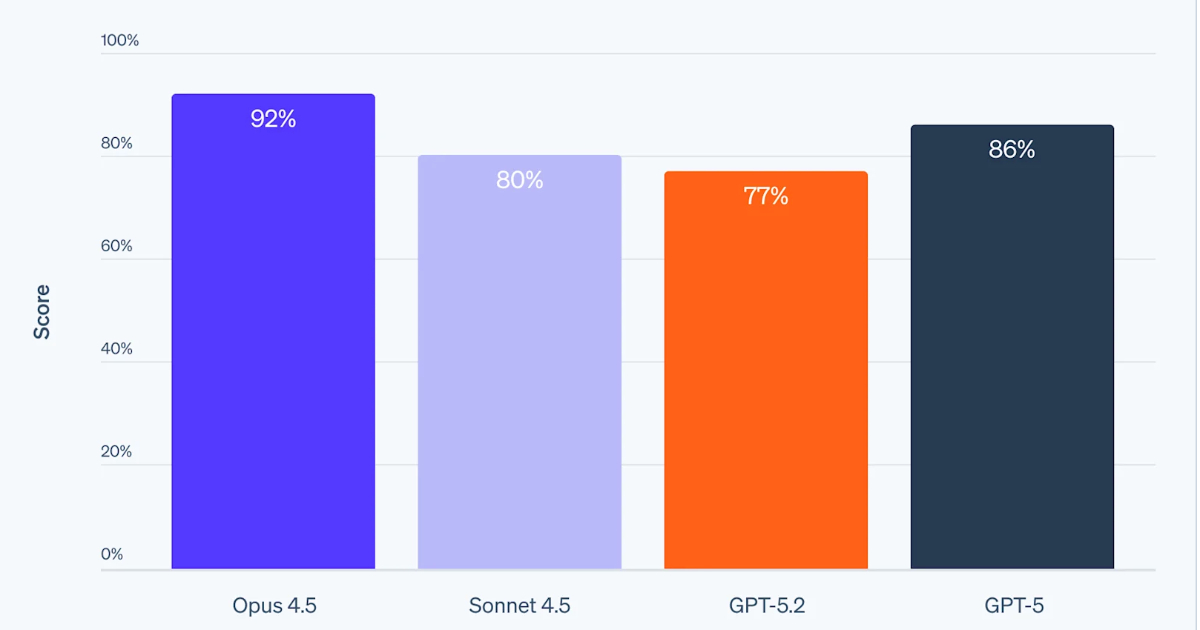
In evaluation breakdowns, Claude Opus 4.5 achieved 92 percent average scores on full-stack API integration tasks across four scenarios, while GPT 5.2 reached 73 percent on structured gym-style tasks across two scenarios. Best-performing runs sustained an average of 63 interaction turns, indicating improved long-horizon execution, although correctness degradation still appeared in extended workflows.
Full Stack Benchmarking result (Source: Stripe Blog Post) Carol L, Software Engineer at Stripe, noted in a LinkedIn post that the core limitation is validation rather than code generation.
AI agents are not going to replace software engineers yet, at least not when building Stripe integrations, financial systems require strict correctness and that current agents lack a stable validation layer for integration workflows.
Two recurring failure modes are highlighted. In SDK upgrade scenarios, agents sometimes misinterpret validation signals. When given invalid Stripe inputs, they observe expected HTTP 400 responses and incorrectly conclude the integration is successful. In more robust runs, agents generate synthetic test data and use it to validate behavior correctly.
A second failure mode appears in browser-based checkout flows. Agents are required to complete a full payment process through a web interface, including entering address and card details and producing a Checkout Session ID. Tool interactions can disrupt browser state, such as shifting focus away from input fields. Although recovery is possible through refresh or refocus actions, agents often fail to recover and terminate tasks prematurely.
Practitioners observing the benchmark note that Many agent evaluations still miss production concerns such as idempotency, retries, and authorization scope errors, which frequently cause real integration failures. The benchmark therefore highlights limitations less in code generation and more in validation reasoning, state management, and recovery in multi-step execution.
Stripe positions the benchmark as an evolving framework for studying agentic software engineering in realistic environments. It has been open-sourced as part of its AI toolkit, enabling further experimentation. Future iterations are expected to improve handling of ambiguous validation signals, browser state continuity, and end-to-end integration correctness in production-like systems.