In this newsletter:
- A new feature for my blog, built using my voice
- Claude Haiku 5.5
- Hello Python 3.15, goodbye 3.10, and now I can use 3.11
Plus 5 links, 7 quotations, 1 note, 6 releases, 1 TIL, 1 tool, and 2 comments
Sponsor message: Static OAuth scopes and leaky sandboxes aren’t enough to protect autonomous AI agents. Legacy playbooks and threat models fail when applied to dynamic agentic workflows. Pomerium’s fine-grained access control gives you the confidence to move fast with agents. See why leaders like NVIDIA, OpenAI, and Uber trust Pomerium.
A new feature for my blog, built using my voice - 2026-10-09
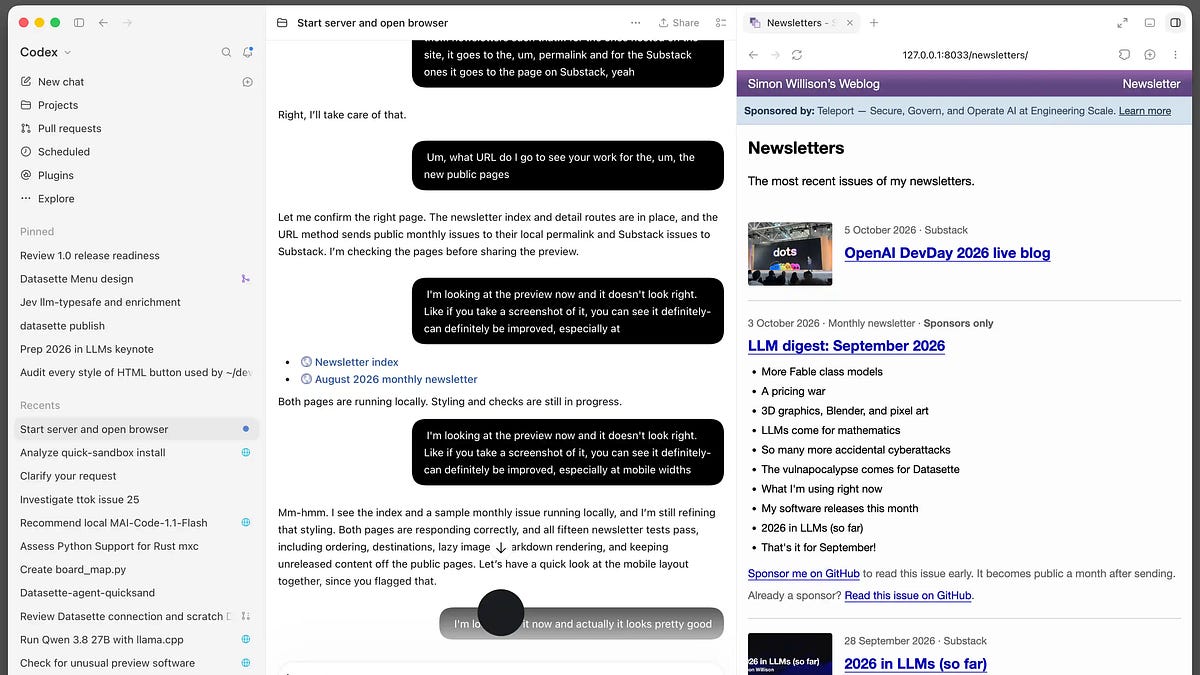
I shipped a new feature for my blog: the Newsletters page, which offers an index of all of the newsletters I’ve sent out, both my free weekly Substack and my monthly sponsors-only updates. I built the feature almost entirely using my voice, chatting away to my laptop while I cooked dinner.
Codex voice mode
I used the ChatGPT desktop app for this, in the Codex tab, using the voice conversation mode, running against a local development environment. Here’s what that looks like:
I started the session against my local simonwillisonblog checkout by typing:
Start dev server and open in browser
This gave me a preview of the site that it would be working on, and meant that I could later ask it to show me the new pages so I could visually track its progress.
Then I clicked the “Start new voice chat” button - that’s not the microphone button, it’s the one to the right of it - and set my laptop up in the kitchen so I could talk to it while I cooked.
Talking to my computer
I had a pretty good idea of what I wanted to build, and it’s a simple enough Django feature that I was certain the model (in this case GPT-6 Astra High) would be able to do it. A new model, a migration, some view code, templates, and a couple of import functions to populate the database from external sources.
Here’s an extract of my voice transcript that was captured by Codex:
Um, they do not. Um, this is going to be a new type of content. Um, it’s not going to show up... Oh, hold on. Yeah, no- I do not want this to show up in my, um, tag pages and date archive pages and... Actually, no, I think... I don’t want it on the tag pages. I don’t want it on the, um, blog index page. But I think I do want it to show up on the date-based pages. You know, if you navigate to September the 19th, and I sent a newsletter on that page, I think I want that to show up. So... this is- so I think we probably need a new model. The other thing is that I want them searchable, uh the Substack ones are not searchable, because those are actually just copies of other s- on content on my blog. These monthly ones do contain unique content, and spe- and once they’re... published, like once they’re made public a month after they’ve gone out, I want them to show up on my search results.
Apparently this was clear enough that the model knew what I wanted to build! You can read the full transcript, disfluencies and all, in this Gist.
We went on like this for about half an hour (the time it took to cook dinner). The model would reply and occasionally ask clarifying questions, then get to work modifying the code.
What we built
We got a surprisingly long way entirely by voice:
- A new model and migration to represent imported newsletters in Django, plus Django Admin configuration for that
- Four working imports:
- The most recent Substack items via RSS
- Every other Substack item via their undocumented API, which GPT-6 Astra knew about (it tried
/api/v1/archivedirectly) and then ran a search to figure out how to paginate it and foundthis article by Karen Spinner - All of my published monthly newsletters from my simonw/monthly-newsletter-archive GitHub repository
- My most recent private sponsors-only newsletter from a private repository
- The /newsletters/ and/newsletters/2026/ public archive pages
- Newsletters showing up on day and month archive pages too, but not on tag pages or my homepage
- Weekly Substack newsletters link to Substack; archived monthly newsletters have their own pages
- Integration with my site search engine
It was almost ready to ship. The catch was the imports: Astra offered to export data from my local copy so I could import that into production, but I wanted it to work like my other import scripts. Since some of the data lived in a private GitHub repository, this would involve creating a new API key, and for that I knew I’d have to sit at the keyboard for a while.
Finishing it with a review
Once I had finished cooking and judged it mostly feature-complete, I had Codex create a branch and open a pull request.
I reviewed the code in the GitHub PR interface. It was nearly what I needed, except it had chosen to use Git in a subprocess for one of the import scripts. I needed one of the imports to pull from a private Git repository, so I figured the API would be a better bet. I switched to typing and had Codex swap that out for an API-based import instead.
You can see the changes I made during the review in the extra commits on the PR. I fixed the import mechanism and made a few tweaks to the display of those public pages. It took an additional half hour of typing-based prompting to get to the point where I was happy to deploy it to production by landing the PR.
The end result
You can see the end result at the new newsletters index page, or view the page for a previous monthly newsletter.
The index page shows my most recent Substack weekly newsletters and GitHub sponsors monthly newsletters mixed together in reverse chronological order. Further down the page are links to my by-year archive pages.
GPT-6 Astra designed the page, and then tweaked that design based on my vocal feedback from glancing at the local preview across the kitchen.
Better for multi-tasking than as a daily driver
OpenAI love using voice-driven demos like this one for things like DevDay - and they do work well in that environment. I don’t think this is going to be a daily driver for me though.
I’ve written before about how much “work” I get done using ChatGPT voice mode on my phone while walking the dog - mostly research and brainstorming, but occasionally actual development work by having ChatGPT write and test out snippets of code.
This feels different. The addition of the visual preview, plus being able to type or paste things in via the keyboard when I need to communicate something that doesn’t work vocally, makes this a much more powerful way of interacting with a coding agent.
I still switch back to typing once I get down to the details of things though. Being able to paste in examples and error messages, or directly highlight the code or feature that needs changing, remains more efficient than trying to describe it in words.
I mainly work from home, which is good because there’s no way I’d want to talk to my computer like this in a shared workspace!
The killer feature for me is the ability to multi-task. I usually cook with a podcast or TikTok running; now I can actually build stuff instead.
Claude Haiku 5.5 - 2026-10-07
As previously promised, here’s Anthropic’s new fast, low cost model: Introducing Claude Haiku 5.5.
The previous Haiku, 4.5, was very much showing its age. It came out almost a year ago, and was priced at $1/million input and $5/million output - relatively expensive even back then, and a full 10x the price of OpenAI’s GPT-6 Luna, released last month.
The new Haiku exactly matches the price of GPT-6 Luna - $0.10/$0.50 - up to 100,000 tokens. Beyond 100,000 tokens the price increases 5x to $0.50/$2.50. Luna itself has a price increase at 272,000 tokens but only to $0.20/$0.75.
Haiku 5.5 also uses a new, less generous tokenizer. My Claude Token Counter tool shows that the same long prompt uses around 1.25x as many tokens with Haiku 5.5 compared to Haiku 4.5, so there’s a hidden price increase there.
If your workloads fit in 100,000 tokens, Haiku is the same price as Luna and reports higher benchmark scores. Above 100,000 tokens, Luna looks like a much better deal.
The most recent release of llm-anthropic finally fixed it so I don’t need to ship a new version of that plugin for every new model. I tested the new model like this:
llm install -U llm-anthropic
llm anthropic refresh
llm -m claude-haiku-5.5 "Generate an SVG of a pelican riding a bicycle" -o thinking_effort low
Pelicans
Here are pelicans for low, medium, high, xhigh, and max. The new Haiku doesn’t let you disable reasoning, and defaults to medium. I got a good bicycle frame for everything beyond low. The low effort pelican cost 0.0936 cents and took 7 seconds.
This max effort pelican (with a reasoning tracethat starts “This is the classic pelican-on-bicycle SVG test...”) took 5 minutes 9 seconds to generate, but still only cost me 3.3826 cents:
(Since the reasoning trace exhibits awareness of the benchmark, here’s Generate an SVG of an armadillo in fishnet tights jaywalking on Mars (on xhigh), and the same prompt against some other recent models. Background on that.)
For comparison, here’s the pelican I got a year ago from Haiku 4.5 (for 0.7583 cents - Haiku 4.5 did not support reasoning levels). It suckedat drawing pelicans:
And a generous API credit scheme for subscribers
In addition to Haiku 5.5, Anthropic announced today that they are halving the price of cache reads for Sonnet 5.5. They’ve also added API credits to subscription plans:
Second, this week, we’ll roll out a new monthly API credit to all Max and Team subscribers for use on the Claude Platform. Max 5x users will get $100 in credits per month, Max 20x users will get $200, and Team subscribers will receive up to $500, pooled across their users.
Claiming this is pleasantly easy: navigate to Settings -> Billing and select the API organization that should benefit from the credits every month:
The API credits exactly match the cost of the subscription itself. This is really generous - it makes it much easier for subscribers to use the API. Anthropic also let you disable auto-reload for the API, with the consequence that “API requests will stop when your balance runs out” - exactly what you want if you’re planning to burn through those API credits without risk of a nasty billing surprise.
Note that the monthly credits do not roll over - use them or lose them.
OpenAI still allow you to use your Codex subscription for personal API use, which works out as a better deal for heavy API users. This new credit scheme goes at least some way to overcoming that difference.
Hello Python 3.15, goodbye 3.10, and now I can use 3.11 - 2026-10-12
Python 3.15 is here! Here’s the essential What’s new in Python 3.15 guide, this year curated by 3.14 and 3.15 release manager Hugo van Kemenade. As someone who builds open source software that works in every supported Python version, I get to say goodbye to Python 3.10 and start embracing features from Python 3.11.
First, some highlights from Python 3.15.
Explicit lazy imports
I’m most excited about Explicit lazy importsfrom PEP 810. These let you import modules like so:
lazy import json
lazy from pathlib import Path
The module will then be imported the first time those symbols are used in the code that follows.
My LLM CLI tool implements plugins. I had to recommend manual lazy imports in the plugin author documentation, because simply installing plugins that used heavy dependencies such as sentence_transformers could add multiple seconds to every invocation of the llm command. Lazy imports directly address this startup cost.
Unpacking in comprehensions
The new [*sublist for sublist in lists] unpacking syntax is neat. Here’s an illustration lifted from the documentation:
lists = [[1, 2], [3, 4], [5]]
[*L for L in lists]

sets = [{1, 2}, {2, 3}, {3, 4}]
{*s for s in sets}

dicts = [{’a’: 1}, {’b’: 2}, {’a’: 3}]
{**d for d in dicts}
PEP 798: Unpacking in Comprehensions by Adam Hartz and Erik Demaine proposed this as an extension of the unpacking syntax from PEP 448, which landed in Python 3.5 back in 2015.
A sampling profiler
Python’s existing tracing profiler has been renamed from cProfile to profiling.tracing, and has been joined by an exciting new sampling profiler called Tachyon, aka profiling.sampling.
Sampling profilers work by periodically capturing stack traces from running processes, then using those to calculate which functions have the most time spent inside of them. They’re very low overhead and can provide a deep insight into running systems, without needing to instrument those systems first.
I’ve previously used tools like py-spy for this. Now this capability is baked into the standard library.
If you have the PID of an existing Python 3.15 process you can start gathering samples by running this (I had to use sudo on macOS):
sudo uv run --python 3.15 python -m profiling.sampling attach 1234
Interact with the main program a bit, then hit Ctrl+C to stop gathering and see a report, which looks something like this:
It can also produce flame graphs like this and heat maps like this, and can even output a format that can be viewed in the Firefox profiler UI.
3.15 isn’t much faster than 3.14
Miguel Grinberg investigated How fast is Python 3.15? the other day against the 3.15.0rc3 release and found performance to be mostly the same as 3.14, with the exception of the experimental JIT. The JIT gave a 1.2x boost over the standard 3.15 interpreter (on a Fibonacci test), the first time Miguel observed a meaningful JIT performance increase.
Miguel’s explorations of 3.14 last year found significant boosts against Python 3.13 across many more categories.
Upgrading to Python 3.15 with uv
I used the following sequence of commands to get uv to use Python 3.15 on my Mac. First I had to upgrade uv itself to ensure it knew about the new release:
uv self update
Then I installed the stable 3.15 release:
uv python install 3.15
And told uv that I wanted that to be the default for every uv run command, unless the project itself pinned a different version:
uv python pin --global 3.15
Now the following reports 3.15 as the version:
uv run python --version
I already have a bunch of tools installed using uv tool install. I reinstalled them to use Python 3.15 like this:
uv tool upgrade datasette --python 3.15
Then I can confirm the version like this:
datasette --get /-/versions.json | jq
Highlights from Python 3.11
The release of 3.15 means that Python 3.10 (released in 2021) is officially no longer supported.
My policy for my main open source projects is to keep them working in every supported Python version. I can now drop 3.10 and start using features that were introduced in 3.11.
Here’s the What’s new in Python 3.11document. I finally get to rely on tomllib being available!
Datasette makes extensive use of asyncio. 3.11 adds TaskGroup and timeout(), and several more new features.
datetime.UTC is a new in 3.11 alias for datetime.timezone.utc.
Python’s SQLite support got some significant upgrades in 3.11, including:
- setlimit() andgetlimit() expose a mechanism for settingSQLite runtime limits from Python.
- create_window_function() lets us create custom window functions in Python, as a class with
step(),value(),inverse(), andfinalize()methods. - blobopen() provides an efficient mechanism for partial reads and writes of large
BLOBbinary values stored in a SQLite row. - You can now call
set_authorizer(None)to remove a SQLite authorizer. Datasette had a workaround for this!
Plus a whole bunch of improvements to Python’s typing system.
I plan to land Python 3.11 improvements to a bunch of my projects over the next few weeks. Here’s my first Datasette PR removing that set_authorizer(None) workaround.
I’ve also updated my click-app, datasette-plugin, python-lib, and llm-plugin cookiecutter templates to test against Python 3.11 through Python 3.15.
Quote 2026-10-05
The “old” version of Cowork runs model inference in the cloud, executing tool calls in an Anthropic-provided VM we shipped to your computer. We added the VM for capability, safety, and security reasons - mapping in just the data you explicitly added to your session. People loved what they were able to do with Claude but didn’t love the disk, battery, and performance cost of running the VM locally. Also, people didn’t love that closing your laptop means the work stops.
The “new” version of Cowork runs model inference and the VM in the cloud. Each session gets its own sandbox, not sharing state with other sessions. When the VM needs something on the users’ device (like a file), the desktop app is responsible for that file access tool call. [...]
We think this solves a lot of problems we’ve heard about (like using Cowork from a phone, keeping work running, or getting all the same power without losing battery to the VM)
Felix Rieseberg, Anthropic, see also this help page
Tool: Scrimshaw Jukebox
I wanted to see if Claude Opus 5.5 could compose music, so I tried this:
I want you to write some computer game music for me. First design simple text based format for the music and build an artifact that can play it out loud - include some example tracks in that artifact
I am looking for music of the quality of the original secret of Monkey Island
It leaned a lot harder into the Monkey Island theme than I had intended, but the results are surprisingly good.
I wonder if the ability to compose competent music is similar to the 3D graphics thing - a new capability for text models that emerged in the past few months?
Would need some careful experiments with other recent and not-so-recent models to confirm if this is new or if they’ve been able to do this for a while.
Release: datasette-atom 0.11a0
A minor fix for compatibility with the latest Datasette alphas. This meant we could upgrade the datasette.io site to Datasette 1.0a41.
comment: Mistral Large 4
wren6991: The benchmark is saturated. Frontier models are tested with an armadillo in fishnet tights jaywalking on Mars.
OK well I couldn’t resist this one:
llm -m claude-opus-5.5 'Generate an SVG of an armadillo in fishnet tights jaywalking on Mars'
llm -m gpt-6.1-sol 'Generate an SVG of an armadillo in fishnet tights jaywalking on Mars'
llm -m gemini-3.8-flash 'Generate an SVG of an armadillo in fishnet tights jaywalking on Mars'
llm -m mistral/mistral-large-4 'Generate an SVG of an armadillo in fishnet tights jaywalking on Mars'
Default reasoning levels for each: https://tools.simonwillison.net/markdown-svg-renderer?url=ht...
TIL: Using Parseable with Datasette for OpenTelemetry traces
I saw Parseable in a Show HN - it’s a new observability platform with both an open source (AGPL) Rust implementation (a single ~180MB binary), an “Enterprise” version with extra features and a cloud hosted option.
Since Datasette 1.0a41 added OpenTelemetry support (thanks, Alex Garcia), I decided to fire up Codex and have it figure out how to run Parseable and feed it traces from Datasette.
Here’s my (human-written) TIL showing the patterns that worked, and here’s a screenshot of a Datasette trace displayed within the Parseable localhost web application:
Link 2026-10-06 Introducing Mistral Large 4: Le chonk:
Mistral are back in the game. They released a preview of Mistral Large 4, a 1 trillion parameter, 49 billion active parameter model trained on their own cluster of 3,800 NVIDIA Grace Blackwell GPUs.
The preview is available via their API. They promise to release the open weights model at the “end of this month”.
The model only supports two reasoning levels - “none” and “high” - via the Mistral API. Here are both pelicans - the “high” one looks better, though surprisingly it only used 2,717 output tokens compared to “none” which used 3,275:
On Artificial Analysis it scores 38, just behind DeepSeek 4.1 Flash, which is a 552B model. It’s a huge improvement on last December’s Mistral Large 3, which drew this terrible pelicanand scored 9 on AA.
It’s certainly not a Fable-class model, but it’s great to see Mistral put out a model that’s back to being maybe about 6 months behind the frontier.
comment: EmbeddingGemma 2
I really appreciate that EmbeddingGemma 2 is under the Apache 2.0 license.
For embedding models in particular, I don’t think it makes sense to use a closed, proprietary, hosted-only model.
Most applications of embedding models involve calculating thousands or even millions of embedding vectors and storing them for later comparison.
If your model is proprietary, the vendor is likely someday going to decide to stop offering that model. They’ll have a better model to replace it, but you still need to pay to re-calculate those millions of stored existing vectors.
(In April 2024 OpenAI offered to “cover the financial cost of users re-embedding content with these new models” - https://openai.com/index/gpt-4-api-general-availability/ - but I don’t think that’s something we can rely on from every provider.)
Notably, I don’t want to host the model myself. I’d much rather pay a provider for a hosted model while knowing that if they ever stop hosting it I can run the open weights version myself - or find another vendor who can do that for me.
Release: llm-mistral 0.16
Adds support for reasoning models, such as the newly released Mistral Large 4.
Release: llm-openai-decisions 0.1a0
OpenAI released their new Jev-style Decisions API, as previously announced at last week’s DevDay.
Since I already have an llm-typesafe plugin for talking to Jev, I had GPT-6 Astra read the new OpenAI API documentation and build an llm-openai-decisions plugin inspired by llm-typesafe.
Unlike Jev, the new gpt-6-luna decision model supports image input in addition to text. Both models charge for input it and not for output: OpenAI’s is 10 cents per million input tokens, Jev’s is 4.2 cents per million.
Otherwise the API shape is very similar to Jev, at least conceptually. Jev supports three question types for yes/no, choices, or scores. OpenAI Decisions supports the same three types.
Install the plugin like this:
llm install llm-openai-decisions
Here’s an example query against an image attachment:
llm -m openai-decisions/gpt-6-luna \
  -a https://static.simonwillison.net/static/2025/two-pelicans.jpg \
  -s ‘Does this image contain any mammals?’
And example output:
{”type”: “predicate”, “name”: “evaluation”, “probability”: 0.0}
Consult the README for full details of how to run the other types of questions.
Quote 2026-10-06
Since the Medicare breach, OpenAI has put in place additional monitoring to allow “immediate intervention” by staff to stop training if the company’s models access the internet in ways they’re not supposed to, Mr. Kwon [chief strategy officer at OpenAI] said.
Victoria Kim, Reporting from the Australian parliament
Link 2026-10-07 OpenAI “rogue” agent activities found on Wikimedia projects:
Given how tempting a target wikis are for rogue agent swarms, it’s not a huge surprise that Wikipedia found evidence of that activity once they went looking:
The Wikimedia Foundation conducted its own investigation to see whether Wikimedia websites had been similarly affected by AI agents, focusing on those operated by OpenAI. We can confirm that we have discovered some activity by these “rogue” OpenAI agents on Wikimedia platforms. The unauthorized bot activities included edits to our wikis, some unsuccessful attempts to exploit a public note-taking tool we host, and heavy traffic, which are described more below.
They found evidence of agents editing sandbox pages, trying to use pieces of infrastructure such as Etherpad to help proxy content from elsewhere, and saw widespread crawling and “hundreds of thousands of data queries” to their Wikidata Query Service.
My best guess is that most of this was a similar (or the same) swarm of agents as those that defaced that German wiki while training for research tasks.
The Wikipedia sandbox wiki edits appear to have started on May 12th, and the initial test edits to the UseModWiki Sandbox page reported by that incident started on May 11th.
Quote 2026-10-07
I was a graph theory junkie long ago and even moved to Budapest for awhile to study among the greats. While I was there I started working on Barnette’s Conjecture which came to occupy my thoughts over the next 24 years of my life, on and off as I worked in many different fields. Last summer I even thought for a few days that I had actually solved it.
But it’s supposedly proven here - problem 180. I don’t know what to think exactly. I spent thousands of hours on that problem. I really enjoyed it. Hearing that it is solved somehow makes me sad in a far-off way, like hearing an ex-girlfriend died suddenly in a car crash. I don’t know, there’s probably a lot of people feeling odd emotions tonight.
Jake Boggan, Hacker News comment on openai/math
Link 2026-10-07 Anti-Patterns in Software Blogging:
Some excellent writing advice from Michael Lynch. Michael warns against “meandering intros”, misjudging your reader’s existing knowledge, assuming they’ll read your previous posts, and excessive formality.
He also warns against overreliance on links as an excuse not to explain terminology. This one hurt! I do this all the time, but I have a nagging suspicion that almost nobody ever clicks on them.
(In a Lobste.rs comment Michael clarifies that “My rule of thumb is that my article should still make sense to the reader even if they don’t click any links”. That works for me.)
This point about using your own voice is crucial:
Beginner software bloggers suffer from a mass delusion that you have to write in a stiff, overly formal way for people to take you seriously [...]
Just write the way you talk.
With so many developers delegating their writing to AI, software blogging is becoming bland and homogenous. Readers are hungry for writing with personality.
Quote 2026-10-07
I’ve always been kind of into computers since I was young. And then when film started to move from analog film to digital, I became more interested in that aspect of it. And the visual effects workflow for many years has included machine learning.
So I can write like pretty shitty Python scripts and stuff like that because with convolutional neural networks, which were the sort of precursors to what the transformer can do, which is just much more computation simultaneously, you would do things like look at what’s called a tensor, which is just the numerical translation of a visual image in numbers — like the batch number, the frame number, the red, green, and blue values of each pixel in each frame.
And a tensor, you use a convolutional neural network to identify patterns in that that would reveal what’s called edge detection or feature extraction, which is just identifying patterns enough to know like this is where the window ledge is, so we can more easily take the green screen image out and replace it with something.
Ben Affleck, Pythonista
Quote 2026-10-08
Computer programming is, fundamentally, about two things:
Problem-solving using computers
Learning to control complexity while solving these problems
I have a hard time imagining a future where knowing how to solve problems with computers and how to control the complexity of those solutions is less valuable than it is today, so I think it will continue to be a viable career even with the advent of AI tools.
Release: ttok 0.4
ttok is my CLI tool for counting tokens, using OpenAI’s open source tiktoken library.
It hasn’t been in updated in a couple of years, but I finally fixed a Click warning, updated CI, and added a --list-models command to list available models.
It works with uvx, so you can count tokens in anything like this:
cat file.txt | uvx ttok
Release: ttok 1.0
I released ttok 0.4, ran uv tool upgrade ttok, piped a file into the new version... and realized that it was defaulting to the GPT-4 tokenizer when it should very clearly default to GPT-5/GPT-6 instead!
I figured switching the default was a reasonable excuse to finally ship a 1.0.
OpenAI haven’t actually confirmed that GPT-6 uses the same tokenizer as the GPT-5 family yet - there’s an angry issue about it - but I found this commit by William Liu which reports on an experiment he ran confirming that the tokenizers are likely the same:
All seven GPT models (5.5, 5.6 Sol/Terra/Luna, 6 Astra/Sol/Luna) report 44,794 tokens and match each other on every one of the 31 fixtures. GPT-6 introduces no input-count change on this corpus.
Quote 2026-10-09
Everyone is very concerned about being respectable, so I’m going to be the goofball who raises worst-case possibilities. I think there is a 1% chance we live in Minicrypt, and a 15% chance we functionally lose confidence in our existing public-key encryption algorithms. [...]
The problem here is that the speed of AI producing surprises, and the speed of human beings replacing standards (even with the very best AI assistance) are just orders of magnitude different. You only recover from a surprise like this if you do the preparation in advance.
Matthew Green, on Twitter. I looked it up and Minicrypt is Russell Impagliazzo’s hypothetical world in which public-key encryption is impossible.
Link 2026-10-09 Deno is joining Cloudflare:
The Deno team released the first version of celld back in August - their open source implementation of the Durable Objects pattern from Cloudflare Workers.
Today, Cloudflare are acquiring Deno outright, with the goal of building on celld to “make workerd self-hosting a first-class supported way to build and run apps using the Workers programming model” (see the Cloudflare blog.)
The bad news is that Deno itself will not be maintained by Cloudflare beyond the next year:
We will support the Deno runtimefor another year with monthly releases containing bug fixes and security updates. After that year we will end our development of the Deno runtime. Deno will remain open source, and we welcome others who want to continue its development.
Deno (and Node.js) creator Ryan Dahl explained that decision in a comment on Hacker News:
It’s a joint decision and I agree with it. I’m most invested in its success and have put the most work into it - and I no longer think it’s where I can do the most important work. There are some good ideas in Deno and it’s well engineered - but it ultimately is not solving big problems. It has been sucked into the gravity well of node compatibility, which forces it to behave exactly as Node does. Why reimplement Node? It works. Marginal performance or UX or security benefits are not enough.
I’m interested in building powerful new abstractions. celld has been working remarkably well, depending only on object storage for coordination and persistence. It is not just a slightly different API to interact with the file system or network - it’s an entirely new model for server development.
My favorite feature of Deno has long been the permissions system, where you can run a Deno script and specify exactly which files and folders it can read and write to, and which network hosts it can access.
Node.js has a similar permissions model these days, added in Node v20.0.0 in April 2023 and declared stable in Node v22.13.0 in January 2025. They don’t yet support allow-listing specific network hosts though - networking is either on or off.
Quote 2026-10-10
Anthropic detailed the activity of its A.I. agents in a blog post on Friday, without naming the targeted websites. But two sources with knowledge of the incidents said Anthropic’s A.I. agents had submitted 20 visa applications through a form available on the State Department’s website. All the applications were incomplete and were not processed, they said.
The New York Times, Anthropic Agents Tried to Fill Out Visa Forms on State Dept. Website
Link 2026-10-10 Python 3.15.0 added to actions/python-versions:
Bit of a niche link, but I’ve been waiting for this for a couple of days - I even told ChatGPT to check for it:
Clone https://github.com/actions/python-versions and git pull once an hour until they add the stable 3.15 - then tell me about it
Now that this has landed, you can add "3.15" to a GitHub Actions testing matrix to run tests against the new Python 3.15.0 release.
Note 2026-10-11
I remember hearing a while ago that Dwarf Fortress didn’t use version control. That fact has been lodged in my head, because given its inherent complexity I have trouble imagining a codebase that would benefit from version control more. That’s art.
I went looking and I’m sad to report that the days without version control appear to have ended. Quoting Tarn Adams over time:
- March 2013: “I don’t use version control -- I didn’t like the feeling of having the code get committed into a black box thingy with no immediate upside”
- March 2016: “I don’t even use version control. If you don’t know what that is then you’re not gonna yell at me. If you even know what version control is you’re gonna be like, ‘You don’t use version control? You don’t use source control? What is wrong with you? How can you even work? I’m just not cut out for it, in a sense. It’s been 15 years, so the reasons have change over time, but that’s my current understanding of it.”
- March 2023: “I’ve got Discord channels to check and version control stuff to use now, so the process is definitely a little more involved”
That March 2023 quote comes from an interview about the release on Steam which made them millionaires. I’m a tiny bit sad that they gave in before they hit that milestone, but what an impressive run.
Release: datasette-ports 0.4
My plugin for detecting and listing all Datasette instances on the current machine now works with the latest version, and displays the detected PID as well. Knowing the PID makes it easier to attach the new Python 3.15 profiler.
If you find this newsletter useful, please consider sponsoring me via GitHub. $10/month and higher sponsors get a monthly newsletter with my summary of the most important trends of the past 30 days - here are previews from June and July and August.