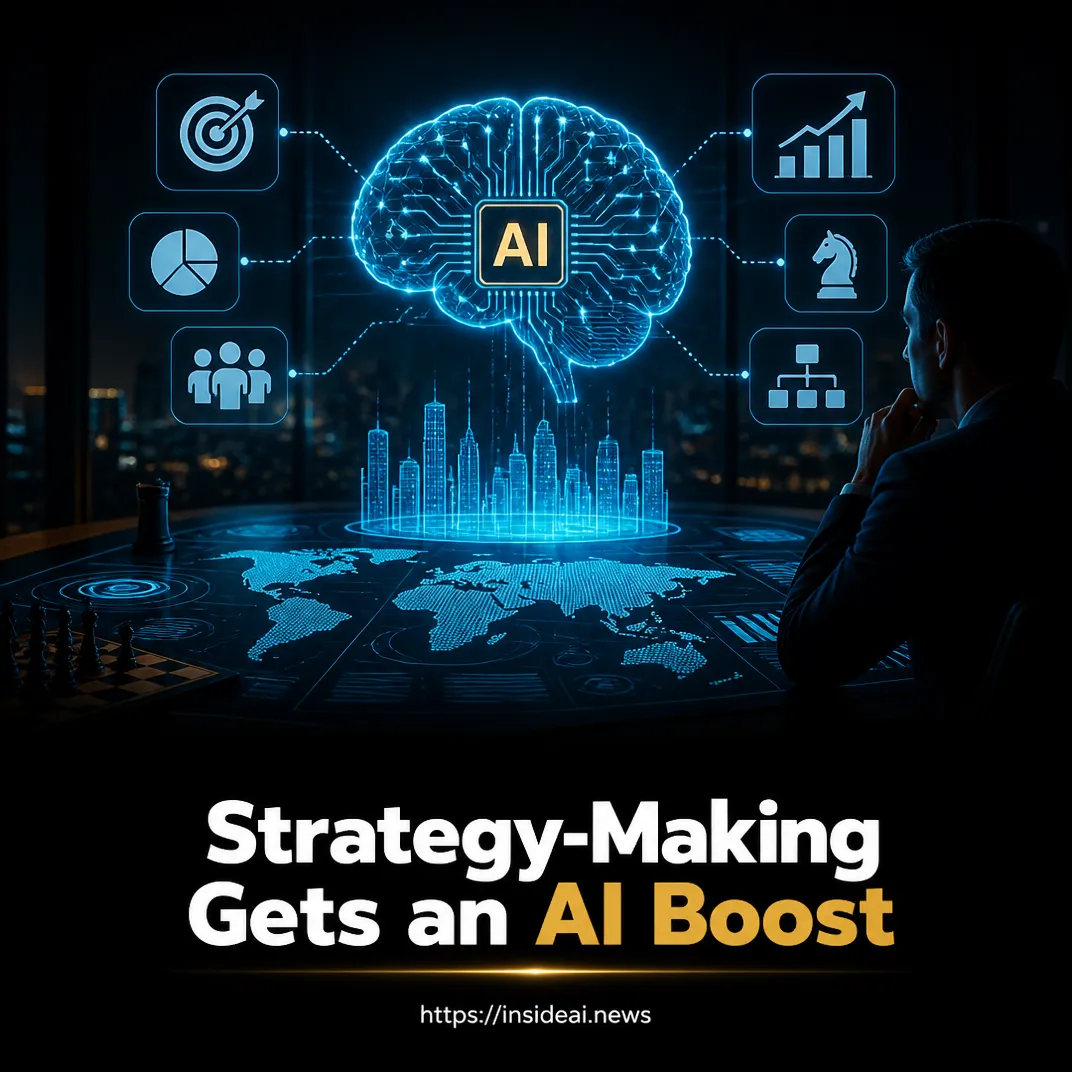
August 18, 2026, (Inside AI) — Corporate strategy has long leaned on static frameworks to tame messy decisions. SWOT grids, growth-share matrices, and Porter's five forces compress complexity into manageable boxes.
University of Michigan professor Felipe A. Csaszar argues these tools exist because of bounded rationality. He defines it as the constraint on human decision-makers by finite attention, memory, and processing power.
Now, generative AI is challenging that assumption. Executives can ask large language models to simulate market shifts, stress-test assumptions, and surface blind spots in real time.
Csaszar's research suggests AI can expand the decision space. Instead of relying on two-by-two grids, leaders can explore thousands of strategic scenarios before committing capital.
This shift matters because strategy errors are costly. A McKinsey study found that companies reallocate just 8% of their capital across business units annually, leaving most resources stuck in inertial patterns.
AI tools can flag those patterns. They can model competitor responses, regulatory changes, and supply chain disruptions with a speed no human team can match.
The promise is not automation of decision-making. It is augmentation of the reasoning that precedes it. Csaszar frames this as moving from bounded rationality to AI-assisted rationality.
Yet the transition is not frictionless. Strategy consultants have built careers on proprietary frameworks. If AI commoditizes analysis, the value shifts to judgment, data quality, and organizational courage to act.
Some executives remain skeptical. They note that AI models trained on historical data may reinforce past strategic orthodoxies rather than break them.
Csaszar counters that the risk is manageable. He suggests pairing AI-generated options with human deliberation, not replacing one with the other.
The timing is notable. Corporate planning cycles are compressing. Annual offsites are giving way to continuous strategy reviews, and AI fits that cadence.
Early adopters include firms in financial services and consumer goods. They use AI to simulate pricing moves, entry into adjacent markets, and M&A scenarios before board discussions.
The technology is not a crystal ball. But it changes the cost of exploring alternatives. What once took a consulting engagement can now be prototyped in an afternoon.
Csaszar's work builds on decades of behavioral economics. Herbert Simon introduced bounded rationality in the 1950s. Daniel Kahneman later mapped the biases that flow from it.
AI does not eliminate those biases. It can, however, surface them by generating counterfactuals that a confirmation-prone executive might never consider.
The organizational challenge is cultural. Teams must learn to trust machine-generated scenarios without abdicating responsibility for the final call.
Csaszar's research points to a hybrid model. AI handles the combinatorial explosion of possibilities. Humans handle the values, ethics, and stakeholder trade-offs.
That division of labor could redefine the strategy function. Analysts may spend less time building slides and more time interrogating model assumptions.
The competitive stakes are rising. A 2025 survey by Gartner projected that by 2028, over half of large enterprises will use AI to support strategic planning processes.
Companies that master this shift may gain an edge in speed and optionality. Those that ignore it risk being outmaneuvered by rivals who see more of the board.
Csaszar's insight is simple but profound. The limits that shaped a century of strategy tools are no longer fixed. They are now variables that technology can stretch.