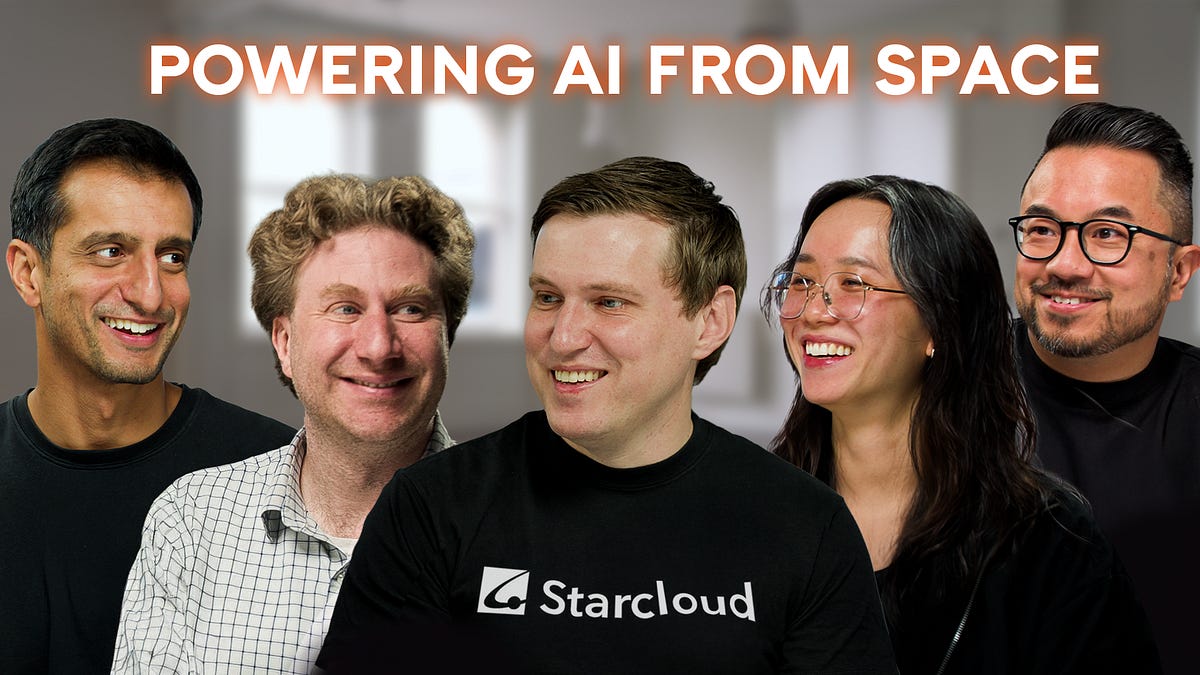
20 gigawatts in orbit against one gigawatt on the ground — Starcloud’s co-founder and CEO on why the compute is going up to space.
Starcloud was founded on January 1st, 2024. On January 2nd, they booked a SpaceX rideshare launch — before they knew what they’d put on it.
Philip Johnston joins the Lightcone pod to explain why data centers belong in orbit, how collapsing launch costs make the math work, and how Starcloud went from demo day to a $170M round led by Benchmark in 17 months, the fastest unicorn in YC history.
Timestamps
00:39 — Why Build Data Centers in Space?
01:40 — The Insight That Started StarCloud
04:43 — Launching StarCloud One
09:45 — The Engineering Behind Data Centers in Orbit
13:49 — Why 100 VCs Said No
16:12 — Book the Launch Before You Build the Product
18:32 — The Roadmap to Commercial Space Compute
21:10 — Building NVIDIA GPUs for Space
23:41 — Raising $170M for a Hard Tech Startup
26:37 — Hiring the World’s Best Space Engineers
31:25 — Why AI Compute Is Moving to Space
34:49 — Advice for Hard Tech Founders
Transcript
Philip: First thing every space company should do is book the first available launch they can.
Jared: Before they built the thing that they’re going to.
Philip: Before they built the thing, before they probably even know what they’re going to launch. Booking a launch is such a good forcing function for a space company. So we founded the company January 1st, 2024. January 2nd, we booked the first available SpaceX rideshare launch. And we were like, okay, something is going to be on that rocket. I’m not 100% sure what it’s going to be at this point, but something is going to be on there. Something’s going to happen.
Diana: Sounds like the same advice for all the software companies. You just got to keep launching and launching. Same thing.
Garry: Welcome back to another episode of The Lightcone. Today we’re sitting down with Philip Johnston, the co-founder and CEO of Starcloud. Starcloud is building data centers in space to address the energy bottleneck that AI is creating here on Earth. Earlier this year, they raised $170 million led by Benchmark and became the fastest growing unicorn in YC history just 17 months after demo day. Philip, welcome to the Lightcone.
Philip: Thanks so much for having me.
Garry: So to start off, why data centers in space?
Philip: So Starcloud is building data centers in space to solve the AI energy bottleneck. We are very quickly running up on constraints on where we can build new energy projects terrestrially. By building them in space, we get access to this almost unlimited low-cost energy in the form of solar. Of course, there are other costs like the cost of launch, and the cost of launch is actually very rapidly trending down with new launch vehicles coming online, the Falcon 9 program and Starship on the horizon. That’s the reason we’re building data centers in space.
Harj: How did you come up with the idea? It’s not like the typical idea that people come up with.
Philip: I’d actually been working, I was with McKinsey for a few years working with the space agencies of different governments, and I could see that the launch cost was very rapidly trending down. And actually in early 2023, I decided randomly on a weekend to take a trip down to Starbase, Texas where they’re building the Starship launch program, even before the first launch. Not many people were paying attention back then. I could see that they were just building enormous capacity. So they’re building these two Starship gigafactories. They’re designed to produce something like three Starships per day. And because Starship is reusable on a three or four-year timeframe, that could lead to us having thousands of times the capacity to get things to space. So I started thinking, okay, let’s just run the clock forward. If the launch cost was 10 times lower than it is today and the launch capacity was maybe a thousand times more than we have today, what would make sense that currently doesn’t make sense?
So I started thinking about some of the concepts from sci-fi that I remember as a kid, like space-based solar where you have these huge solar panels in space, you beam that power down. I reached out to a few folks I knew in the space industry and got connected with a few others and started ideating on, okay, what would make sense if the launch cost was much lower than it is today?
Jared: I’m curious, are there any other ideas that occurred to you during this process when you were thinking of what people could build in space now that
Philip: It’s cheap? Yeah, tons. We definitely looked at manufacturing in space and there’s Varda. We looked at asteroid mining and obviously YC has AstroForge. We looked at space hotels, we looked at basically anything which could make sense if the launch cost was a lot lower than it is today.
Jared: And how come data centers was the best choice?
Philip: Data centers makes a lot of sense to be the first thing that you do because you don’t need to reenter a product. So with things like asteroid mining or with manufacturing in space or space hotels, they require this very expensive reentry process. Initially, what we actually started doing was space-based solar, so huge solar panels and then you beam that power down. It’s a concept from I think the ‘60s, even Asimov in the ‘40s was writing about it. The problem with space-based solar is you actually lose 95% of the energy in transmission from space to Earth. So for the first two months of the company, that was literally what we were doing. We were called Lumen Orbit because of that reason, luminosity in orbit. We were thinking, okay, once we get that power down, what are we going to be using it for? Even back in ‘23, most new energy projects were being built for data centers.
So we were like, okay, well, either directly or indirectly, this power is going to go into data centers. Let’s rerun those numbers. So initially we’d run the numbers to know what’s the launch cost breakeven that makes sense for space-based solar? And we’d come to a number of like $50 a kilo. So then we reran the calculations. We were like, okay, let’s spend a month figuring out what would the launch cost breakeven need to be to make data centers in space breakeven. And we came to a much closer to reality number of $500 a kilo. And that’s what we think currently that the breakeven launch cost is. And so then we rapidly pivoted the company towards that.
Garry: So Philip, you launched Starcloud-1 in November of 2025, and that was a real emotional moment. Can you walk us through what that was like?
Philip: Yeah, it was incredible. So just to tell people a bit about Starcloud-1, we’d set this launch date 18 months in the future, and we initially started with something quite unimpressive. We were going to fly some NVIDIA Jetson chips. They’ve been flown in space before, and we were going to try and do some new workloads on there. It was Adi that came on and said, no, we need to do something way, way cooler than that. And we actually ended up putting five GPUs on there, three from NVIDIA, two from ARM. But the most interesting one was this NVIDIA H100. We did some crazy things. For example, you have to put it through thermal cycling and we didn’t have time to. We’d booked the vacuum chamber, the thermal and vacuum chamber. But we needed to know, okay, if we heat up this phase change material and cool it down and heat it up and cool it down, is it going to crack anything?
And so at 5:00 AM the day we had to ship it down, we were working through the night, Adi and Ezra are dunking this thing in an ice bath to cool it down. And then we pull it out of the ice bath and I’m like, are you sure it’s fine with electronics? They’re like, don’t worry about it. It’s totally fine. They pulled it out of the ice bath. Then we had these hair dryers to heat it up and melt all the wax or hot air guns. And then we’re dunking it back in the ice bath. It is a miracle that it works, to be honest.
Garry: You can just do things.
Philip: You can just do things. Yeah. So this is the kind of thing you can do as a startup because we actually had a quote from one of the primes on what it would cost to do Starcloud-1. And they said 75 million to 100 million dollars. And we did the whole of Starcloud-2, including the launch for $2 million. So yeah, leading up to the launch,
I mean, we got the most incredible separation video. I think we’re going to play it now. So half the time as it deploys, it will be behind the shadow of the Earth and you don’t see anything. The other half of the time it will deploy not into the silhouette of the Earth. And so it just is the most perfect deployment video I’ve ever seen. And this was played by Jensen as he walked on stage at the GTC conference this year, this five-story tall screen behind him playing the Starcloud-1 separation video. Amazing. So no, it was the most incredible feeling seeing this deploy.
Jared: Where was the team for this? Did you all
Philip: Go? So we took the whole team down. Yeah. There were only 12 in the team at the time of Starcloud-1 launch. So we took the whole team to Florida and we had a hundred friends and family investors. Some of our team brought their family and kids down, and it was a really nice day. We’re going to release a behind the scenes video of some of the family moments in that launch.
Jared: How long was it from when the rocket lifted off until the thing deployed until you powered it up and were able to verify the thing actually worked?
Philip: Yeah, so it lifted off. We were all on what they call the banana bleachers. It’s famous from the Apollo era, but it was in the middle of the night. So it lifted off at around midnight. And then at 1:00 AM they closed the bleachers and everyone had to get on a bus and leave. And we’re like, “Oh shit, I thought we were going to be able to watch the deployment.” And then I’m sitting in the back of a cab watching the live feed on spacex.com literally. I was like, “Oh my God, it’s deploying. I can’t believe it’s deploying.” And then it took about 12 hours to make first contact, which is not bad actually. It usually takes at least 24 hours to get first contact. And then it’s like a two-week commissioning period. And we had a whole bunch of software issues we had to work through.
The whole satellite kept restarting every two hours. And what was happening was one of 20 different failure triggers was triggering, and we didn’t know which one it was. And we could only get a ground station pass at least every hour and a half, maybe longer. And so we had to manually turn off each one, turn back on everything else and wait for a ground station pass to know which one it was. So that took three days just to figure out that software issue. And then two weeks after that, then we started commissioning and turning on all the different payloads. And then we trained the first model, ran the first version of Gemini. We did the first fine tuning of a model in orbit. Did the first high-powered inference on satellite imagery and all this kind of stuff.
Garry: So Starcloud-1 right now as we speak has just left Chinese airspace, I think, about to enter Japan. It looks like it’s going quite fast actually.
Philip: Yeah. So it travels around 17,000 miles an hour. It’s about an hour and a half to do one circumnavigation.
Garry: So by Starcloud-4 or so, this won’t be like one, it’ll be a giant network covering the Earth actually.
Philip: Yeah. From Starcloud-3 onwards, we’ll have 88,000 and they’ll all fly. This one is in what they call mid-inclination orbit, so it doesn’t go over the poles. And that’s another point here on how janky this one is. It doesn’t even fly in the right orbit, but at least it enables us to test the hardware. The next one will fly over the poles and that gives us 24-hour always in the sun.
Jared: In order to do that, you need to put thrusters on the satellite to move it into that orbit.
Philip: In the end state will be deployed in that orbit, but you need thrusters anyway to maintain the orbit because you have drag from the upper atmosphere there.
Diana: What are the engineering and physics trade-offs you have to make this happen? Because what you basically are doing with Starcloud is you’re getting infinite energy because the sun is basically the natural fusion reactor, just a giant mass that generates a nuclear reaction with the giant mass. And you have infinite energy, basically abundant and lots of space. But as a result of that, which we’re constrained of that in Earth, you have a bunch of other really hard problems to solve, like things around interconnect, how do you send all the data back and forth back to Earth? How do you handle cooling? People think that space is cold, but actually unlike Earth, there’s no air to circulate it back. So you need some crazy solutions with cooling. There’s things around radiation to flip the bits in processors. And there’s probably other things around how to get the solar panels to become really big and expand and many more.
These are the ones that I could think of. There’s so many things that are just so hard to build.
Philip: Yeah, you are correct. There are many engineering challenges to be solved. The two biggest ones that are outstanding, and most of our engineering, our engineering team is split basically fifty fifty down these two lines, is number one, as you mentioned, how do you get rid of this heat in a vacuum? And then number two, how do we make the chips work in a higher radiation environment? Some of the other problems are being solved by other people. The interconnect, we’ve just signed a contract with SpaceX for our next 20 satellites to have a Starlink laser terminal. That gives us very high bandwidth, low latency connectivity. Other people are solving some other parts of this. The core ones we’re solving are that. And so for the first one, for the thermal management side of things, we are building a very large low cost and low mass deployable radiator.
Now, radiators in space are not new. It’s not a new physics solution. It’s more of a manufacturing and engineering challenge because the International Space Station has had a radiator which dissipates lots of heat already. Very similar mechanism. So a liquid called loop. The challenge with it is making it cheap and light. So our radiator is at least 10 times less mass per watt of dissipation than the ISS radiator, and 500 times less cost per watt of dissipation than the ISS radiator. So very easy benchmark to beat on cost for the ISS. And then on radiation, it’s just a lot of ground testing in different particle accelerators. So we’ve done several rounds of testing at the Brookhaven National Lab Particle Accelerator for heavy ions. And also there’s a cyclotron for high velocity protons down in Knoxville. So we ship all of our hardware down there. My co-founder Adi runs in and out wearing this protective thing.
So yeah, basically you expose it over a 24-hour period to the same radiation dose that you would have in a five-year mission. And then all of that telemetry data then informs our choice on both shielding and software to mitigate bitflips. I think we’re the only people in the world now that know where both an H100, a B200, H200 will fail if you blast it with high velocity protons and heavy ions.
Jared: Do you have to change any of the underlying electronics to solve the problem or you just build shielding around it?
Philip: Both. Both. So we do build shielding around it. A lot of it is just component selection. So for example, all of the SSDs, all of the power delivery system, all of the power converters and everything else, we test 10 components and whichever the best one is we pick. We’re trying not to use space grade rad hard components. We’re trying to use off-the-shelf automotive style components because it’s way cheaper. And most people have never tested those in radiation chambers.
Diana: I think that’s one of the secrets of how SpaceX has actually reduced a lot of the costs of a lot of the satellites as well. They use not space-graded electronics, which would be exorbitantly expensive, but instead you take regular components that there’s a supply chain and run through all the tests and make sure if it works. And I think actually this is one of the things that Astranis does as well, is to make sure that telecommunication satellites actually work in space. Because they’re also in GEO, which has more radiation. Are you in GEO as well? No,
Philip: We’re in LEO.
Diana: Okay.
Jared: When you first told people that you were going to put data centers in space, what were people’s reactions?
Philip: For a very long time, their reaction was, “This is the dumbest thing I’ve ever heard.” So yeah, we actually applied to YC once and then tried to raise, and we tried to raise $2 million at 10 post on a SAFE. It took three months and we got rejected from at least 100 VCs. And then even after YC, when we went out to raise after demo day, I think we got rejected from at least 20 VCs before we got to the first check.
Jared: This is one of these ideas that was extremely unpopular with investors. And if you had listened to what all the investors were telling you, you would’ve quit and not ever done this idea. I’m curious, why did people tell you that they were not investing and what did they get wrong?
Philip: People had a hard time visualizing a world with low cost launch. And to be fair, we’re still not out of the woods on that front. Lots of things need to go right with the Starship program for that to make sense. So that’s one thing. I think it just sounds too sci-fi and too… Yeah, to make this work, there’s a convergence of two factors. One is the launch cost coming down and people have to believe that. The second is it becoming way harder to build stuff terrestrially. Maybe two years ago, that wasn’t quite as obvious as it is today. Now people are like, okay, well, they’re just banning building new data centers in New York. They’re going to ban it in seven other states. Now those two things I think converge to make it more investible essentially.
Diana: And I think the other thing, after hearing you explain all the engineering and physics, it actually is doable. It doesn’t sound like sci-fi from first principles. It’s actually buildable.
Philip: The reason I had confidence in it is because we had such a strong engineering team. So if you have the world’s best space engineers saying this is possible, and to be frank, my background isn’t as a space engineer, but I have full confidence in my two co-founders, one from SpaceX, the other was building satellites for NASA. Saying it’s possible, then it’s good enough for me.
Harj: Once you had the idea and then say once you were in YC, how did you break the problem down into a plan for what to do? Obviously in software, you think of your MVP and you launch quickly and you get feedback, but hard to do that with data centers in space.
Philip: I have a very tangible piece of advice for all space companies. The first thing every space company should do is book the first available launch they can.
Jared: Before they built the thing that they’re going to launch.
Philip: Before they built the thing, before they probably even know what they’re going to launch. Booking a launch is such a good forcing function for a space company. So we founded the company January 1st, 2024. January 2nd, we booked the first available SpaceX rideshare launch, and it was cheap. It’s like 300 grand.
Jared: Which was how far out was the launch?
Philip: It was 18 months out, and then it got pushed to 21 months out. And we were like, okay, something is going to be on that rocket. I’m not 100% sure what it’s going to be at this point, but something is going to be on that. Oh, that’s interesting.
Diana: Sounds like the same advice for all the software companies. You just got to keep launching and launching. Same thing.
Philip: Yeah. And what we initially planned to launch was very unimpressive, actually. It was like we were going to put a Jetson chip, which has been flown on many satellites before, and we were going to use it for edge processing and things. We actually had a co-founder change quite early on when we got Adi from SpaceX. Adi was like, “Oh, that’s lame. Let’s put an H100 on there.” We’re like, “Adi, you can’t put H100 on a satellite.” He’s like, “Sure you can.” The amount of people that said it was physically impossible to run a chip that’s that power dense in orbit. People just thought it was literally impossible to run data center grade GPUs on orbit.
Jared: What would’ve caused it to be impossible?
Philip: There’s two things. One is the thermal side of things. They’re very power dense, they produce a lot of heat. And the second is they’ve never been tested in the radiation environment in space. And both of those, so for the first one, it’s kind of a wacky solution. We submerged the entire thing in this phase change material. So everything on Starcloud-1 is submerged in this phase change material. So it’s like immersion cooling for all of the components, all of the power delivery, memory, everything is submerged. Nobody’s ever considered doing anything like that in space before. It’s not a particularly scalable solution. You have quite a low duty cycle. You have to wait for it to melt, and then it solidifies every so often. But it enables us to prove that you can run the H100 in space. The next one is this directed chip liquid cooling architecture that we can run continuously.
But yeah, I give full credit to my co-founder, Adi, for coming up with some pretty wacky and crazy ideas.
Jared: To get to a data center that’s commercial scale where you can actually make money on it, it’s actually profitable. It’s going to require many steps. How did you think about sequencing out the journey to get there?
Philip: So as I say, first step was book whatever the first launch is, the lowest MVP we can have available. Second step is producing something which is a product we can sell to customers. So that’s Starcloud-2. That’s a 10 kilowatt spacecraft that we can sell compute to government and military satellites. And then the third step is the product that we are going to be able to sell to hyperscale data centers. So that’s the Starcloud-3. It’s 200 kilowatt, three ton spacecraft, about six meters long. With that, we can fit 50 of them per Starship. So about 10 megawatts of new compute capacity per Starship. And we’ve just filed with the FCC for a constellation of 88,000 of those. So that means on the order of 20 gigawatts of new compute capacity.
Diana: Wow. And
Philip: We can fit up to 10 terawatts in the dawn-dusk synchronous orbit. So that’s like 20 times the entire US power grid.
Diana: For context, what’s the largest data center deployment on Earth? Because you’re talking about 22 gigawatts. Oh my God. What’s the largest one here on Earth today?
Philip: They’re about a gigawatt is the largest. Yeah.
Jared: What’s the timetable for all of this to become real?
Philip: Yeah, it’s very dependent on the launch cost. And so the estimates for Starship, if you believe Elon, it’ll be end of this year, but let’s say it could be end of next year, early 2028 for Starship deploying, ramping up the launch cadence. They’re actually phasing out Falcon 9, so they’re going to be moving over commercial customers to Starship. There’s also a whole bunch of other launch vehicles coming online. Stoke Space has the Nova Rocket. Rocket Lab has Neutron. Blue Origin has New Glenn. So end of the 2020s, I’d say is when we’re starting to ramp up for the terrestrial business, competing with terrestrial data centers.
Garry: So your customers are actually anyone who wants compute. And then initially-
Philip: Initially, it’s government and military, but then as Starship ramps up. So for the next two, three years, we’ve just won four contracts with various DOD and government entities.
Garry: And then initially also it’s people who want that compute actually for other purposes in space then. Is that right?
Philip: Yeah, exactly. So right now, many satellites are very constrained with the amount of data they can downlink. And so using optical terminals, we’ll have three optical terminals on our second satellite. They can ship enormous amounts of raw satellite imagery and SAR data, synthetic aperture radar data to us. We then process that on orbit, and then we can just downlink very quickly the insight from that. And the insight might be the coordinates of a vessel or something like that.
Garry: In terms of NVIDIA, how are you partnering with them around chip design? And are there changes that you have to make to the design as you reach scale, making it more radiation resistant or what does that look like?
Philip: Yeah, so we’re working very closely with NVIDIA. We recently announced this Space Rubin-1 chip that we’re working with them on. So that’s designed for the space environment. We very heavily modified the H100 to make it work in space. On the mass side of things, we stripped out a lot of things like the AC to DC converters, the cold plates, and everything else we stripped out. Then we stiffened the board. We made it radiation tolerant. Because of that, they’re very interested in whether there are any people that have any data on how one of these high-powered GPUs operates in space. So yeah, we’re working with them very closely on designing this new space chip because you can actually do very simple things to make these chips way more effective to run in space. That’s what we’re doing.
Diana: I think the thing of getting GPUs to now natively run on DC, you avoid the whole conversion of energy AC to DC because that’s what makes solar panels not as efficient is the whole conversion. Exactly. Lose a lot of power,
Philip: Which is very hard. Our solar panels generate DC immediately. So there’s no point doing. We just need DC to DC converters, but that’s much better than AC to DC converters.
Diana: So we could unlock a bunch of companies also just building DPU data centers just using solar power, period. Whether in space, under the water, or on Earth.
Philip: Yeah. Actually, people can definitely use this tech for other things. Yeah.
Garry: Can you talk about Starcloud-2 a little bit more? Is there actually a Bitcoin miner in there as well?
Philip: Yes, we will be flying a Bitcoin mining ASIC next year, which the crypto community is very excited about. There’s much more enthusiasm than I was expecting, to be honest, about that.
Harj: Crypto community loves a good narrative.
Philip: The number of people that want me to launch Starcoin, you have no idea. There is actually a Starcloud meme coin, I think, out there.
Garry: Yeah, don’t buy it. That’s not official. Do not buy
Philip: The Starcloud
Garry: Memecoin.
Philip: So yeah, we’ll have one of those on there. We’ll have a whole bunch more H100s, Blackwell chip. We’re also partnering with AWS on launching the Outposts hardware. That’s their on-premises server blade that they give to customers to run a local instance of EC2. That will be useful particularly for our military customers.
Harj: Something we were talking about earlier is at YC, we just observed over the last few years, it’s been quite hard for hard tech companies to raise funding in general. There’s not been much investor appetite for it. It certainly seems to have changed over the last six months. Great news. From your perspective, I’m curious, how was it raising the seed round during YC, and then this huge round you raised from Benchmark? Just maybe tell us the inside story of how that all came together and what it feels like being a hard tech founder raising money today.
Philip: So when we first raised end of 2023, we tried to raise $2 million at 10 post. And yeah, that took three months to get together. About a hundred VCs said no. Deep tech and hard tech and space were definitely not a cool thing to invest in back then. Then after YC, it took us quite a while to raise. So I think we got rejected from at least 20 VCs before we got our first check on the demo day raise. And things have definitely swung around since then. It’s become a lot easier to raise for deep tech, I think. I think a number of reasons for that. One is people think that software doesn’t have a moat anymore, which I think is probably accurate.
Harj: It’s funny, the hive mind just switched,
Philip: Seemed to
Harj: Me very quickly. It was just like the SaaS stocks. Claude code came out, SaaS stocks, public company stocks all went down. And then suddenly it was, I think the fastest I’ve seen things in the public markets directly affect demo day where suddenly everyone’s like, “Oh, we need to invest in hard tech now.”
Philip: Yeah, that’s fascinating. I think people are just much more open to investing in hard tech now. I think we were the first space investment Benchmark had done.
Harj: Yeah. I mean, whatever you can share. How did that round come together? And again, what do you think Benchmark saw in you guys?
Philip: So to be frank, that round wasn’t as easy as it looks from the outside. There’s a lot of VCs that have big SpaceX positions for one thing. And SpaceX midway through the round came out saying they’re doing exactly what we’re doing and it wasn’t public then. And so anybody with a conflict policy then was like, okay, we’re conflicted out. But towards the end of the round, it certainly came together much faster. I think, to be frank, I don’t think. So Chetan is our partner. Chetan’s awesome.
Garry: Amazing investor.
Philip: Yeah, he’s great. I think basically he saw a really, really strong technical team doing something that if it worked, could be incredible. And I think when he came to visit us, he spent a lot of time doing DD on other things on the backgrounds of all of our team. We literally have the best fricking engineering team in the world in Redmond building this stuff. Half of them from SpaceX, half from some of the hyperscalers. So he spent a lot of time with the team. He spent a lot of time. But I don’t think if he’d come across a report that said that cooling in space was impossible, that would’ve thrown him off. I think he was like, “Okay, this is a good enough team that they can figure it out.”
Jared: How did he build such an awesome team?
Philip: So my co-founders, Adi and Ezra. With Ezra, I reached out to him after I’d been down to Starbase, Texas, and I was like, “Have you got any ideas that would make money if launch cost was 10X cheaper than it is today?” We started with this space-based solar idea with Adi, who was introduced through a friend. He actually had already been thinking about this. He already had registered the domain name stellarcloud.com before. With the team, we were just ruthlessly slow at hiring and picky about hiring. After YC, we’d raised 11 million at 40, which is a decent round in YC. Even then it took us six months to make our first hire. We’ve got the most kick-ass space engineer as our first hire. We’ve raised a lot of money now. Even this round that we announced in March, we’ve raised a much larger round since then.
We’re still only 20 engineers. We have one commercial guy who came from the Space Force who was working on Golden Dome. We are so picky about who we hire. It is to a point of being very frustrating, to be honest, but it’s the whole game. The whole game is having a kick-ass engineering team.
Garry: What was it like to have this idea, have people sort of poo-poo it, didn’t really get it, and then suddenly, to have much more commercial validation that Google, SpaceX, the stalwarts of the industry embraced the idea and realized actually some crazy percentage of future data centers likely are going to be in space. What was that like to see the sea change and be early?
Philip: It was surreal. If you go back through my Twitter feed, I’ve been shouting from the rooftops for the last three years about this. Contrarian, but right. Every day I would post something about why data centers in space are going to make sense. Then slowly and slowly, people would start to drop hints about things. Elon at one point was like, 99.999% of the energy in the solar system is from the sun. So I’d repost that and I’d be like, “We need to build data centers in space.” Everything I would find a hook for.
Diana: I think this is one of the things we see with all the best hard tech founders. You’re essentially living in the future and are almost like a prophet that brings the future back to us underlings on the Earth that don’t quite get it yet.
Philip: I’m going to tell my mom, who’s very religious, that you said I’m a prophet.
Diana: But I think that’s cool. The other thing that’s fascinating to me is that your background, if you go on your LinkedIn, is not very legible that you would be in space. But you had a background previously doing software and physics and then went to business, but nothing there that says space.
Philip: Yeah. So for people who don’t know my background, I spent the first five years of my career as an engineer on the software side, studying math and physics before that, undergrad and master’s. Then I went to McKinsey more on the commercial product side. But I actually ended up doing a couple of projects with national space agencies on different satellite missions. That’s where I really started to notice the launch costs coming down very rapidly. I actually had another startup before this. When I left that one, I decided, okay, if I’m going to do another startup, it has to be something I’m very passionate about. For my whole life, I’ve been very passionate about space. Because I don’t have a space engineering background, I realized, okay, I’m going to need the world’s most kick-ass space engineers. Actually, this is where I give credit to YC.
I was blindly following the YC advice. I thought, okay, the first thing we need to do before coming up with an idea is get the most incredible space engineers in the world on the team, essentially.
Jared: This was before you even knew what you wanted to do in space. All you knew at that point was that launch costs were going to come down dramatically and there was going to be cool stuff to do in space. And you wanted to find some space people to do it with.
Philip: Yes, that’s literally it.
Garry: But it wasn’t a vibe of, oh, can you please build this crazy idea that I have? No, no. It’s like the reverse even. Exactly. I’m going to figure out the commercial part.
Philip: Yeah, exactly. My pitch to Adi and Ezra was essentially, if you have any ideas that would make sense if the launch cost was 10X less than it is today, I can figure out everything else around that besides building the satellite piece.
Jared: How did you find them? How did you recruit them?
Philip: So Ezra and I had grown up in the same place in the UK. To be frank, I messaged a lot of space engineers. Maybe 10 of them took a call and two of them said yes. I found it. That’s all you
Garry: Need. You don’t need a hundred people to do it. You only need one or two.
Jared: So Philip, during the batch, the way I thought about Starcloud was that it could only work if you were able to make it cheaper per unit of compute than ground-based compute. And I think you will, but it’s occurred to me since then that it’s not actually clear to me anymore that that is necessary for Starcloud to succeed. I’m curious if you think about it the same way, because since the batch, we’ve learned that AI data centers are becoming politically incredibly unpopular. And it seems not unlikely to me that it will soon become basically de facto impossible to build AI data centers anywhere, at least in a democratically minded country. I’m curious how you think about that, how it affects your plans for the company.
Philip: Yeah, 100%. And this has moved faster than I was expecting as well, to be honest. We’ve just seen New York now blocking data centers construction for reasons which are not grounded in science really. It seems more like vibes than anything else. Building these things in space will definitely be much easier from a regulatory perspective.
Garry: So let’s do some myth busting. There are a lot of misconceptions about certainly water and data centers, but also power. What are some of the things that come to your mind?
Philip: With water specifically, water is really actually just a function of power. You can cool data centers with no daily consumptive use of water if you just throw more power at the problem essentially. And that is what all of the data center companies are now proposing. It’s very unlikely that any data center company proposes any data center that is going to be consuming daily amounts of water.
Garry: And there is actually evidence that you can have closed loop systems that consume very little water. Yeah, exactly. And I think the analogy is like if you ran a burger shop, a fairly large data center with hundreds of megawatts would consume about the same amount of water as a McDonald’s. So it’s really a non-issue, but it’s unbelievable that they’re repeating this so much.
Philip: Yeah. They do use a lot of power though. And so most new power projects for data centers right now are being built with natural gas generators actually. And so there’s certainly some people that are pushing back on those.
Garry: One of the arguments is that as data centers get built, they compete on the grid, which is not true. People actually—also not true.
Philip: If you build a new power project for it.
Garry: Right. Which is generally what people are doing. You just can’t get enough power from the grid. So there’s also some evidence actually that adding data centers increases the capacity of the grid and then prices actually come down over time. That being said, it’s a perfect storm. We need intelligence, we need data centers. It’s become basically a national security issue for America and for the West to have access to intelligence—it’s the most important tech tree of the next hundred years. And so for tech policy to put us back into the stone age and possibly lose the war for us, that puts Starcloud in a different position in terms of bringing compute and AI and power online.
Philip: Yeah, for sure. It definitely puts us squarely in the national security bucket at that point.
Garry: Thank you so much for fighting for the West then. We’re
Philip: Doing our best.
Garry: So as one of the fastest growing unicorns in YC history and to do it as a hardware company, do you have any closing thoughts for people who are looking at space, looking at hard tech as a thing that they want to work on? What have you learned and what would you tell the just starting out version of yourself based on where you’re at now?
Philip: Yeah, I think there’s just huge opportunities now coming in with space. We’re really at the very early innings with what’s going to be this enormous industry in space. The amount of capacity and launch that’s going to come online in the next five years is really mind-boggling. So yeah, I would definitely encourage people to step into that. In terms of advice, the YC advice stands true. It’s technical talent and founding team is the thing you need to solve for first, and then everything else follows from there.
Garry: Philip, thanks so much for coming on the Lightcone.
Philip: Yeah, thanks so much for having me. Nice being here.