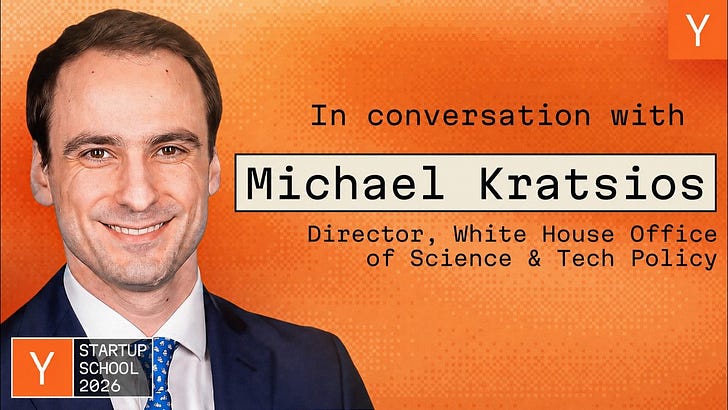
The White House's top science and technology advisor on open weights, state-law preemption, and why AI regulation shouldn't hand incumbents a moat.
Michael Kratsios has seen the AI boom from both sides: as COO of Scale AI and inside the White House. Today, as the director of the White House Office of Science and Technology Policy, he helps shape America’s national strategy on AI, science, and emerging technology.
At Startup School 2026, he sat down with YC’s head of public policy, Luther Lowe, to talk about how Washington makes technology policy, why the White House supports open source AI, and why little tech needs a seat at the table.
Timestamps
02:38 — From Tech to the White House
04:39 — How Technology Policy Actually Gets Made
05:51 — The White House on Open Source AI
08:28 — How Washington Sees AI Differently
09:53 — Regulating a Technology That Changes Every Six Months
11:37 — Which AI Risks Are Overblown?
13:03 — Giving Little Tech a Seat at the Table
17:31 — Regulation Without Creating Incumbent Moats
18:01 — Born Free vs. Born in Captivity Technologies
20:46 — What Working in the White House Is Actually Like
25:56 — A New Golden Age of American Science
31:32 — Quantum, Congress, IP, and What Comes Next
37:54 — Why Technologists Should Consider Public Service
Transcript
Luther: Michael, welcome to Y Combinator Startup School. We’ve got an amazing crowd here. It’s been an amazing day and I’m really excited to talk about AI policy and your role at the White House under President Trump. But I wanted to tell the audience a little bit about your background. First of all, Michael Kratsios is the director of the White House’s Office of Science and Technology Policy. He’s the president’s top advisor on science and technology and one of the key architects of America’s national AI strategy. He previously served as the country’s chief technology officer in the first term for President Trump, where he led the early federal AI initiatives. He was chief operating officer of Scale AI in between government tours. So he’s seen the frontier from both inside a hyper-growth startup and inside the White House. And so we’re going to talk about how Washington actually thinks about AI.
So I want to get in—you have gone from the government to the private sector and you went back into the government, which is actually not a common thing. And I think it speaks to your character, Michael, because public service is not easy and it is a sacrifice. You could be out making a lot more money doing God knows what, your choice of roles, given the level of connections you have, your background. Why do you choose to do this work?
Michael: To me, I fundamentally believe that American leadership in these emerging technologies is one of the most critical questions of our time. For the American people to have all these benefits that AI is going to offer, we have to make sure that we have a regulatory environment that allows that to succeed. And to me, even a little bit selfishly, I think there is no place where you can work on bigger problems than the US government. Even at the biggest tech companies in the world, you’re never going to be dealing with problems of this scale. So being able to work on that is something that I find very rewarding and very fulfilling. And I just deeply believe that we have to find a way to keep winning. And the government can either help or they can unfortunately screw things up. So being there to try to put it in the right direction is something that I enjoy doing every day.
Luther: Let’s rewind the clock. How did you even find yourself in this place? I’m really curious, at what point in your life did you know that you were going to be passionate about science, technology, this whole field? I don’t know, like 14-year-old or even earlier, Michael Kratsios, and up until the age of the audience, like early 20s, even late teens. Tell me about that part of your life and how you gravitated toward this type of work.
Michael: Yeah. I’d always been obsessed or interested in technology. I would follow all the Steve Jobs keynotes every year obsessively. I still remember in college when the first iPhone came out—I’m dating myself here—but it was this amazing moment. We’d run around and talk to our friends about it. I was not an engineer in college, so I always wasn’t quite sure how to manifest my extreme excitement for technology into something I could do as a career. But ultimately, I ended up in San Francisco and worked for Peter Thiel for almost seven years. Working with him and working with a lot of the companies that he invested in, that’s when it all came together. Over the course of my time there between 2010 and 2017, as we were looking at more and more companies in the portfolio, what kept coming up was this question about regulations.
So whether you were thinking about Lyft and the challenges that they were having at a state or local level, SpaceX with the challenges they were having for launch permits and things that the FAA and Department of Commerce were doing—no matter what kind of industry you were looking at, there was this government angle where the government’s policy actions could be ones that could actually unlock technology. So when the president won and I had the opportunity to join the administration, my first instinct was, how do we look across all the rules that we have and make it easier for innovators to build? How do we get drones flying for commercial drone operations? How do we get autonomous vehicles on the road? How do we get drone deliveries to happen? And those are things that the government can unlock.
Luther: What’s something surprising about how technology policy actually gets made that would surprise everybody in this arena?
Michael: Yeah. I think typically what people who haven’t really worked in this space don’t realize is that these decisions are extraordinarily federated. There isn’t just one or two people in the White House who decide something. Kind of a blessing, I think, of the US system is that there isn’t one agency that does technology. We have a health agency, we have a defense department, but there is no technology department. And what that means is a lot of these tech issues are spread out across multiple agencies. So you have equities from national security questions to commercial-oriented questions to core science and technology research questions. And to make good policy, what the White House has to do is bring all of these agencies together. So whenever—take for example, drones. If you want to make sure that the rule is right to allow for commercial drone operations, you have to make sure that the FAA has the right rules in place, but also that the people who oversee our nuclear weapons are happy so that drones aren’t flying over nuclear sites.
Luther: Take us into the last week or so. Really, this week felt like a noisy week in AI policy. You saw the letter that dropped Friday morning from a lot of the larger companies—Y Combinator had signed it, but also Y Combinator helped organize a letter that you were one of the recipients of on Wednesday evening, really advocating for the government to not clamp down on open weights models. The impetus for that, the energy behind it, was this buzz and rumored, speculative worry that the White House was on the verge of doing an EO that would have restricted or clamped down on open source. Can you talk a little bit about that? How connected to reality is some of the stuff that you’ve seen on Twitter in the last week or so?
And then what is the White House’s policy? I actually spoke with Secretary Lutnik last night at the Correspondents Center, and he said that the White House strongly supports open source. So this is a great audience to clarify: what is the White House’s position on open source, open weights? Can you talk a
Michael: little bit about that? Yeah. So Luther over here has turned into a little mini reporter. He’s got lots of people following his Twitter. But I will say, I think what the secretary said yesterday is the same policy that we had on page one of our AI action plan that was released last July. For those of you who aren’t necessarily tracking this, the US strategy for artificial intelligence was released in July of last year. It was something that I co-authored with David Sachs and Secretary Rubio. The number one thing, the first thing that we talk about in chapter one, is a commitment to open source. The idea is that if the US wants to lead in artificial intelligence, we have to have a vibrant closed and open source ecosystem. That’s the only way they can all work together. So to me, that’s number one.
But I think what this week really showed, and what excites me about the job that I’m doing, is we have to have these conversations. If DC is in a vacuum and isn’t hearing anything from the startup ecosystem, or even from the big tech ecosystem, or from financial services, or all these different industries, we can’t make the best decision. So to me, I find it inspiring and extraordinarily tactically, practically helpful for weeks like this to happen because it forces a lot of the community to come up and say, what do we as Americans believe in? And we as policymakers can internalize that and make sure that we’re saying the right policy going forward.
Luther: That’s the democratic process in action, I guess. So every founder here is building with AI. Where you sit in Washington, what do you think is the single biggest gap between how Washington sees AI and how this room sees it?
Michael: I think in Washington, when people think about AI, it is a sweeping technology that covers everything from the perception of middle America, their perception on things like data centers, to questions about AI in healthcare, to questions about job loss and how it’s going to impact the labor market. There’s also a conversation about how it’s going to impact new company growth and productivity improvements across our tech ecosystem. What typically is different in Washington is you can’t separate those conversations. It’s very hard to not think about the labor implications of the AI boom or not be worrying about how, generally, Americans don’t really love data centers. They poll horribly; people don’t want them in their backyard. But everyone in this room knows very well that we need as much compute as we possibly can spread across the country. So for us, we end up having to balance a lot of this stuff, which is our job.
But we need the input from the startup community to know at least that element of the conversation, to make sure that gets done right.
Luther: And governments are usually regulating industries that have settled. AI seems to be reinventing itself every six months. How do you write the rules for something that is moving so quickly?
Michael: Yeah. The answer to that really is you don’t want to set very firm red lines in the sand because they ultimately don’t work. The best example of that in the world right now is the EU AI Act. When we were in the first Trump administration, the EU went through a lot of fanfare and spent many years putting together this EU AI Act. This rule of essentially regulation through Europe was passed and finalized before ChatGPT was ever invented. So now, going forward, all of these large language models—everything that’s happened since November of 2021 when ChatGPT came out—have to abide by this rule that was written before LLMs were even a thing. That shows how challenging the situation is if you try to set the line too firm to begin with. I think our own administrators have had challenges with this.
The Biden administration set a specific hard cap compute threshold: if you do anything above a certain threshold, then you have to do a bunch of disclosures to the government. Over time, having these firm red line thresholds does not stand the test of time. A lot of what we do is to make sure that any type of action can move along with the frontier. What’s been proven very much so by the government is that once it sets a line, it’s very hard to reset it. So we are very cautious and try not to set these hard thresholds.
Luther: It seems like a lot of the policy conversation around AI has to do with safety and risk. What do you think is an AI risk that builders underwrite and that you think is probably overblown?
Michael: I think the risk of the day, at least today, there’s two main ones. I think the first one is obviously the cyber risk presented by the Methos moment. Ultimately, the analysis that the labs had to do when they were putting out Fable on what kind of guardrails are put in place to make sure that the more exquisite, powerful, quote unquote, dangerous capabilities of Methos were appropriately limited for the release. But again, the challenge with a lot of these cyber capability models is the same model that is able to do something nefarious is the same model that can be very valuable in hardening an existing system. So there are these inherent trade-offs that happen. I think the second risk that always comes up, that we think is coming over the horizon, is this biological risk question.
My sense is that at the moment, and it has been for many years, it’s a bit overblown. People were shouting about the bio problem back in ‘21, ‘22. It hasn’t been an issue for three years. But I think we definitely need to build the right infrastructure to run the right test and evaluation processes on models as they creep past the frontier.
Luther: Got it. A lot of tech policy conversations end up dominated by the five biggest tech companies. This is one of the reasons that Y Combinator, with a handful of other companies a couple of weeks ago, helped spin up a trade association called the Little Tech Association. Sometimes, I live in Washington DC, you do as well—obviously, we were actually on the flight this morning at eight o’clock together—it feels like kind of a Google, Apple, Facebook, Amazon Truman Show sometimes in Washington. Every position paper you read or speech you hear, you think, gosh, that has some big tech influence behind it. How does a two-person company even have a fighting chance if those large companies are writing the rules? How does the White House make sure that the kind of company that’s sitting in this room gets heard?
Well, Michael: The most important thing that I do is talk to you as often as I possibly can. But the reality is there’s a great number of institutions that help support and stand up for little tech. Generally, government is quite cognizant of the influence of a lot of large players in every industry. This isn’t a problem or a situation that is only occurring in tech. It happens in everything from energy to healthcare to whatever it may be. What we try to do very hard is—there are lots of mechanisms where you can get input from a wide variety of folks. So the traditional request for proposals or request for information process, where you can get everyone to submit comments. For us, I think it’s actually working.
If you think about one of the major priorities that the president himself spoke about in the speech that he gave when our strategy was released in July of last year, it was this question about preemption of state laws around AI. The fundamental thesis there is that if you create or allow for the creation of a patchwork of regulations—meaning there’s one set of regulations for AI in California, another one in Maryland, another one in Texas—the big tech guys, they can deal with that. Google can hire an army of lawyers and they’ll figure it out and they’ll be fine. But for all of you out here, that’s just not going to work. The president stood up and said, no, we have to have one national standard for AI so we can make it easy for anyone who wants to build an AI company to know what the one set of rules is and build a company that way. So I think that’s an example of us really taking that to heart.
Luther: Well, I will say, I commend the White House for continuing—and really it started with the first Trump term—the bipartisan antitrust project with respect to big tech. US v. Google was started under the first Trump administration. US v. Apple is being continued. Hopefully the reports that it might settle imminently are incorrect. And FTC versus Facebook, FTC versus Amazon. These are cases that the Trump DOJ and FTC have continued. I think it’s that, coupled with the president’s own usage of the phrase “little tech” and championing little tech companies. Probably when we met years ago, I said we just have to make sure that little tech has a seat at the table. So as you go back to Washington, making sure that we’re doing everything we can to make sure that little tech has a seat at the table.
Michael: It’s important to me. I spent most of my 20s here in San Francisco working at a venture firm. I understand how challenging it is to build these companies. What makes the US so special is that there is no place in the world that is better to do a startup than in America. It is easier here and the opportunities are just unbelievable. As a public servant, what I think about every day is how do we protect that ecosystem? How do we make it even easier? How do we create all the opportunities for all of you to create great companies and succeed? Everyone in the world is clamoring to come to America to build companies. There’s something very special about here that we must preserve.
Luther: Is there a version of AI regulation that protects consumers, but doesn’t hand the incumbents a moat? And what does that look like concretely?
Michael: I think back to what I was saying with this one national framework. I think it’s all about having regulatory clarity and ease for all sizes of companies. If we can work with Congress to do something like that, I think that would be the biggest boon for startups.
Luther: The United States’ advantage has always been that anybody can start something. To your point, we are unique in that respect. This is the greatest place in the world to build a company. What would you tell a founder here who is worrying about compliance costs and that locking them out before they even start?
Michael: I would tell them that there’s probably no administration in history more committed to reducing regulations than the current one. Our Office of Management and Budget, which runs our regulatory process—the guy who’s running it is Russ Vought, and his life’s mission has been to eliminate as many regulations as possible. That is what we think about every day. From a tech standpoint, when we talk about regulations, the biggest question to me is how do we remove barriers to innovation? I talked a little bit about this. To me, there are two ways to think about the world of regulations: they’re about technologies. A lot of people talk about this in Washington. There are technologies that are either born free or born in captivity. For each of those categories of technology, you have a different set of regulations to look at.
Born free technologies are ones where there aren’t regulations on the books—things like the internet when it just started. Those are the types of technologies you have to preserve. You have to be very thoughtful about whether or not you’re going to introduce new regulations into that domain because people can build anything and thrive in those areas. So those born free technologies you want to preserve. Then the born in captivity technologies are technologies where you’re building something, but you can’t commercialize it or take it to market unless you get some sort of government approval. Think about commercial drone operations. You could go build an amazing drone in your backyard. You could build the most amazing software to connect a vendor to a customer and set it all up. But to actually close that transaction legally and have the drone fly, you can’t do that unless you get a waiver from the FAA.
Those are the types of technologies that we relentlessly think about—how to remove those regulatory barriers or make it much easier to do so. I think earlier, some of you may have heard from the founder of Boom Supersonic. I’ve been obsessed with supersonic flight for years. I think it’s the most obvious, in-your-face example of technological stagnation. We had the Concorde flying years ago. We’re flying slower than we were back then today. Absolute tragedy. In that situation, he can’t get his supersonic plane to fly unless the rules are set such that there is a noise limit instead of a speed limit over the United States, for example. In those born in captivity technologies, that’s what we relentlessly try to figure out—how do you remove those barriers and make it easier for these technologies to work?
Luther: I want to go back to a question that I probably forgot to ask at the beginning, which is about your day-in, day-out role. You’re not only the director of the Office of Science and Technology Policy—and maybe you can talk a little bit about this when you answer—but also a special advisor to the president. There’s probably not a typical day, but if you had to average the days across, what does a typical day look like? What time are you showing up to work? A lot of people don’t realize in the White House, the White House is a sprawling complex. There’s the Oval Office, obviously, but then there’s something called the EEOB, the Eisenhower Executive Office Building. How big is your team? Just help us visualize what it’s like working at the White House and what your job is actually like day to day.
And is the role of director of the OSTP always a special advisor to the president? I think that’s an extra, additional role you take on. So talk about that a little bit.
Michael: So I think maybe the most abstract way to think about it is, and I mentioned this a little bit earlier, the federal government is made up of all of these agencies. You have HHS, which does healthcare. You have Department of Defense, which does defense. You have Department of Energy that runs energy and national labs. For any type of policy that you do, you essentially have to get concurrence or have some sort of conversation among all of these different agencies. There’s only one building in the whole world that can get all of these agencies to come together and have that conversation and bring some resolution, and that’s the White House. Generally, there are four categories of policy that get sorted out in the White House. There’s national security, and there’s a council that runs that process. There’s domestic policy—healthcare and immigration type stuff—and there’s another council that runs that. There’s economic policy that does tax and other economic policy. And then there’s us, that does science and technology. So essentially there are four policy councils and four policy leads, and each of us runs policy processes on the topics at hand. In our portfolio, we obviously have AI that we talked about a lot, but we do things like quantum, civil nuclear energy, biotech, space. For each of those portfolios on my team, I have one or two people that help run that portfolio. I have a space team of about three people, and they coordinate space policy across the government. They bring NASA in, they bring the Department of Defense that has a bunch of satellites for national security purposes, and they all sit together and sort out the policy.
So I would say on a typical day, the general things that you do are, one, stakeholder meetings. So Luther comes and says, “Oh, hey guys, you got to look out for little tech.” And I listen to him, and then Google shows up. Don’t settle the
Luther: Apple case.
Michael: So there’s the stakeholder stuff. And the second category of work is just the blocking and tackling of doing policy. The president has said, “We have to make sure that commercial drone flight is happening. So let’s figure out how to do it. Let’s push FAA to change this rule,” that kind of stuff. Bring the agencies together and do that kind of work. So those are the two big buckets of stuff. And then the third is doing things like this, sharing the president’s message and talking to people around the country, understanding what their challenges are and trying to see how we can be helpful. To your point on the director versus the assistant to the president, within the White House, there are folks called commissioned officers and they have three ranks. There’s an assistant to the president, which are the most senior advisors to the president.
There’s about 20 or so of those people. That’s a title that I have, but that’s one that the chief of staff has and others. Then there’s deputies and then there’s specials. So it’s this hierarchy where we all flow up to support the president. So
Luther: Practically, what does that mean? Can you just wander into the Oval Office whenever you want? How often are you interacting with the president? And how does it function? Because I think people don’t necessarily appreciate how many people work at the White
Michael: House. Yeah. So I won’t get too much in the weeds of the mechanics, but as I mentioned, there are these policy processes where you bring all the agencies together and start working on a problem. You can imagine that as the bottom of the pyramid. They try to sort out the problem. If they sort it out, then it’s great. Then policy’s over and it gets executed. If there is disagreement and someone’s like, “No, no, no, no.” Making this up—some guy at Department of War is like, “No, I don’t like this drone policy because I don’t want drones anywhere near military sites. It has to be way more stringent.” If they can’t agree, then it kicks up to the next level. Then you can imagine more senior people at all the agencies chat. If they can’t agree, then it gets up even higher.
And then if they can’t agree, then it ultimately goes up to the president for decisions. What you try to do is limit the decisions that get to the president because he has a limited amount of time and he should be focused on the things that are most important to the country and to the national priority. For us, when there are certain high-stakes AI or technology issues that the president needs to weigh in on, we bring them to him. We have a conversation and he weighs in and makes the ultimate decision.
Luther: Well, part of the reason I ask this, and I wanted to unpack that, I wanted people in this audience to appreciate how busy Michael is. Truly, we owe a debt of gratitude to just the amount of public service and the fact that we got some time with him today because sometime in managing all of that flurry of activity, you’ve just released a 150-page report. I want to talk about Science: A New Golden Age. This came out this week. Tell us about it.
Michael: Well, maybe we can start with just a little bit of history because I think that’s what inspired us to write this report. In 1945, FDR wrote a letter to his science advisor, the person who had my role, this guy called Vannevar Bush. In that letter, he essentially asked his science advisor, “What should we do? And how do we approach the science ecosystem after World War II?” If you can imagine, during World War II, a lot of the energy that the federal government put into the science and tech ecosystem was around getting the nation ready for the war. A lot of money was spent in launching the Manhattan Project and all this other stuff. And Vannevar Bush replied back to FDR with a famous report called Science: The Endless Frontier, where he essentially said the government has a very important role to play in funding science and technology in the national interest, and particularly in funding early-stage basic research.
He made the point that there is stuff that only the government is going to do because the private sector isn’t incentivized to do it. Essentially, that report laid out how we’ve been doing science as a country for the last 70 years. But the times have changed pretty dramatically. Back then, around 1950, almost 70% of all R&D was being funded by the federal government. So they kind of had a monopoly over where the money was going to go. Only about 30% or less was done by the private sector. Over time, that has inverted completely. The private sector plus philanthropy now do about 70% of R&D and the government only does about 30%. If you think of pure basic research, the kind of stuff that you see at universities, there’s almost parity between the federal government and the private sector now.
So the system has fundamentally changed and the actors within the system have changed dramatically. All of you exist. You are doing incredible work as startup founders. You have these organizations called FROs, which are focused research organizations that sit outside of universities and do their own research. And because that system has changed, we as an administration believe that we have to re-examine the way that science and technology is done in this country to get the most out of it. When I was confirmed by the Senate for my role, President Trump wrote me a letter, very similar to what FDR did, and asked me a couple of questions around how we can revitalize and re-energize the science ecosystem. We spent the last year writing a report back to him on what we can do. There are a couple of main themes that we can get into around that, but the core thesis about it that I think applies to you, one of the main pillars of it, is around this fundamental belief that artificial intelligence is going to transform the way that scientific discovery is done in this country.
If you are working on material science, if you are working on pharmaceuticals, if you are working on chemistry, you in two, three years, or even today, are doing your role as a scientist dramatically differently because of artificial intelligence. And we as a government that spends almost $200 billion a year on funding R&D need to be aware of that and prioritize that so we can make sure that our ecosystem is putting out the best possible research in the world. Luther: So the last chapter of this report sketches this almost sci-fi picture. You’re talking about AI agents posting bounties for experiments, contracting robotic cloud labs, settling results on a ledger, and then the budget memo gets really concrete. Fast grants decided in under a month, prizes built for three to one private leverage, every major agency filing an action plan within 90 days. You write in this report that the government’s job is to shape the arena, not direct discovery. So for the thousands of people we have assembled here, what’s the piece of that vision you’re hoping a couple of 20-year-olds build because the government cannot or should not?
Michael: To me, I think the infrastructure that is going to support the scientific ecosystem in the United States is going to fundamentally change over the next few years. The idea that you can have autonomous cloud labs running experiments on a loop without human intervention, testing hypotheses, running the experiment, seeing the results, creating a new hypothesis, testing it and running it, and ultimately getting to a conclusion, that is in our sights. But for all of that to work, there are lots of things that still need to be done. We have to get robotics perfected so that you can create these labs. You have to create the right software ecosystem to be able to think through the next hypothesis and create the next hypothesis. So to me, I think there’s almost this infinite category of work that can be done to create this world of autonomous experimentation that all of our scientists across so many domains are going to be leveraging to make these discoveries.
Luther: You alluded to some of the things that I think you’re looking out toward into the future, but beyond AI, what technology do you think Washington will care enormously about in five years that it barely discusses today?
Michael: Well, we discuss it a lot, but I don’t think it gets as much airtime as it should. That would be quantum information science technology or quantum computing. Back in the first Trump administration, in the 2017, 2018 era, I was chief technology officer of the United States. In that role, I remember constantly running around the West Wing, trying to convince people that artificial intelligence was an important thing. Maybe once every couple of months, some journalist would be nice enough to write an article about AI and what the government was doing. This is
Luther: 2017, 2018.
Michael: 2017, 2018. And I give President Trump an incredible amount of credit. He stood up and said, “I’m going to sign the first executive order in the history of the United States prioritizing artificial intelligence in February of 2019.” That essentially set out the first national strategy in history on AI. Through that, we created the first kind of regulatory thinking around how our agencies should be contemplating AI-powered technologies. But times have really changed. I think the effort that we put in there to essentially double the amount of R&D that we’re putting into AI in our budgets then, and you fast forward three or four years and we have ChatGPT and everything’s exploded. Now, obviously what we did in the administration wasn’t necessarily the reason why ChatGPT happened or whatever, but I think we spent a lot of work trying to prioritize and prime the S&T ecosystem to be ready for the moment, and I think it was.
If we parallelize that to today, I think that same moment is happening with quantum. There are truly some basic fundamental scientific questions that still need to be answered on how quantum can be applied to things like computing and sensing. That work goes on. The president just signed an executive order on quantum information science, and we’re going to do a ton of work over the next few years to prioritize it. He set a pretty ambitious goal for the Department of Energy to build a scientifically relevant quantum computer by 2028. My sense is we’re going to wake up in three, four, five years and see the progress we’ve made. Luther: We’ve talked a lot about the executive branch and its authority, executive orders being used to shape AI policy. What do you think Congress could be doing better on these issues? Because it seems like the mere fact that we read so often about executive orders in AI might imply that our legislative branch could be doing a better job.
Michael: Yeah. I think that the congressional stuff is a little bit tricky with AI. I think the challenges that we spoke about a little earlier are where you don’t necessarily want to set rules of the road too early that end up hurting the industry rather than supporting it. The thing about executive orders, which is a little secret, is when an administration changes, you can just revoke the executive order and start from scratch again. When something is a law, you can’t do that. It’s the law and that’s the law of the land. So we work very hard to try to find places where we can collaborate with Congress to set rules that are actually pro-innovation and help the country. And the White House put out a set of legislative proposals to Congress earlier this year that walked through a couple areas where we think a lot of benefit could happen if it was in statute.
I’ve said this a couple times, I’ll say it again, we would urge Congress to be able to pass some sort of law around preemption so we don’t have this crazy patchwork of all these different states doing all these different things on AI. I think another area that a lot of Americans want to see Congress step up on is how AI interacts with intellectual property and with name, image, and likeness of certain Americans. I think there’s a lot of creators out there that are worried about how AI is going to impact what they do. And I think all of us, we all have a craft of some kind. Some people are singers, some people are writers. All of you are unbelievable coders. All of you have skills and talents, and having some protections and knowing around that is important and something we’ve implied.
Luther: Yeah. What is the White House line on that? If you had a magic wand and you could solve the IP issue, how would it be described? Because I feel like I’ve spoken with people from the traditional media industry that are just filing lawsuits against AI companies left and right. And then on the other end of the spectrum, I’ve talked to pure maxis that say that you should not even be able to opt out of being crawled for the purposes of training. Could you talk a little bit about, maybe unpack that issue a little bit?
Michael: Yeah. I think the one area where I’ve been clear is the model outputs. If you create a model that is outputting Mickey Mouse, not cool. Can’t do that. That’s Walt Disney and they should be the only people to output that. So I think making that more clear in statute is very important. I think there’s also a lot of things that the industry can self-coordinate on, like finding interesting revenue sharing models for creators. There are a lot of creators out there that would love to license their own personal IP to companies that can do all sorts of stuff with it, whether they’re musicians or anything else.
Luther: I actually just read this morning, my old company, Yelp, did a deal with ChatGPT where I guess they’re outputting some of the reviews. So yeah, you’re starting to see a lot more of
Michael: That. Exactly. And look, it’s early, but I think over time that market is going to mature. And I think that’s maybe a category of places where you probably don’t want to legislate too fast. So you have to let the market sort itself out. But I do think it’s important because Americans generally do care.
Luther: Well, to close us out, I have one final question, which is that you were one of the youngest people ever in your role. To the 20 year olds in this room who care about technology and how it shapes the country, should some of them work in government someday? And what would they find there?
Michael: I would recommend to all of you, if there’s a moment in your career or a moment in your life where you can take a role in government, I guarantee you will never feel or have a moment where it’s more fulfilling and more rewarding. I think it can be a slog, it can be bureaucratic, it can be painful, but when the outcome actually happens and you deliver the result, there is no place where you can have a bigger impact on this country. And I think all of you are here. You’re here to build companies. You’re excited about building new things, about hiring more Americans, about building technologies and amazing things that will touch the lives of so many of our fellow citizens. And there’s some flavor of that in government and creating the environment that can allow startups to thrive, that can allow new companies to be built.
I believe there’s something very fulfilling and rewarding about that. And being able to do that in the service of your fellow Americans is something I encourage all of you to do. And if any of you want to work in the White House Science and Technology office, you just look us up because we’re always looking for good people.
Luther: Well, Director Kratsios, I just have to say as Y Combinator’s head of public policy based in Washington, I really appreciate the accessibility of your office and the administration and the thoughtfulness on these issues. And I also really appreciate you coming out and speaking to Y Combinator AI Startup School today. Let’s give it up for Director Kratsios. Thank you.
Michael: Thank you.